The shortcut that introduced feral cats to an island
One day in 2021, a boat operator working for a contractor made what probably seemed like a harmless decision.
The company had been collecting cats from the oil facilities on Lavan Island, in the Persian Gulf, and transporting them by boat to the mainland. The operator had made this journey many times. But on his final trip, he apparently looked at the distance ahead and decided there was an easier option.
Shidvar Island was much closer.
So instead of continuing to the mainland, he released 17 cats there.
He did not know that Shidvar was a protected wildlife refuge, a Ramsar Site, and one of the most important breeding grounds for seabirds in Iran. He probably did not imagine that choosing the shorter route could change what was happening inside the nests of birds across the island.
But that is exactly what our data later appeared to show.
An island that had never needed cats
Shidvar is a small, uninhabited island near Lavan. Every year, large colonies of terns return there to breed. Because these birds nest on the ground, islands without introduced mammalian predators provide them with something increasingly rare: a relatively safe place to lay their eggs and raise their chicks.
A cat on the mainland is an ordinary animal. A cat released on a small seabird island becomes something entirely different.
In this case, the introduction was neither planned nor malicious. It resulted from one person’s lack of awareness and a desire to avoid a longer boat journey. That is what makes the story both slightly absurd and deeply serious. A few hours saved by one person created months of work for several conservation organisations—and introduced a new predator into an ecosystem that had not evolved to accommodate it.
We had already been monitoring breeding birds on Shidvar for several years when the cats were released. Within a few days, our local contacts informed us what had happened. This meant we had an unusual advantage: we knew about the introduction very quickly.
Many ecological changes on remote islands are noticed only after years, when an introduced population has multiplied and the damage has become difficult or impossible to reverse. Shidvar was fortunate. People were already watching.
Removing the cats
Once we learned what had happened, teams from the AvayeBoom Bird Conservation Society, the Hormozgan Provincial Department of Environment and the Shirdal Wildlife Foundation began working to remove the cats.
In 2021, we placed 12 baited live-capture cage traps in areas where cat activity had been observed. Fourteen of the 17 cats were captured and removed from the island, but three remained.
Three cats may not sound like a population. On a small breeding island, however, the relevant question is not whether the number sounds large to us. It is how many vulnerable nests and birds those animals can reach.
Capturing the final three proved more difficult. In autumn 2022, a team of three to five trained people returned for a one-week operation. Anchored cable foot snares were placed along routes used by the cats and checked at least once every 24 hours. The remaining cats were captured without trapping any non-target animals.
After eight further months of observation, we found no additional evidence of cats on Shidvar. The introduced population had been completely removed.
We had solved the immediate problem. What we did not yet understand was what the cats might already have changed.
The result we were not looking for
When we began the next round of breeding surveys, we expected that the presence of cats might have reduced the number of birds attempting to breed. That seemed like the obvious outcome to look for.
But that was not what stood out in the data.
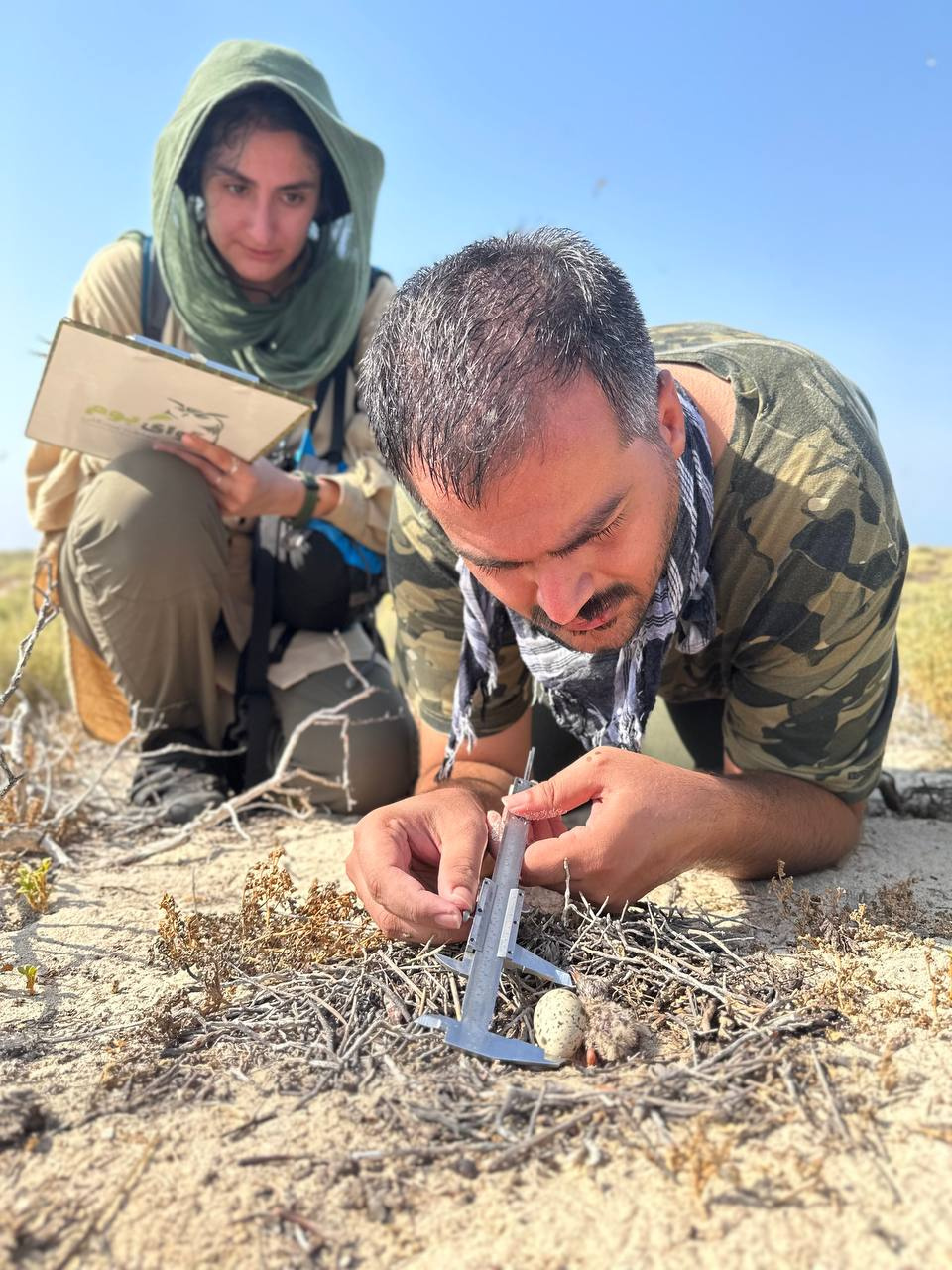
As we followed our usual monitoring procedure and counted nests, we realised that something else had changed. During the period when three cats remained on the island, most white-cheeked tern nests contained only one egg. In the first breeding season after the complete removal of the cats, nests containing two eggs again became much more common.
This was not an effect we had set out to demonstrate. It emerged while we were carrying out routine monitoring and comparing the new observations with data collected before the cats arrived.
That unexpected result became the basis of our recently published paper, Rapid shift in clutch size distribution of white-cheeked terns following feral cat removal on Shidvar Island, Persian Gulf.
We did not observe the cats directly killing adult terns, chicks or eggs, and our study cannot prove that the cats alone caused the change. Breeding conditions naturally vary between years, and other environmental differences may have contributed. With only three survey years available for comparison, the result must be interpreted carefully.
Still, the timing and scale of the shift raise an important possibility: introduced predators may influence seabird reproduction in ways that are less visible than direct predation.
When we think about cats on seabird islands, we usually imagine the animals they kill. But the presence of a predator may also affect where birds nest, how secure they feel, how much energy they invest in breeding, or other processes that eventually appear in the contents of a nest. Our study does not identify the mechanism. It shows that there is something here worth investigating.
One decision, an ecological change
For me, the main lesson from Shidvar is not simply that feral cats are dangerous to island wildlife. We already know that.
The more unsettling lesson is how quickly one human decision can alter a small island ecosystem.
The boat operator did not intend to damage Shidvar. He simply decided that the island was closer than the mainland. But ecosystems do not respond to intentions. They respond to actions.
In this case, we were lucky. We were already working on the island. Local people informed us within days. Conservation organisations and government staff were able to respond. Most of the cats were removed quickly, the final three were eventually captured, and the breeding colony continued to be monitored closely enough for us to detect an unexpected change.
Without that existing network of people, monitoring and cooperation, the same shortcut could have produced a very different ending.
The story of Shidvar therefore has two sides. It demonstrates the extraordinary vulnerability of small islands: one person and one boat were enough to introduce a new ecological pressure. But it also demonstrates the value of sustained conservation presence. Because people were paying attention, a casual human mistake did not have to become a permanent ecological reality.
Preventing an introduction would have taken one informed decision. Correcting it required multiple organisations, trained teams, repeated visits, specialised equipment, months of effort and continued monitoring.
That is a poor exchange rate—and a strong argument for making sure that boat operators, contractors and companies working around protected islands understand that the nearest piece of land is not necessarily an empty place.
Sometimes it is an entire ecosystem. And sometimes, someone is watching closely enough to notice when it changes.
Read the paper:
Rapid shift in clutch size distribution of white-cheeked terns following feral cat removal on Shidvar Island, Persian Gulf

am Iman Ebrahimi, a conservationist and the founder and CEO of AvayeBoom Bird Conservation Society, the first bird conservation NGO in central Iran. Over the past decade, I have led various projects focusing on bird conservation, wetland restoration, and community engagement. My interests include wetland and waterbird conservation, migratory bird monitoring, and engaging local communities in environmental stewardship.
Through AvayeBoom, I’ve had the privilege of collaborating with over 310 volunteers and conducting educational programs for thousands of people. I’m passionate about building partnerships, sharing knowledge, and learning from the global conservation community to protect biodiversity for future generations.