Captive Breeding or Wildlife Laundering? : Strengthening Legal & Enforcement Safeguards for CITES-Listed Fauna
Introduction:
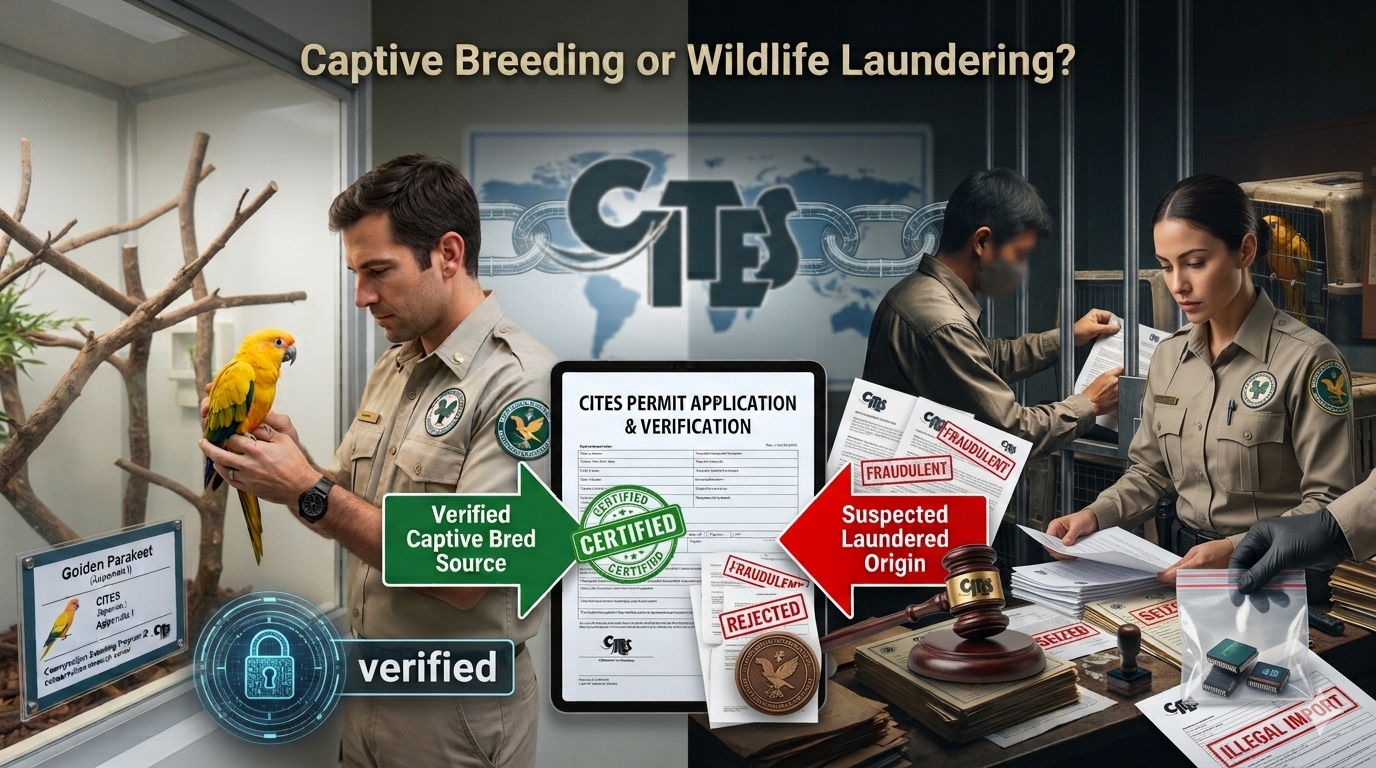
Captive breeding of CITES-listed fauna serves legitimate conservation and trade-management objectives. It can reduce pressure on wild populations, support ex-situ conservation and, where appropriately regulated, provide a lawful source of specimens for international trade. However, the differential treatment accorded to captive-bred and wild-sourced specimens creates a significant enforcement vulnerability: wild-caught animals may be introduced into legitimate breeding facilities and subsequently represented as captive-bred. This process is commonly described as wildlife laundering.
Wildlife Laundering: Reported Experience:
The study “Wildlife laundering through breeding farms: Illegal harvest, population declines and a means of regulating the trade of green pythons (Morelia viridis) from Indonesia” by Daniel Natusch and Jessica Lyons exposed how commercial breeding farms in Indonesia are utilized to launder thousands of illegally wild-caught green pythons into the legal global pet market. The research estimates that at least 80% of green pythons exported annually as captive-bred were actually harvested illegally from the wild, severely depleting native wild populations.
CITES Concept of Captive Breeding:
CITES has special provisions for animals that are bred in captivity. These are mainly contained in Resolution Conf. 10.16 (Rev. CoP19), Specimens of Animal Species Bred in Captivity. The important point is that an animal is not automatically considered “captive-bred” merely because it was born or kept in captivity. It must satisfy specific CITES requirements.
First, the breeding stock—that is, the parent animals used for breeding—must have been obtained and maintained legally, in accordance with CITES and the country's laws. The breeding programme must also be managed in a way that does not harm the survival of the species in the wild. Normally, the breeding stock should be maintained without regularly taking new animals from the wild. Only limited additions from the wild may be allowed under CITES rules and applicable national law.
There is an additional safeguard for Appendix-I species, which receive the highest level of protection under CITES. For such species, the breeding operation generally must have produced animals of the second generation (F2) or later, or must be demonstrably capable of reliably producing such generations in captivity.
“Born in captivity” is not always the same as “bred in captivity”. Suppose a wild-caught animal is brought into a breeding centre and later gives birth. The baby was certainly born in captivity, but that does not automatically mean that CITES will treat it as a captive-bred specimen.
CITES Registration and Review of Captive Production:
CITES has special provisions for commercial breeding of Appendix-I animals, because these species receive the highest level of protection under CITES. Resolution Conf. 12.10 (Rev. CoP15), Registration of Operations that Breed Appendix-I Animal Species in Captivity for Commercial Purposes, provides a system under which such breeding operations can be registered.
A breeding facility seeking registration has to provide information about its parent animals (breeding stock), how they were obtained, how many animals are produced, died, and how individual animals are identified. This information helps CITES authorities determine whether the facility is genuinely breeding animals in captivity and whether its activities comply with CITES requirements.
However, registration does not mean that an operation can be ignored thereafter. Captive-breeding operations and the trade they generate may require continuing monitoring. For this purpose, Resolution Conf. 17.7 (Rev. CoP19), Review of Trade in Animal Specimens Reported as Produced in Captivity, provides a process for examining international trade reported under the CITES source codes C, D, F and R. Authorities may look for warning signs such as:
- a breeding facility reporting unusually large numbers of animals;
- sudden or unexplained changes in the source codes used for specimens;
- differences between the quantities or source information reported by the exporting and importing countries; and
- claims that animals were bred in captivity in a country where the species does not naturally occur, particularly where there is insufficient evidence showing that the original breeding animals were obtained legally.
India's Statutory & Enforcement Framework:
The Wild Life (Protection) Amendment Act, 2022 introduced Chapter V-B into the Wild Life (Protection) Act, 1972 (WPA), providing a dedicated framework for implementation of CITES obligations. Its significance lies in regulating not merely import/export but also domestic possession, breeding, transfer and documentation of living CITES-listed animals. Relevant provisions are discussed below:
- Section 49M: Registration and Provenance
Section 49M requires possession of living specimens of animal species listed in Schedule IV to be reported and registered. Registration is linked to the authority's satisfaction that the specimen was not obtained in contravention of wildlife-protection law. This section further provides for reporting and registration of births, deaths and transfers and regulates possession, transfer and breeding of such animals.
This provision creates the foundation of provenance control. In a properly monitored facility, the stock should be capable of being traced through:
lawful acquisition → registered possession → breeding → registered birth → transfer/death → export.
An unexplained increase or decrease in stock can therefore provide an important investigative lead.
- Sections 49N and 49O: Appendix-I Breeding
Section 49N requires persons engaged in breeding in captivity of an Appendix-I scheduled specimen to obtain a licence from the Chief Wild Life Warden. Section 49O regulates grant and cancellation of such licences and recognises non-compliance with CITES or the WPA, as well as furnishing of false particulars, as grounds for regulatory action.
The provisions are significant because they make captive breeding of the most highly protected species subject to a specific licensing regime rather than leaving it solely to private certification.
- Section 49P: Identification
Section 49P prohibits alteration, defacement, erasure or removal of identification marks placed on scheduled specimens or their packages. Where animals are individually marked, such identification becomes an important chain-of-custody link connecting the animal, registration record, breeding history, transfer documentation and CITES permit.
The Living Animal Species (Reporting and Registration) Rules, 2024:
These Rules operationalize Section 49M. They establish procedures for registration and reporting of possession, births, transfers and deaths of living Schedule IV animals on PARIVESH 2.0 Portal. For imported specimens, relevant import and CITES documentation is required as part of the provenance record. The Rules also provide for physical verification of facilities and inspection of animals and records.
Particularly significant is the requirement to report births within the prescribed period. This transforms reproduction into a legally documented event and enables authorities to compare claimed production with registered breeding stock.
Death reporting, supported by veterinary documentation, provides a corresponding control over disappearance of animals from the registered population. The resulting stock equation is straightforward:
Opening stock + lawful acquisitions + registered births − deaths − transfers − exports = closing stock.
Material discrepancies should trigger verification.
The Rules also require periodic veterinary health checks and maintenance of health records. These records can provide independent evidence concerning the existence, condition and continuity of the captive population.
The Wild Life (Protection) Licensing (Additional Matters for Consideration) Rules, 2024:
These Rule require the licensing authority to consider the following before granting the licence:
(1) whether the applicant has suitable facilities, equipment and premises;
(2) where and how the supplies will be obtained;
(3) how many similar licences already exist in the area; and
(4) how granting the licence may affect the hunting or trade of the wild animals concerned.
Further, a licence relating to a Schedule I wild animal cannot be granted without prior consultation with the Central Government.
The Wild Life (Protection) International Trade of Specimens Rules, 2023:
These Rules provide a further layer of scrutiny at the export stage. Export applications require prescribed documentation, including a legal procurement certificate issued by the competent Forest Department authority. For relevant Appendix-I captive-breeding operations, the applicable Section 49N licence and CITES registration documentation are also required. This creates a multi-stage verification process:
lawful acquisition → domestic registration → breeding records → statutory licence → legal procurement certification → CITES export documentation.
The export stage operates as a second line of defence, not as the first point at which provenance is examined.
Conclusion:
Captive breeding of CITES-listed fauna is a legitimate conservation mechanism, but its credibility depends fundamentally upon the integrity of the breeding stock and the traceability of subsequent generations. Captive origin must be demonstrated, not merely declared.
A CITES source code or breeding-facility certificate should not end the inquiry where credible contrary evidence exists. The decisive safeguard is a continuous, legally valid, and scientifically proven paper/digital trail that links every traded live wildlife species directly back to its original breeding stock. Where that chain is demonstrable, captive breeding can fulfil its conservation purpose. Where it cannot, the possibility that captivity is being used to launder wild-caught wildlife demands rigorous investigation.

I am an Indian Revenue Service (Customs & Indirect Taxes) officer with vast experience of law enforcement especially in tackling transnational smuggling including willdife trafficking. Also, as an expert I have been conducting sessions on various aspects of wildlife crimes and its convergence with other serious crimes, legal and enforcement framework to counter it, wildlife cyber crime, OSINT for combating wildlife crime, combating money laundering associated with wildlife crime, CITES, role of Customs in tackling the menace of wildlife crime, Digital Forensics etc. for forest, police, customs and other enforcement agencies' officials.