We Count What We Catch: Air Cargo, Wildlife Trade, and the Number Nobody Has Measured

Between 2015 and 2022, the transport sector was drawn into the response to the illegal wildlife trade more deliberately than ever before. The Buckingham Palace Declaration came in 2016, alongside an IATA resolution and, later, a wildlife module in its environmental assessment program. Airlines and airports signed commitments, staff were trained, and red-flag indicators were written and circulated. Much of the convening ran through the ROUTES Partnership, which brought airports, airlines, conservation organizations, and three US federal agencies to one table on USAID funding.
ROUTES closed in 2022. The commitments remain, and the signatory lists have kept growing. The money that paid for somebody to sit in the middle and hold the parties together does not, and the environment for donor-funded international coordination has narrowed considerably since. Whatever gets built from here must work without a funder underwriting the table. Together, this puts a premium on understanding the systems that already exist, what they were designed to do, and where the joins between them fall.
So, I want to ask a question that comes before any proposal: why do the systems that move and clear international air cargo record what they record? Not as an accusation. As an explanation of a lean.
Where I am writing from
From 1982 to 1989 I worked for what was then the Dade County Aviation Department at Miami International Airport, in its development arm. Among other projects, I worked on the Miami International Cargo System (MICS), which was one of the first automated cargo clearance systems in the United States developed and operated by an airport authority rather than by Customs or a carrier consortium. Concurrently, I worked on the Consolidated Cargo Clearance Center, which brought the federal inspection agencies at MIA under one roof, and on forecasting international passenger arrival flows to help preplan federal inspection inspector staffing for passenger processing.
I then practiced law for nearly thirty years, largely on commercial instruments and technology licensing. More recently, I have worked in wildlife conservation, on grant development and wildlife trade, and I have spent the past two years training and evaluating large language models, which, as it turns out, is directly relevant to what the field is now proposing to build.
The thread running through it all is narrow and worth stating, because it is the lens for everything below. I look for the seam between two systems that were each built correctly for their own purpose, that nobody owns jointly, and then try to specify the fix as something negotiable and draftable.
What was in the room
In the early 1980s, Miami was building toward paperless cargo clearance, and our model was British. Our advisers included NDPS, British Telecom's National Data Processing Service, which ran LACES at Heathrow. I traveled to London several times to work through the project with them, and we quickly learned how little of the model transferred. LACES was effectively a single box, interfacing with government systems that were in step with it or inside it. MICS would be one of many port systems in a country with more federal inspection agencies, each with its own requirements. US Customs had its own platform and kept developing its interface requirements; in practice, it issued requirements that MICS adapted to. The other agencies, as I recall, were further behind in their own automation and notably willing to work with us. Willing, but not yet fully ready, at least at the outset.
What was discussed in those developmental years was entries and brokers, commodity descriptions, tariff classification, duties and fees, and getting cargo released. Enforcement was not our conversation. Customs did not discuss detection or targeting with an airport authority, and there was no particular reason it should have. What everybody in Miami knew that decade, from Customs' own seizure announcements and the press, was that the preoccupation was narcotics: cocaine concealed in legitimate cargo, including consignments of cut flowers. Plants mattered to us commercially; animals mattered as food. Zoonotic disease was never mentioned in my hearing.
Wildlife trade was never a primary consideration on our side of that wall, so far as I recall, and there is no reason in principle it could not have been. Permits, declarations, species descriptions on a document are commercial paperwork, the kind of thing MICS existed to handle.
One further detail matters more than the first. On the passenger side, we held ourselves to an average clearance time of under forty-five minutes, arrival gate to exit door after Customs, and we measured it. Our airport staff sampled passengers leaving the federal inspection halls, arrival times were logged, and I forecast the queues from schedules, aircraft capacity, and projected load factors so the federal agencies could roster their staff requirements against them. A working measurement loop, run for years at a major gateway. It measured how long it took a passenger to leave the building.
Nobody asked for a different measurement, and not because the question was overlooked. My forecasting stopped at the immigration queue, which was usually the first bottleneck. What happened to a passenger after that turned on what the agencies chose to do, and that was not my business. I was never asked about inspection, about what was being inspected, or about what was found. The airport's purpose was commercial in both cases. On the cargo side, we were automating the paperwork that slowed shipments down; on the passenger side, we were not building a system at all, but forecasting demand so the agencies could staff against a clearance-time target. Enforcement sat on the other side of a wall we were not invited through. What we built fed that side, supplying manifests, entry details, and the documentary facts that can be screened, but apart from what was voluntarily disclosed to us, we had no view of what happened to any of it, and no reason to design for an outcome we would never see. Disclosure occurred when the systems had to interoperate, or when brokers and airlines needed to know what would be expected of them. It was sanitized, and it was the agencies' to give: what, when, and to what purpose.
Forty years and many revisions separate MICS from the infrastructure in use today, and its origins do not tell us how any current system performs. What they support is narrower. The import architecture grew up around real, pressing concerns: admissibility, revenue, narcotics, and plant, animal, and food safety. Partner agencies built their own systems on their own timelines and connected afterward through interfaces, rather than designing them in. Those concerns remain major focal points. Wildlife entered that architecture as a plant and animal health question, if at all, rather than as a question about whether a species was endangered or lawfully taken.
What arrived later
The scale and character of the trade changed after the systems were designed. Seizures between 2015 and 2021 documented illegal trade in 162 countries and territories, affecting around 4,000 plant and animal species, roughly 3,250 of them listed under CITES. The wider picture is larger still: a review published in October 2026 identified 107,356 species in use and trade globally, more than double the figure the field had been working from. Among them are 31,306 vertebrate species, which is 42 percent of all currently described vertebrates.
An estimated 99.99 percent of detected wildlife trade is legal. That proportion matters more than it first appears, and I will come back to it.
The consequences have compounded in two directions the 1980s did not contemplate. Zoonotic risk is one: live animals moving through dense international hubs read very differently after 2020 than in 1985. The second is distributional. The biological loss falls on the countries whose ecosystems are richest and whose enforcement budgets are smallest, while the demand, and most of the inspection capacity, sit elsewhere. UNODC's Congo Basin study found great ape prices stable at source but two to five times higher at export and import levels over five years. The margin accrues at the far end of the chain. The party that bears the harm is never the party in a position to pay for the remedy. That is a structural problem rather than a funding shortfall, and it is both why donor-convened arrangements like ROUTES did useful work and why their ending matters more than the size of the budget that ended.
That study also found something that bears on everything below. Live great apes and African grey parrots are, in its words, usually transported by air with CITES permits issued for other species. Ivory and pangolin scales travel concealed in airfreight and shipping containers, mixed with legitimate cargo such as wood and peanuts. The networks rely heavily on falsified documents, particularly CITES permits.
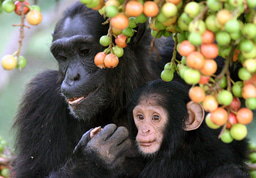
I have seen what that looks like at the receiving end. In December 2023, forty young primates were flown out of the Democratic Republic of the Congo for Thailand and intercepted in transit, on CITES permits that falsely stated the species and the number of animals. I drafted the emergency funding request for the sanctuary that took in the survivors. Sixteen of the forty died. The crates had to be opened before anyone could determine what was inside: ten species, as it turned out, including two olive baboons and two animals too decomposed to identify at all.
A permit valid on its face, describing the wrong animal, defeats any amount of inspection capacity. It is a failure of the record.
For scale at the receiving end: the US Fish and Wildlife Service had 74 wildlife inspectors at the time of a 1994 review, stationed at 11 designated ports and 14 other locations. In fiscal 2016, it had 124, covering 18 designated and 20 non-designated ports of entry.
What nobody can measure
Consider how little is known about the outcome. Seizures are counted and reported. No published method I have found estimates what share of shipments is never detected at all.
The nearest thing to an answer looks like one and is not. The Country Enforcement Index in Flying Under the Radar scores the United States at 84.6 percent for detecting and seizing illicit wildlife products moving through its airports. Its denominator, though, is trafficking instances that became known: a consignment seized in a third country counts as a miss for the country it passed through, and one never caught anywhere counts nowhere at all. The authors are candid about this, calling the index an approximation and giving an appendix to the reporting biases it carries.
The consequence shows up in the newest attempt to size the trade. In July 2026, Tow and Carrasco put the global value of illegal wildlife trade at $34.0 billion a year, replacing the familiar $7 to $23 billion range, which they trace to UNEP–INTERPOL assessments published in 2014 and 2016 and describe as outdated and methodologically unclear. Some $10 billion of that total comes from a single step: correcting for trade that was never detected. The instrument they use for it is the Country Enforcement Index. A measure whose denominator is trafficking that became known is doing the work of estimating trafficking that never did.
This is not a criticism of careful people; they say as much themselves, noting the correction could be recalibrated given better data. That is the difficulty. The data that would recalibrate it cannot come from the enforcement record, because the enforcement record is what needs correcting.
Nor is this only a researcher's problem. UNODC's Sustainable Development Goal indicator on wildlife trafficking, first reported in 2024, measures intercepted illegal trade as a share of all wildlife trade. It rose from 0.5–1.1 percent in the years up to 2019 to 1.4–1.9 percent in 2020 and 2021, a movement UNODC attributes to a fall in legal trade and a handful of very large timber seizures in South America. UNODC adds that without those timber seizures, the measure of seizures of both plant and animal species declined in those years. The official global measure of progress rose while the underlying seizure measure fell.
Which returns me to the 99.99 percent. The reason the illegal trade cannot be sized is that the legal trade, where almost all the records are, is not recorded in a form that would allow it. Most countries hold no systematic data on trade in species not listed under CITES. Global monitoring systems collapse thousands of species into single tariff codes that describe a product and not an organism. On current trajectories, global trade indicators will continue to cover under two percent of the species actually in trade. The illegal trade measurement problem is downstream of a legal trade record problem.
What is now being proposed
Two communities have arrived at much the same remedy from opposite directions, three years apart, without citing each other.
A serving officer of India's customs administration, writing for this community in 2023, observed that customs already holds what a wildlife investigation needs: manifests, bills of lading, declarations, consignor and consignee details, risk-profiling history. He argued for instruments that let that data be verified across borders while a shipment is still moving. In October 2026, twenty-four conservation scientists proposed digitizing the customs declaration around pre-agreed fields, extracting species-level data from commercial invoices, aligning it with biosecurity and phytosanitary declarations, and automatically cross-checking the result against reference databases to flag mislabeling, impossible origins, and inconsistent pricing.
One is asking for better detection of the object. The other is asking for a better record of it. Both describe work that would have to be done inside the commercial documentation systems that brokers, forwarders, and carriers already use. That is not the field either of them works in. It is the field I spent seven years in, and it is the reason I am writing this.
The machine learning involved is real and tractable: document extraction, classification, anomaly detection. Having spent two years evaluating these models, I would add one caution. A species identification that is ninety-four percent accurate is an impressive research result and a troubling legal instrument. Six times in a hundred it is wrong, and it will not announce which six. In a regime where misdeclaration carries penalties, a system like this has to be built from the start around knowing which of its answers can be relied on. That is a design requirement, not something to resolve after the pilot.
And there is a sentence in the scientists' proposal worth dwelling on. After several hundred words on building the data infrastructure, they write that once these systems are in place, it is paramount that they be followed up with appropriate inspections and adequate enforcement actions. One sentence for the entire handoff, from the commercial system that would generate the data to the enforcement system that would have to act on it. From where I sat in 1985, that handoff is not the easy part. It is the wall.
Where this goes
This is the first of a series. Next, I want to trace what actually happens to the information a shipment generates: who files what, when, and who can act on it before the aircraft lands. Then I want to look at what other jurisdictions have built. Electronic CITES permitting exists, but Hughes and colleagues report that it has reached only around 30 of the 184 countries that have ratified the Convention, so most legal trade still moves on paper. There is a comparative story there that I do not yet know the end of.
There is a more hopeful reading, and I think it is the right one. The information that would close the gap already exists, sitting in commercial invoices and customs declarations written by people who had no reason to think of it as conservation data. Extracting it at species level is now tractable in a way it was not five years ago.
What follows is less obvious. The countries with the best wildlife trade records are the ones with the most entrenched systems to change. The countries with the least may be able to do what mobile telephony did across much of Africa and arrive without a landline stage. A cloud-based permit system built jointly by the CITES Secretariat and UNCTAD is aimed at exactly those Parties; its documentation says it "does not require advanced technical expertise or IT systems," and the development has already been paid for. Mozambique and Sri Lanka have adopted it.
That would serve the lawful trade as much as the illegal, which is the point: you cannot manage what you cannot see, and almost everything that moves is lawful. A record is not the same as the capacity to act on it, and the handoff travels with the problem. But the leapfrog is available, and the countries best placed to take it may not be the ones with the most to spend. It is also in the interest of the countries receiving the goods, since a permit can only be verified at the importing end if it was issued properly at the exporting end, which makes better records in a source country something destination countries have reason to pay for rather than donate.
I am writing this as someone who helped build part of the foundation, not as someone auditing it, and I would rather be corrected early than published confidently and wrong. If you work in cargo operations, customs brokerage, freight forwarding, or wildlife inspection, and any of the above reads oddly from where you sit, I would be glad to hear it.
Ricky A. Naudé worked on airport cargo systems at Miami International Airport from 1982 to 1989, including the Miami International Cargo System, and then practiced law for nearly thirty years. He now works at the intersection of wildlife trade, trade regulation, and the data systems that carry both, and writes about the seams between systems that were each built correctly for different purposes. He is based in Georgia and can be reached at rickynaude1101@gmail.com or on LinkedIn.
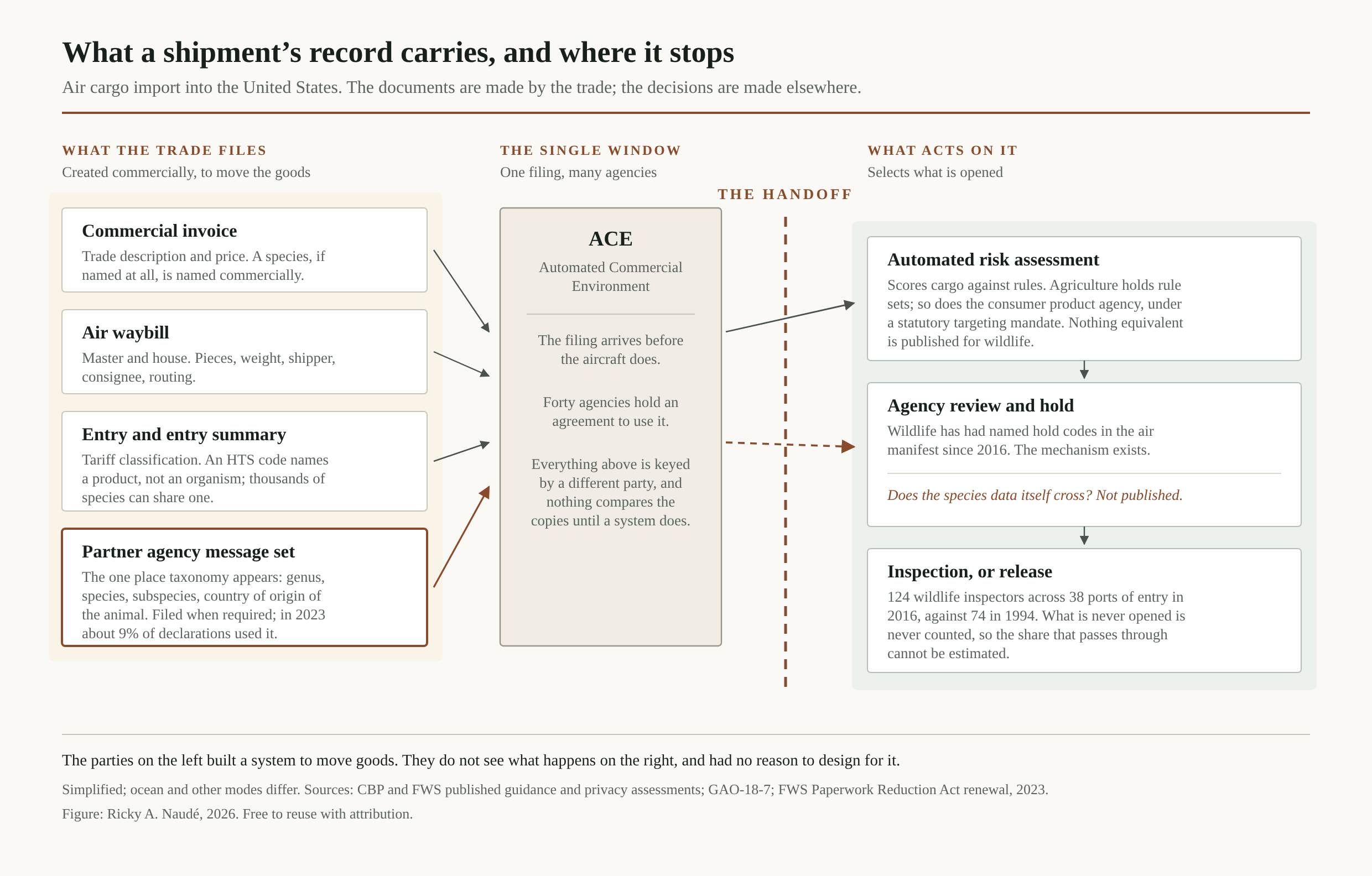
© 2026 Ricky A. Naudé. The figure may be reused with attribution.
Sources
- Hughes AC, Marshall BM, Challender DWS, et al. "The true scale of global wildlife trade is obscured by data gaps." Science Advances 12, eaei3504, October 30, 2026.
- Tow JH, Carrasco LR. "A Comprehensive Reassessment of the Global Illegal Wildlife Trade's Economic Value." Integrative Conservation, July 14, 2026.
- UNODC, World Wildlife Crime Report 2024: Summary, conclusions and policy implications.
- UNODC / UNEP Congo Basin Landscapes Initiative, Knowledge Brief: Wildlife Trafficking in Central Africa.
- Utermohlen M, Baine P. Flying Under the Radar: Wildlife Trafficking in the Air Transport Sector. C4ADS and ROUTES.
- US Government Accountability Office, GAO-18-7, Combating Wildlife Trafficking, October 2017.
- US Government Accountability Office, GAO/RCED-95-8, Wildlife Protection: Fish and Wildlife Service's Inspection Program Needs Strengthening, December 1994.
- Chaurasia AK. "Safeguarding Species: Role of Transportation Sector in Combating Wildlife Smuggling." WildHub, December 7, 2023.
- Chaurasia AK. "Leveraging Customs Mutual Assistance Agreements for Wildlife Enforcement." WildHub, October 7, 2026.
- Chaurasia AK. "eCITES: Moving Towards Paperless Enforcement of CITES." WildHub, July 2023.
- UNCTAD and CITES Secretariat. ASYCUDA eCITES BaseSolution. UNCTAD/DTL/ASYCUDA/INF/2019/2.
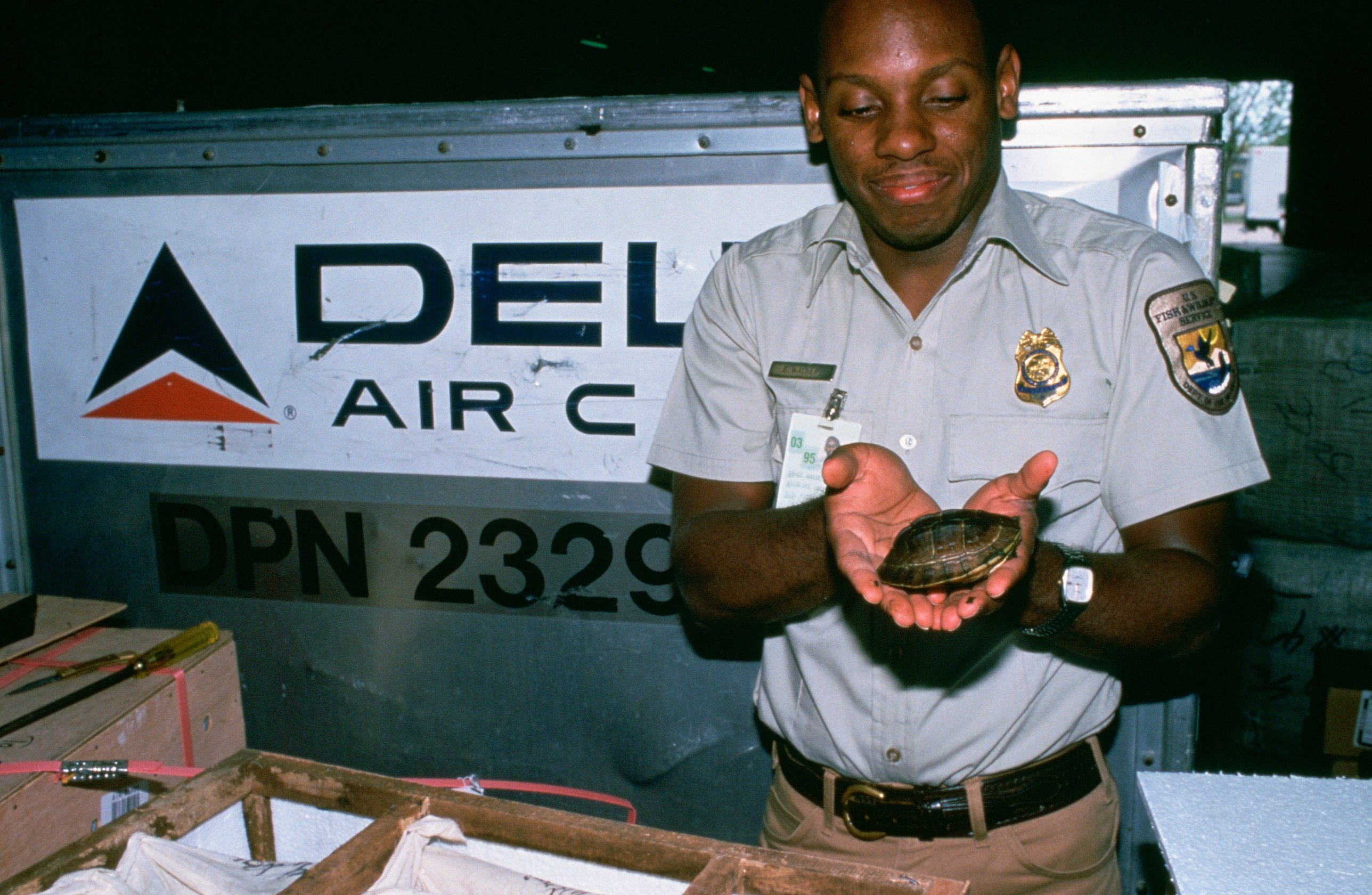
- Cover photograph: a US Fish and Wildlife Service inspector examines an imported Asian box turtle at Miami International Airport. John and Karen Hollingsworth / USFWS, public domain.
- Pan African Sanctuary Alliance. "Largest seizure of monkeys in Africa welcomed to J.A.C.K. Sanctuary in the Democratic Republic of Congo." December 28, 2023.