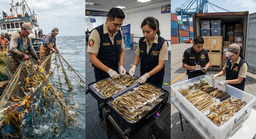
Leveraging Customs Mutual Assistance Agreements for Wildlife Enforcement
Introduction:
Wildlife trafficking is no longer simply a conservation problem or a series of isolated smuggling incidents. It has increasingly transformed into a transnational organized crime involving source, transit and destination countries, complex logistics, concealment techniques, false documentation, financial transactions and, in some cases, networks that overlap with other forms of organized criminality. CITES, INTERPOL, UNODC and the World Customs Organization (WCO) have repeatedly emphasized that no single country or agency can effectively address this crime acting alone. That is why, the International Consortium on Combating Wildlife Crime (ICCWC) was constituted in 2010 as a unified global partnership of five intergovernmental organizations (WCO, CITES, UNODC, INTERPOL & the World Bank Group) to strengthen criminal justice systems and provide coordinated support against wildlife crimes.
The cross-border character of wildlife trafficking creates a particular enforcement problem. A seizure in India may provide evidence of an exporter in another country; the shipping container may have originated in a third country; the customs declaration may contain information held by another administration; and the financial beneficiary may be located in yet another jurisdiction. For customs, therefore, the seizure at the border is often only the visible end of a much larger transaction.This is where the Customs Mutual Assistance Agreement (CMAA) becomes an important enforcement instrument.
Customs Mutual Assistance Agreements (CMAAs): The WCO's Model Bilateral Agreement provides a useful framework. Commonly called CMAAs, provide an operational legal bridge between customs administrations. A CMAA is a bilateral treaty or arrangement through which two customs administrations agree to assist each other in preventing, investigating and combating customs offences. Properly used, they allow customs agencies to seek timely administrative assistance, verify trade and transport information, exchange intelligence, request surveillance, coordinate controlled deliveries, and support risk-based interdiction. Their value to wildlife enforcement lies not merely in obtaining information after a seizure, but in disrupting future shipments and identifying the network behind them. CITES & National Wildlife Protection Laws establishes the international & national frameworks regulating trade in listed wild fauna and flora. Customs is often the frontline agency detecting whether a wildlife shipment complies with that framework. The WCO’s INAMA Project specifically supports customs capacity to enforce CITES against illegal wildlife trade.
What a CMAA Does:
Typical CMAA functions include:
- Information on request: Confirmation whether wildlife consignment was lawfully exported or imported, and under which customs procedure they moved.
- Exchange of offence-related intelligence: Information about planned, ongoing, or completed conduct reasonably believed to constitute a customs offence.
- Spontaneous assistance: A customs administration may also alert its counterpart about wildlife trafficking without waiting for a request.
- Advance and automatic information exchange: Parties may arrange pre-arrival exchange of selected shipment information to strengthen targeting of wildlife consignmnets.
- Surveillance: On request, Customs may monitor identified persons, premises, goods, or means of transport connected to a suspected transnational wildlife offence.
- Controlled delivery: Subject to domestic law and mutual arrangements, suspect or unlawful wildlife consignments may be allowed to continue under official control in order to identify the entire supply-chain of wildlife trafficking.
- Officer presence and joint activity: Depending on the agreement and authorizations, officials may also observe inquiries, examine records, or participate in coordinated control or investigation teams.
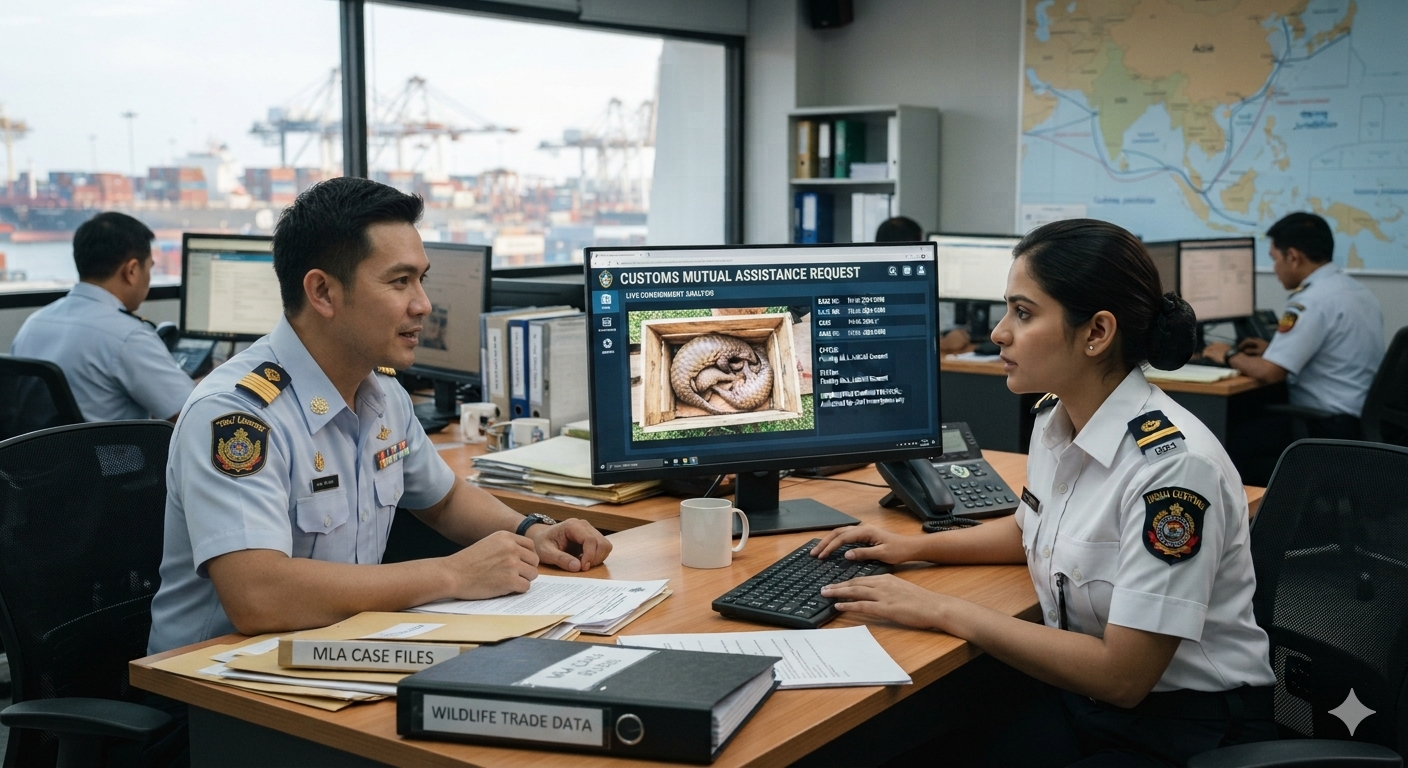
The mechanism is practical. A request is normally made directly from one designated customs contact point to another, in writing or electronically, with enough case detail to identify the matter, the legal basis, the persons or consignments involved, and the assistance sought. Urgent verbal requests may be possible under the WCO Model, followed by written confirmation.
The Indian Legal Framework:
In India, the statutory basis for CMAA is Section 151B of the Customs Act, 1962. It empowers the Central Government to enter into agreements or arrangements with foreign governments or their competent authorities to facilitate trade, enforce the Act, and exchange information for risk analysis, verification of compliance, and the prevention, combating and investigation of offences under the Act or corresponding foreign law:
- Notification: under Section 151B(2), the Government notifies the contracting states to which the provision applies, with any conditions. Notification No. 58/2021-Customs (N.T.) of 1 July 2021 (G.S.R. 467(E)) contains the table of such agreements. It was amended in March 2024 and again by Notification No. 32/2025-Customs (N.T.) of 28 April 2025, which added a cooperative arrangement with the New Zealand Customs Service and an agreement with Madagascar.
- Evidentiary Use: Section 151B(3) allows information received under an agreement to be used as evidence in investigations and proceedings under the Customs Act, subject to the conditions in the Notification.
Why CMAAs Suit Wildlife Enforcement: Wildlife moves through the same channels as other contrabands: air passengers and cargo, sea containers, postal and courier streams. Importing CITES-listed or protected species without authorization is prohibited under the Customs Act, 1962 read with the Wild Life (Protection) Act, 1972, and Indian Customs routinely seizes wildlife contrabands. Customs also holds the data that is required for wildlife crime investigation: manifests, bills of lading, shipping bills, declarations, consignor/consignee details and risk-profiling history. A CMAA lets that data be verified across borders, and also lets customs officers act on intelligence while the illegal wildlife shipment is still moving.
Why CMAAs are often More Effective than Mutual Legal Assistance Requests or Letters Rogatory: CMAAs do not replace Mutual Legal Assistance (MLA) and they do not eliminate the need for Letters Rogatory. They serve a different purpose in the enforcement process. Mutual Legal Assistance (MLA) and Letters Rogatory are Judicial or Central-Authority Instruments. In India, MLA requests in criminal matters go through the Ministry of Home Affairs as Central Authority, and Letters Rogatory are issued by a judicial Court under the erstwhile Code of Criminal Procedure and now under the Bharatiya Nagarik Suraksha Sanhita.
MLA is ordinarily a formal state-to-state criminal-justice mechanism used when prosecutors or courts need evidence or coercive action abroad, such as executing searches, taking testimony, obtaining bank material through judicial process, freezing assets, or securing admissible evidence for trial. The United Nations Convention against Transnational Organized Crime calls for mutual legal assistance to the fullest extent possible, but UNODC also notes that differences among legal systems can complicate cross-border evidence gathering.
A CMAA is normally more effective at the intelligence, interdiction, and customs-investigation stage because it is designed for direct administrative contact between customs administrations. The WCO specifically distinguishes mutual administrative assistance from mutual legal assistance, explaining that the latter is used when information is required in evidential form for criminal proceedings.
|
Enforcement Need |
CMAA Advantage |
When MLA/Letter Rogatory is Needed |
|
Verify an export declaration or transit record |
Direct customs-to-customs request; operationally suited to trade data. |
Usually unnecessary initially |
|
Target an imminent shipment |
Can support advance information sharing, surveillance, and rapid alerts. |
Usually too slow for immediate border intervention |
|
Compare exporter, consignee, routing, and container data |
Fits customs risk analysis and investigation. |
May later be needed if records must be formally proved |
|
Conduct a controlled delivery |
Specifically contemplated by the WCO model, subject to domestic authority. |
May be necessary if police, prosecutors, or judicial authorization is required |
|
Obtain evidence for prosecution |
Information may require consent for use beyond customs purposes. |
MLA or judicial process may be required |
The real advantage of CMAAs lies in timing. A live wildlife consignment has a short window for action. Customs may need to confirm within hours whether an export permit exists, who the shipper is, or whether similar cargo has left the same port. An MLA request cannot answer that question quickly. ICCWC and CITES documents have long recognized this by pointing to agency-to-agency (administrative) cooperation as the step that precedes formal MLA.
The two channels are complementary, not competing. Many CMAAs themselves state that they do not displace mutual legal assistance in criminal matters. A sound strategy uses the CMAA to build the case quickly and then uses MLA for what only a Court/Central Authority can obtain.
Illustration: A Hypothetical Wildlife Smuggling Case
- Incident & Seizure: Indian Customs intercepted a cargo shipment declared as "decorative wooden handicrafts" after X-ray and physical checks revealed hidden reptile specimens and carved ivory. The shipment originated in Country A, transited Country B, and was destined for a small Indian trading firm.
- Immediate Enforcement Action: The customs must secure the consignment, preserve all packaging, labels, and airway bill identifiers, and immediately engage the wildlife/CITES authority for species identification. Simultaneously, initiate a domestic investigation into false declaration, prohibited imports, and permit fraud.
- CMAA Information Requests: Customs should send targeted Mutual Administrative Assistance (CMAA) requests to Countries A and B, citing the specific shipment, suspected offences, and legal arrangements rather than making generic inquiries:
- To Country A (Origin): Request the export declaration, commercial invoices, packing lists, exporter/forwarder identities, history of similar shipments, and verification of any CITES permits.
- To Country B (Transit): Request confirmation of physical transit, package weights, cargo substitution checks, and links to prior suspicious wildlife movements.
- Network Investigation & Advanced Tactics: If responses reveal a pattern of repeated shipments, fake addresses, or weight discrepancies, Customs should upgrade the risk profile for related cargo, passengers, and financial transactions.
- If a matching shipment is detected en route, administrations should coordinate a controlled delivery to identify the receivers, financiers, and distributors, ensuring proper domestic authorization.
- For advanced steps like asset freezing or formal prosecution evidence, the case should transition from CMAA intelligence to Mutual Legal Assistance (MLA)/Letters Rogatory channels.
Limitations of CMAAs and How to Overcome Them:
- Scope Limited to Customs Matters: CMAAs only cover customs offences, excluding pure poaching or forestry violations.
Enforcement Response: Coordinate domestically with the domestic wildlife protection agencies such as Wildlife Crime Control Bureau (WCCB) in India to align customs actions with the Wild Life (Protection) Act/CITES. Internationally, leverage INTERPOL or regional networks like SAWEN for non-customs wildlife agencies.
- No Coercive Powers: CMAAs cannot compel foreign banking records, searches, arrests, asset-freezing or witness testimonies.
Enforcement Response: Use CMAA intelligence to build precise targets, then transition to Mutual Legal Assistance Treaties (MLAT), Letters Rogatory, or Joint Investigation Frameworks for coercive action.
- Evidentiary Restrictions: Shared data is often restricted to intelligence use and may require consent for court admissibility.
Enforcement Response: Explicitly state the intended use in the initial request, request authenticated/admissible documents upfront, and engage prosecutors early.
- Gaps in Agreement Coverage: Key source or transit countries may lack bilateral CMAAs.
Enforcement Response: Utilize multilateral frameworks like the WCO Nairobi Convention, WCO networks: Customs Enforcement Network (CEN) & The Regional Intelligence Liaison Offices (RILO), or INTERPOL’s I-24/7 system. Prioritise negotiating new pacts along high-risk routes.
- Confidentiality & Data Protection: Partner nations may withhold personal data due to privacy laws or fear of operational leaks.
Enforcement Response: Use secure, designated contact points, apply strict security classifications, and strictly share data on a need-to-know basis.
- Operational Capacity & Delays: Agreements fail if designated contact points are unresponsive or untrained.
Enforcement Response: Maintain an active, updated contact register, test channels via routine exchanges, and build operational trust through global initiatives like Operation Thunder.
- Financial & Transnational Dimensions: CMAAs rarely expose illicit financial flows or kingpins.
Enforcement Response: Pair customs requests with Financial Intelligence Unit (FIU) cooperation. Treat trafficking under the UN Convention against Transnational Organized Crime (UNTOC) to unlock advanced cross-border enforcement toolkits.
Conclusion:
Strengthening the operational use of existing CMAAs with key source, transit and destination countries should therefore be viewed as an augmented wildlife-enforcement capability. When combined with CITES controls, Customs risk management, WCO Intelligence systems, INTERPOL cooperation, FIUs/EGMONT Group of FIUs cooperation and Mutual Legal Assistance/Letters Rogatory, CMAAs can help transform wildlife enforcement from isolated border seizures into coordinated transnational investigations targeting the entire trafficking chain.
That is ultimately the objective that matters: not merely seizing/confiscating the wildlife, but identifying who sourced it, who financed it, who moved it, who received it and who profited from the crime.

I am an Indian Revenue Service (Customs & Indirect Taxes) officer with vast experience of law enforcement especially in tackling transnational smuggling including willdife trafficking. Also, as an expert I have been conducting sessions on various aspects of wildlife crimes and its convergence with other serious crimes, legal and enforcement framework to counter it, wildlife cyber crime, OSINT for combating wildlife crime, combating money laundering associated with wildlife crime, CITES, role of Customs in tackling the menace of wildlife crime, Digital Forensics etc. for forest, police, customs and other enforcement agencies' officials.