Seahorse Trafficking and the Need for Smarter Marine Wildlife Enforcement
Introduction:
Seahorses (Hippocampus spp.) are small marine fishes with a distinctive reproductive biology, in which the male carries the young. They live in seagrass, mangroves and coral habitats and are slow to recover from exploitation. Nine species occur in India, with the Gulf of Mannar and Palk Bay in Tamil Nadu the best-known hotspots.
Seahorses were among the first marine fishes added to CITES Appendix-II, at CoP12 in Santiago in November 2002. Exports of listed species require permits, and the genus was also the first marine fish to enter the CITES Review of Significant Trade, after which most historic exporters, including India, Indonesia, Malaysia, Peru, the Philippines, Thailand and Vietnam, no longer had legal exports. As far as India is concerned, in 2001, all seahorse species were placed on Schedule-I of the Wild Life (Protection) Act, 1972, shortly after 1999 surveys estimated that India caught a median of about 16.76 million seahorses a annualy. Schedule-I species are granted highest level of protection as their harvesting, hunting, possession, trade etc. are completely prohibited.
Why Seahorses Are Smuggled:
The central driver is persistent demand for dried seahorses, primarily in traditional medicine markets in East and Southeast Asia. Dried specimens are used in traditional Chinese medicine and may also be sold as curios, ingredients in medicinal preparations. The dried seahorse trade historically dominates global seahorse commerce: CITES material has reported that dried specimens accounted for approximately 98% of recorded trade between 2004 and 2011, while live specimens are principally associated with ornamental aquarium markets.
Several characteristics make seahorses attractive to traffickers:
- They are lightweight, dry easily, and can be packed densely. A relatively small package can hold hundreds or thousands of specimens, creating a favourable value-to-weight ratio.
- Dried specimens are durable and do not require food, water, veterinary care or specialized transport conditions. This makes them easier to conceal than live wildlife.
- They can be misdeclared as dried fish, marine curios, herbal ingredients, seafood, fish feed, ornamental material.
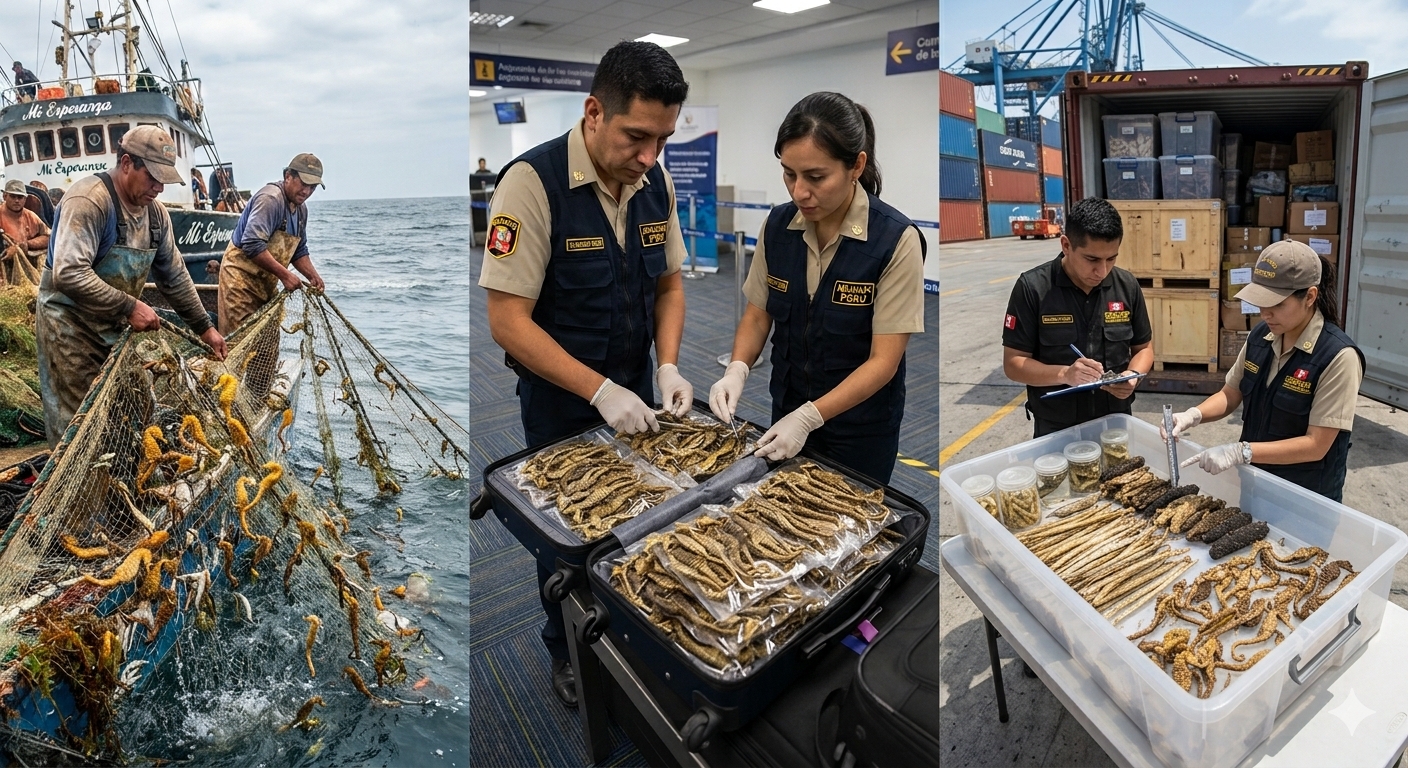
- Their collection can be integrated into existing fisheries. Seahorses are frequently caught as bycatch in trawls and gillnets and then retained, aggregated by middlemen and diverted into illegal trade. This complicates the distinction between fishing activity and wildlife trafficking.
- Dried seahorses can be moved with other wildlife or marine products. In the global seizure review, seahorses were often found alongside sea cucumbers, shark fins, pipefishes, fish swim bladders, ivory and pangolin products. This indicates that seahorse smuggling may be embedded in wider wildlife-trafficking and marine-product networks rather than being operated by isolated collectors.
Source, Transit and Destination Countries:
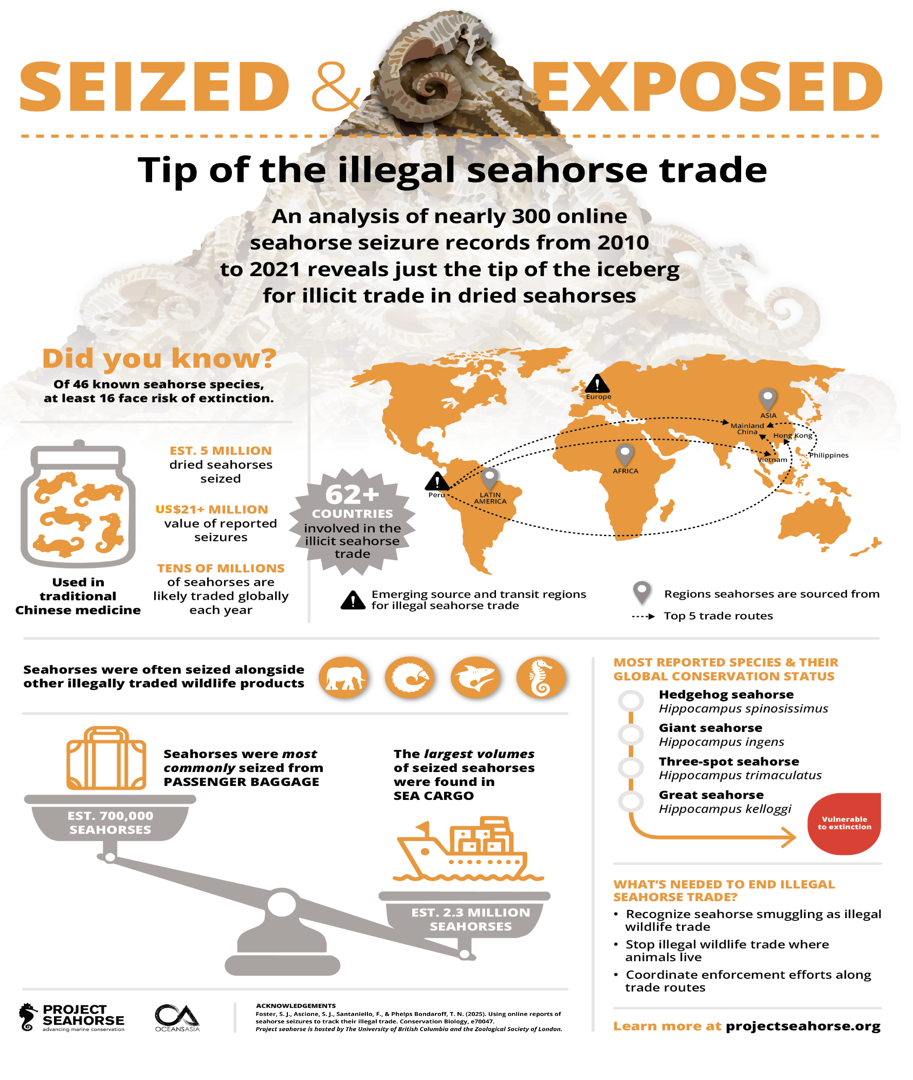
The most useful evidence is the 2025 Conservation Biology analysis by Project Seahorse and OceansAsia. It covered 297 online seizure records from 2010 to 2021, totalling about 4.93 million seahorses worth over US$21 million, and involved 62 jurisdictions.
- Source Countries: Seized seahorses predominantly originated in Africa, Asia and Latin America. Peru was the source of the three largest routes, and Guinea and Egypt ranked first and second by number of seizures at source. The ten largest routes were Peru to Mainland China, Peru to Hong Kong, Peru to Vietnam, the Philippines to China, Vietnam to China, India to China, Egypt to China, Indonesia to Hong Kong, Thailand to China, and Egypt to the UAE.
- Destination Countries: China was the primary destination market, followed by Hong Kong and Vietnam, which recorded the largest median seizure sizes. Other main destination countries include Singapore, Malaysia and Thailand.
- Transit Countries: The analysis flagged Belgium as the most frequently reported European transit point and Peru as a significant transit location. India appears both as a source and, in five seizures, as a transit location.
Modus Operandi:
- Bycatch Retention and Local Aggregation: Seahorses caught in trawls, gillnets and other fishing gear are retained rather than discarded. Collectors or intermediaries purchase them from fishers, dry them, sort them by size or species, and consolidate stock for wholesalers.
- Drying and Concealment: Specimens may be sun-dried or otherwise dehydrated, then packed in plastic bags, jars, cartons, pouches or sealed containers. Drying reduces odour, weight and spoilage risk and enables high-density packing.
- Passenger Baggage: This is the most frequently detected method by seizure incidence. Couriers may carry hundreds or thousands of specimens in checked-in baggage, sometimes split among multiple passengers.
- Postal and Express Courier Consignments: Small parcels may be falsely declared as dried seafood, herbal material, handicrafts or samples and they also lower the loss if intercepted.
- Sea Cargo and Commercial Shipments: Although fewer in number of detected cases, sea-cargo seizures are by far the largest and the principal risk for high-volume trafficking.
- Mixed Wildlife Consignments: Seahorses may be moved with sea cucumbers, shark fins, fish maw, pipefish, ivory or pangolin products. Such bundling indicates shared logistics, shared buyers, and opportunities for joint targeting across wildlife and fisheries offences.
- Misdeclaration and Identity Exploitation: Small dried specimens are difficult for non-specialists to identify. Traders may exploit confusion with pipefish, dried fish, herbal ingredients or legal aquaculture products. Species-level identification is often absent from seizure records, weakening route analysis.
Challenges for Law Enforcement:
- The first major challenge is detectability. Seahorses are small, dry, easily packaged, and visually unfamiliar to many frontline officers. X-ray screening may reveal organic material or dense packets, but not the species identity. Dried specimens may also be mixed with legal dried seafood.
- Second, enforcement data are fragmented. Species identification are available in only a small fraction of recorded seizures and information on routes, actors, financial value and final legal outcomes are frequently missing. Without consistent data fields, enforcement agencies cannot reliably identify repeat offenders, source clusters, freight forwarders, financial facilitators or route displacement.
- Third, seahorse trafficking occupies an institutional gap between wildlife enforcement and fisheries management. The upstream criminality often begins as bycatch or illegal retention at sea, but the downstream offence emerges at a market, warehouse, airport, seaport or border. Weak coordination between Fisheries Departments, Forest/Wildlife authorities, Customs, Coast Guard, port authorities and police allows offenders to exploit jurisdictional seams.
- Fourth, legal trade and illegal trade can be confused. CITES Appendix II allows regulated international trade in principle, whereas India has chosen much stronger domestic protection. Officers need clarity that foreign CITES documentation does not automatically legitimize possession, import, export or transit under Indian law. At the same time, purported captive-bred origin claims require scrutiny
Making Enforcement More Effective:
An effective response should combine fisheries intelligence, wildlife law, customs risk management and financial investigation.
- Establish a National Seahorse Trafficking Threat Profile: Record every seizure and intelligence input in a standard format: date, location, quantity by weight and count, form, suspected species, source area, route, transport mode, co-seized items, persons involved, digital evidence, declared commodity, consignee, freight forwarder and final judicial result.
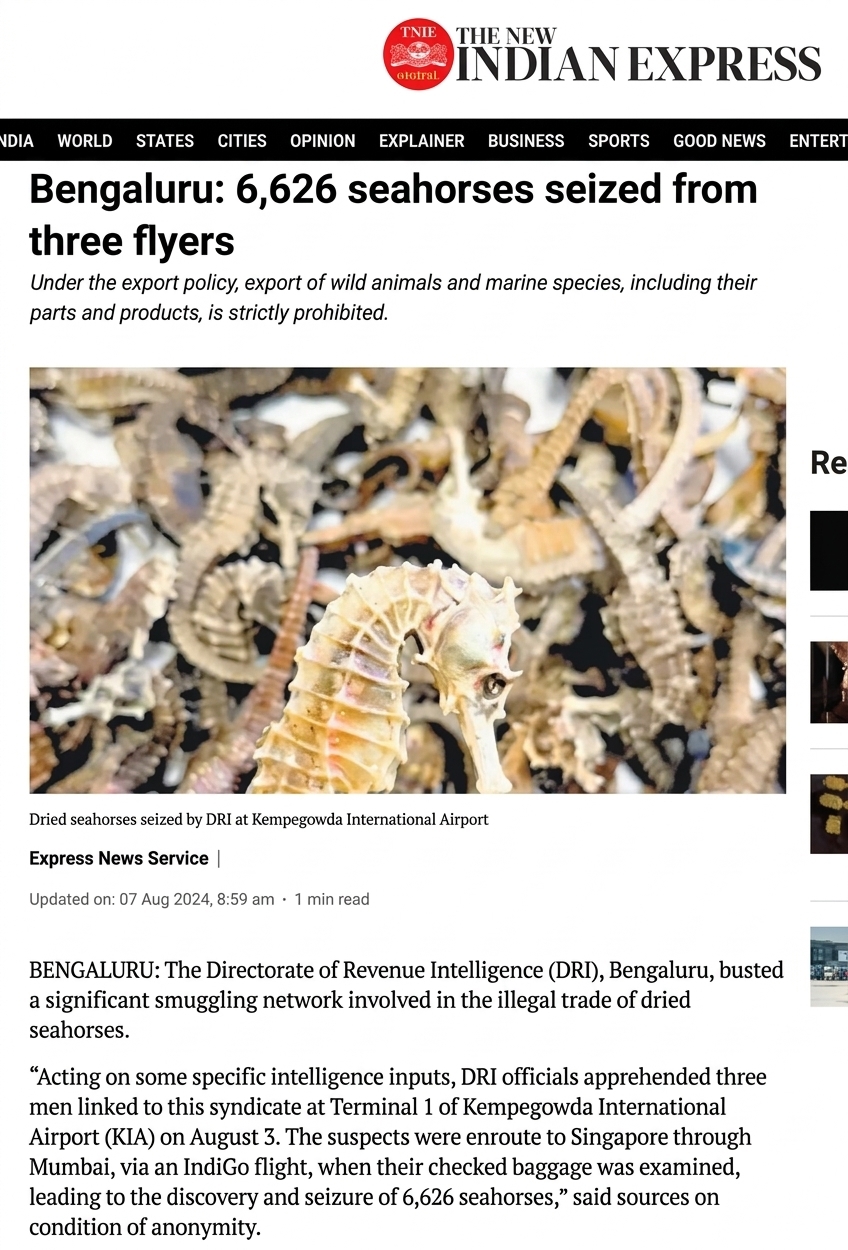
- Prioritize Intelligence-led Targeting: Screen passengers and shipments using route, booking, baggage, freight, declaration and behavioral risk indicators. Particular attention should go to consignments linked to dried seafood, traditional medicine, fish maw, sea cucumber, shark fin, curio products and unexplained high-density organic material. Indian cases cluster on flights from Chennai, Mumbai and Bengaluru to Singapore and Malaysia; on coastal roads and buses from Ramanathapuram, and on Chennai godowns. Targeted baggage screening, Port and Container Intelligence are needed for effective enforcement.
- Investigate the Network, Not only the Courier: Examine call records, payment trails, bank accounts, social-media contacts, procurement records, travel histories, repeat consignors, freight forwarders and co-shipped wildlife products. Apply applicable proceeds-of-crime, money-laundering and customs provisions where evidentiary thresholds are met.
- Capacity Building: Build capacity at airports, ports, courier hubs and coastal landing centres. Training should include AI-assisted visual identification of dried seahorses and pipefishes, recognition of packaging patterns, document scrutiny, sampling methods, chain-of-custody procedures and use of CITES identification materials.
- DNA Foresnsics: Send samples for DNA analysis. DNA forensics are available and species identification is what revealed the West Africa–Peru–Vietnam route.
- Share Data Across Borders: Importing jurisdictions must share seizure data with source countries. Use INTERPOL, WCO and CITES channels.
- Prosecute Fully and Publish Results: Build the evidential chain from seizure to conviction, and publicize outcomes. Sharing information on successful prosecutions with significant penalties raises perceived risk.
- Work with Fishing Communities: Awareness drives, safe release or reporting protocols for live bycatch, and informant networks amongst fishing communities address the supply end.
- Close Permits and Integrity Gaps: Verify CITES permits with issuing authorities for marine consignments, and watch for corruption signals at export points.
Conclusion:
Seahorse trafficking demonstrates that wildlife crime is not confined to iconic terrestrial species. It is a high-volume marine wildlife trade driven by continuing demand for dried specimens, enabled by fisheries bycatch, informal aggregation, cross-border logistics and weak detection at key nodes. The available evidence points to a trade centred on Asian destination markets—especially mainland China—with supply originating across Asia, Africa and Latin America and moving through airports, sea cargo, passenger baggage and postal/courier systems.
India’s strong legal protection gives enforcement agencies a solid basis for action. The operational priority is to move beyond opportunistic seizures toward a coordinated, intelligence-led approach that starts at coastal landing centres, identifies consolidators and financiers, targets high-risk export channels, and produces evidence capable of dismantling the entire network. Seahorse smuggling will be reduced not simply when more specimens are seized, but when traffickers know that collection, storage, transport, finance and sale all carry a credible risk of detection, forfeiture of their assets, their arrest and conviction.

I am an Indian Revenue Service (Customs & Indirect Taxes) officer with vast experience of law enforcement especially in tackling transnational smuggling including willdife trafficking. Also, as an expert I have been conducting sessions on various aspects of wildlife crimes and its convergence with other serious crimes, legal and enforcement framework to counter it, wildlife cyber crime, OSINT for combating wildlife crime, combating money laundering associated with wildlife crime, CITES, role of Customs in tackling the menace of wildlife crime, Digital Forensics etc. for forest, police, customs and other enforcement agencies' officials.