
Introduction:
The illegal wildlife trade is not confined to iconic mammals such as tigers, elephants, rhinoceroses etc. Reptiles, amphibians, insects and other invertebrates are also collected from wild and traded to meet the demand in the exotic-pet market. Among these less conspicuous victims are Tarantulas—large spiders prized by collectors for their unusual appearance, striking colours, distinctive markings and behaviour.
The commercial demand for tarantulas creates enforcement challenges that differ from those associated with trafficking in animal skins, ivory, horns or other durable wildlife products. Live spiders can be transported in small containers, concealed in ordinary postal/courier packages and misdeclared as commonplace consumer goods. Some consignments contain dozens or hundreds of individual specimens, making a single postal/courier shipment potentially significant from a conservation perspective. Moreover, a parcel may contain several species with different legal protection requirements, creating difficulties in identification and determining the applicable offences.

Natural Habitat and Ecological Role:
Tarantulas occur across tropical, subtropical and dry forest ecosystems in the Americas, Africa and Asia. They generally live in burrows, tree hollows, rock crevices and prey mainly on insects and other invertebrates; thus, they help regulate insect populations.
India is especially significant: it has more than 60 tarantula species, over 55 of which are endemic. Many Indian tarantulas depend on fragmented forest habitats, including the Eastern Ghats and Western Ghats, where habitat loss, soil extraction, logging, firewood collection and collection for the pet trade threaten their survival.
Protection Status and Legal Frameworks:
The legal framework governing the trade of tarantulas varies across international, regional, and national jurisdictions, often creating loopholes that traffickers exploit.
|
Framework / Authority |
Protection & Coverage |
Legal Scope & Enforcement Relevance |
|
CITES |
Not all tarantula species are CITES-listed. Appendix II: Includes genera such as Brachypelma, Aphonopelma, Caribena, and all Poecilotheria species. |
Commercial international trade is strictly regulated and requires valid CITES permits issued by the Management Authority of the exporting country. Unpermitted movement constitutes wildlife trafficking under international law. |
|
IUCN Red List |
Multiple species listed as Critically Endangered (CR), Endangered (EN), or Vulnerable (VU). |
Poecilotheria metallica (Gooty Sapphire Ornamental), & Poecilotheria hanumavilasumica (Rameshwaram Ornamental) are listed as Critically Endangered. Brachypelma boehmei (Mexican fireleg) is listed as Endangered & Thrigmopoeus insignis, an Indian Western Ghats tarantula is listed as Vulnerable. |
|
Wild Life Protection Act (WPA), 1972 (India) |
Schedule II: Genus Poecilotheria (Indian Ornamental Tarantulas) protected under national law. Schedule IV: Regulates non-native CITES Appendix II species. |
Unauthorized possession, capture, or trade of native species carries heavy penalties. Under the PARIVESH / CITES Regulation Portal, keepers and traders in India must declare non-native CITES-listed exotic tarantulas. |
The Demand-Supply Chain:
Demand is driven by the pet and collector market, with colour, rarity and novelty commanding premiums. Three supply pathways can be distinguished:
- Wild Collection in Source Countries such as Mexico, India, Sri Lanka, South-East Asia and usually by local collectors paid per tarantula.
- Laundering through Captive-Breeding Claims.
- Re-distribution by Hobbyist Networks and Breeders.
Some Documented Seizures:
- Mumbai Airport, India: In June 2025 a passenger from Bangkok carrying nearly 100 animals, including two tarantulas, was intercepted. On 11 August 2025 another passenger arriving from Bangkok was held with around 100 Tarantulas packed inside biscuit boxes with reptiles and mammals.
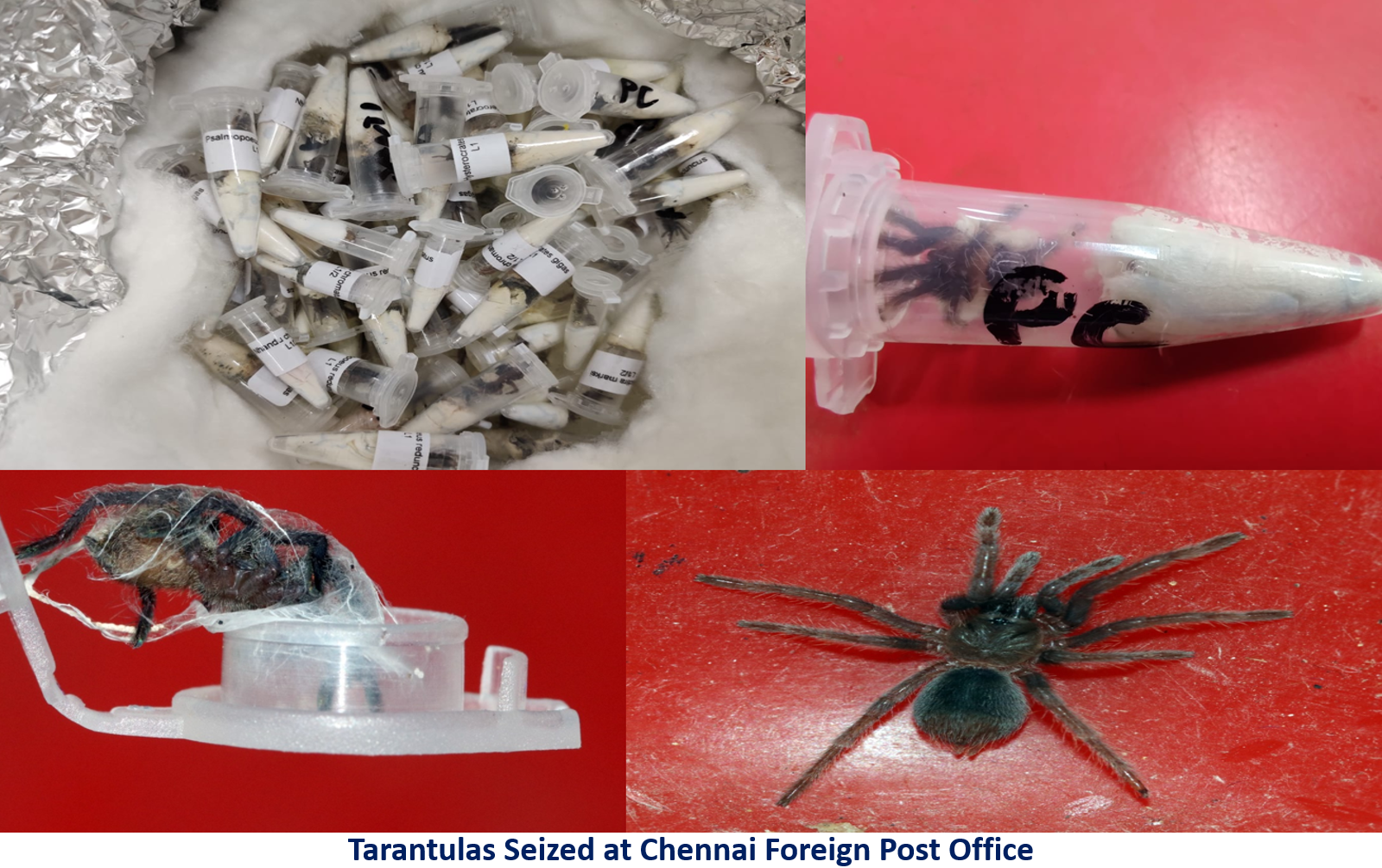
- Chennai Foreign Post Office, India: Chennai Air Customs intercepted a postal parcel from Poland at the Foreign Post Office, addressed to a person in Tamil Nadu. Inside a thermocol box were 107 small plastic vials wrapped in silver foil and cotton, each holding a live spider. The Wildlife Crime Control Bureau and the Zoological Survey of India (Southern Regional Centre) identified them morphologically as probably Aphonopelma and Brachypelma, CITES-listed species from Mexico and Central/South America.
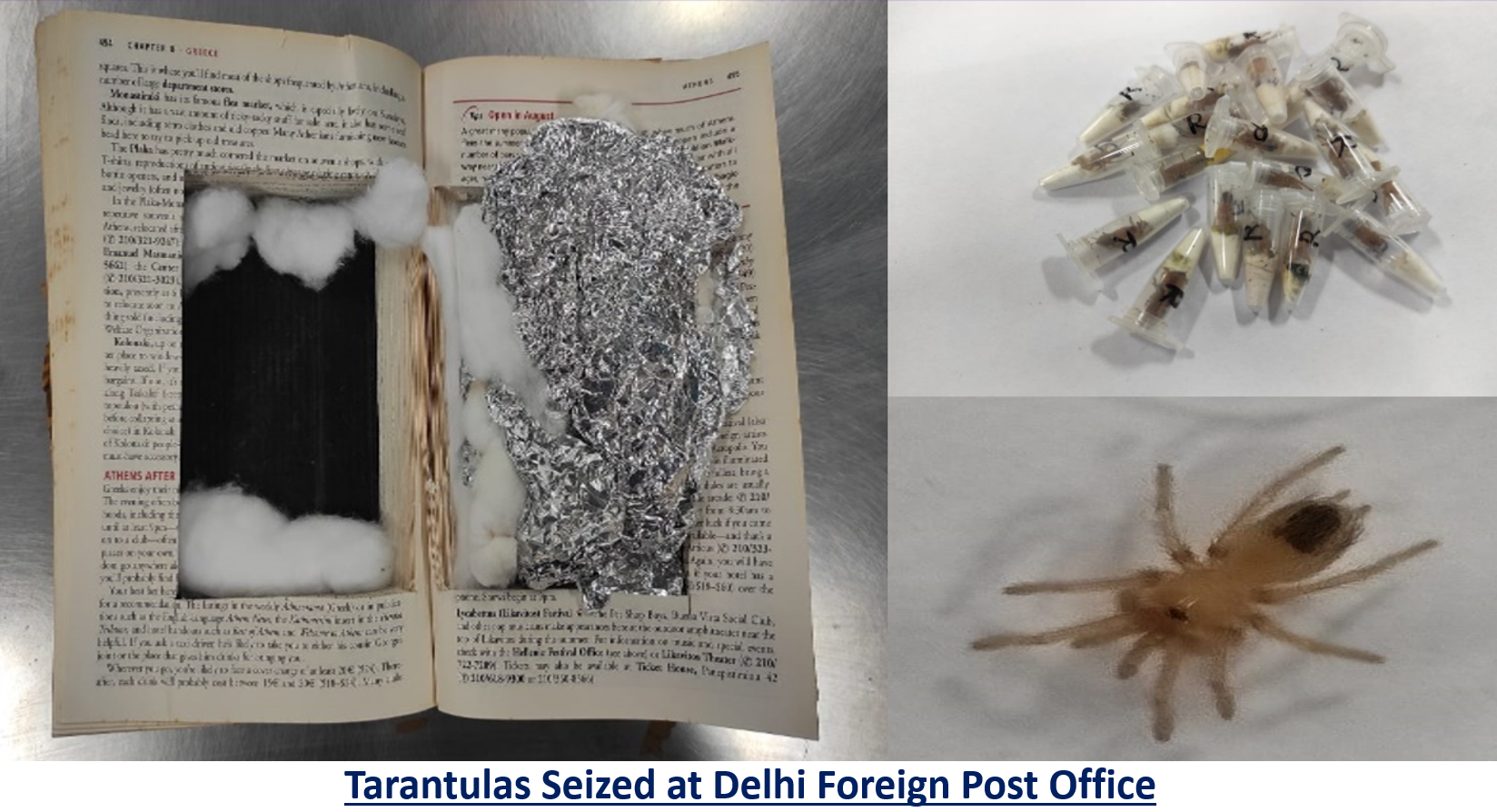
- New Delhi Foreign Post Office, India: In March 2022 a postal parcel was intercepted at New Delhi Foreign Post Office. The parcel was found to contain 101 vials. In each vial one little tarantula was kept. These vials were ingeniously concealed inside a book.
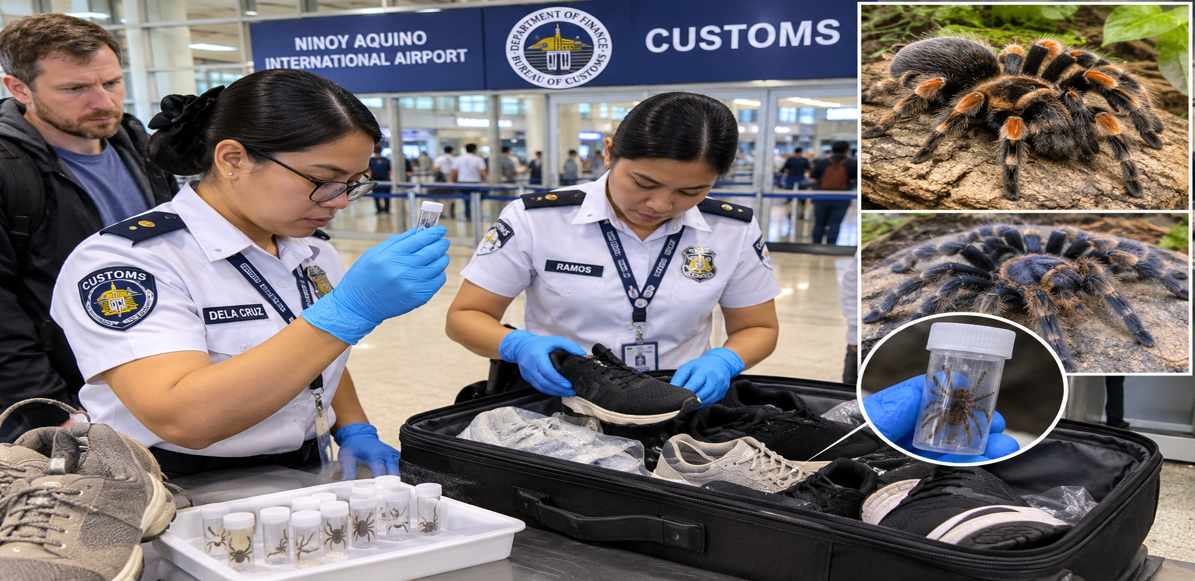
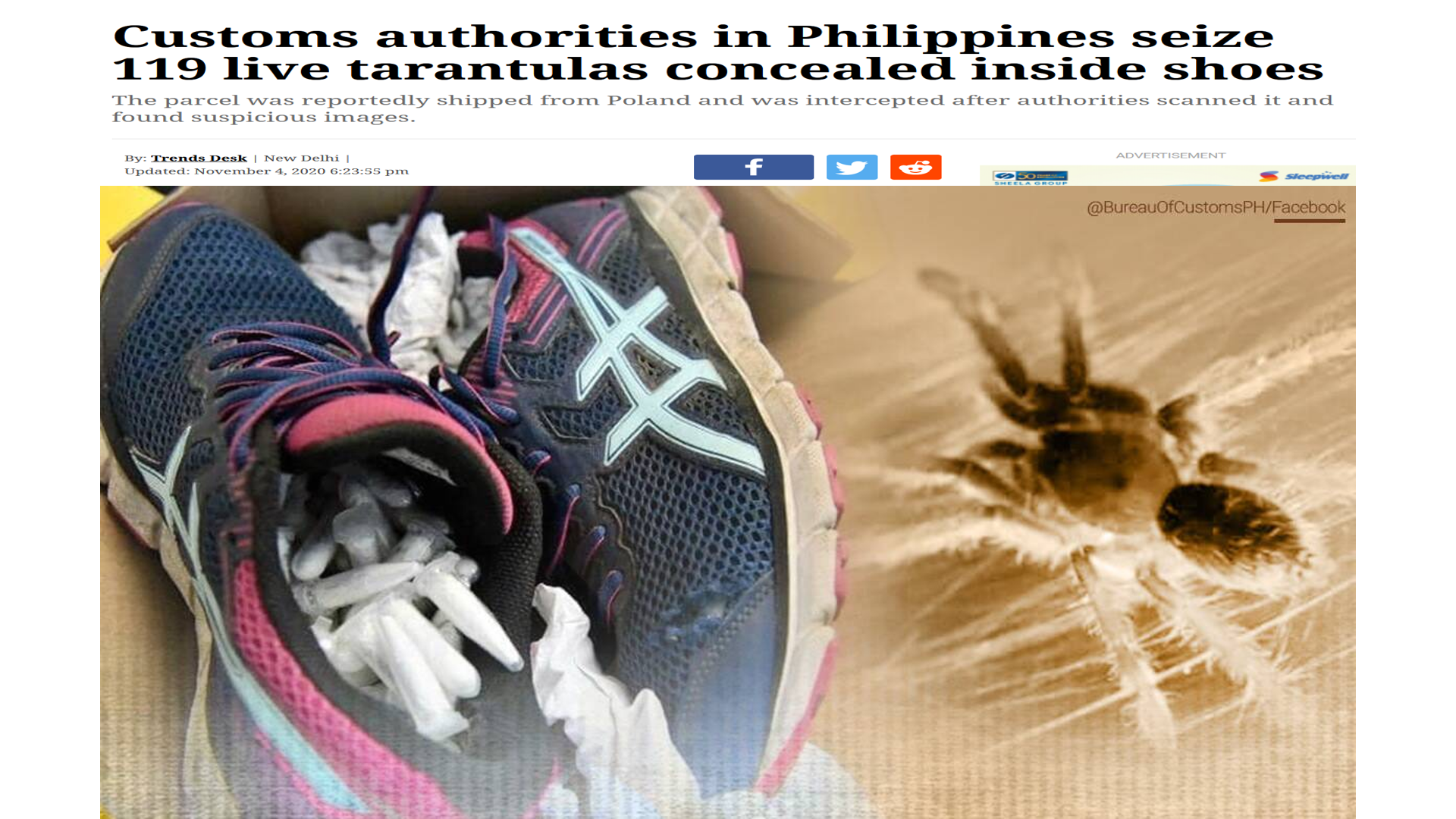
- Philippines: In October 2020, Philippine Customs at Ninoy Aquino International Airport seized 119 live tarantulas concealed inside rubber shoes in a DHL warehouse. The parcel was declared as “buty”—the Polish word for shoes—and had been shipped from Poland. Customs examiners detected suspicious images during scanning and found the tarantulas in individual plastic vials during physical examination. The case illustrates the use of footwear as concealment and the importance of image analysis, profiling and physical inspection of courier parcels. Earlier, in 2019, Philippine authorities intercepted 757 live tarantulas concealed in oatmeal and cookie boxes, and 87 live spiders in white plastic canisters, both shipments originating from Poland. These cases show that traffickers adapt concealment methods—food packets, shoes, canisters and vials—to defeat routine screening.
- Other Examples: CITES documentation records Brazilian seizures including 81 Brachypelma specimens in 2020, 19 Acanthoscurria specimens bound for Poland in 2021, and 50 Theraphosidae specimens from Belgium in 2024. In Europe, Portugal and France reported eight live tarantulas across seven seizure records in 2021, including Mexican red-knee and curly-haired tarantulas.
Modus-Operandi of Traffickers:
Evidence from seizures indicates following modus-operandi:
- Postal and Courier Concealment: Live Tarantulas are placed in plastic vials, thermocol boxes, shoes, food packets/containers, canisters or other ordinary packaging.
- Mis-declaration: Parcels are labelled as shoes, food items, toys, electronic goods or other innocuous commodities.
- Fragmentation: Many small vials are used instead of one large container, making detection harder and spreading risk across multiple parcels.
- Use of Legal Grey Zones: Traffickers exploit non-CITES species, incorrect identification, captive-bred claims.
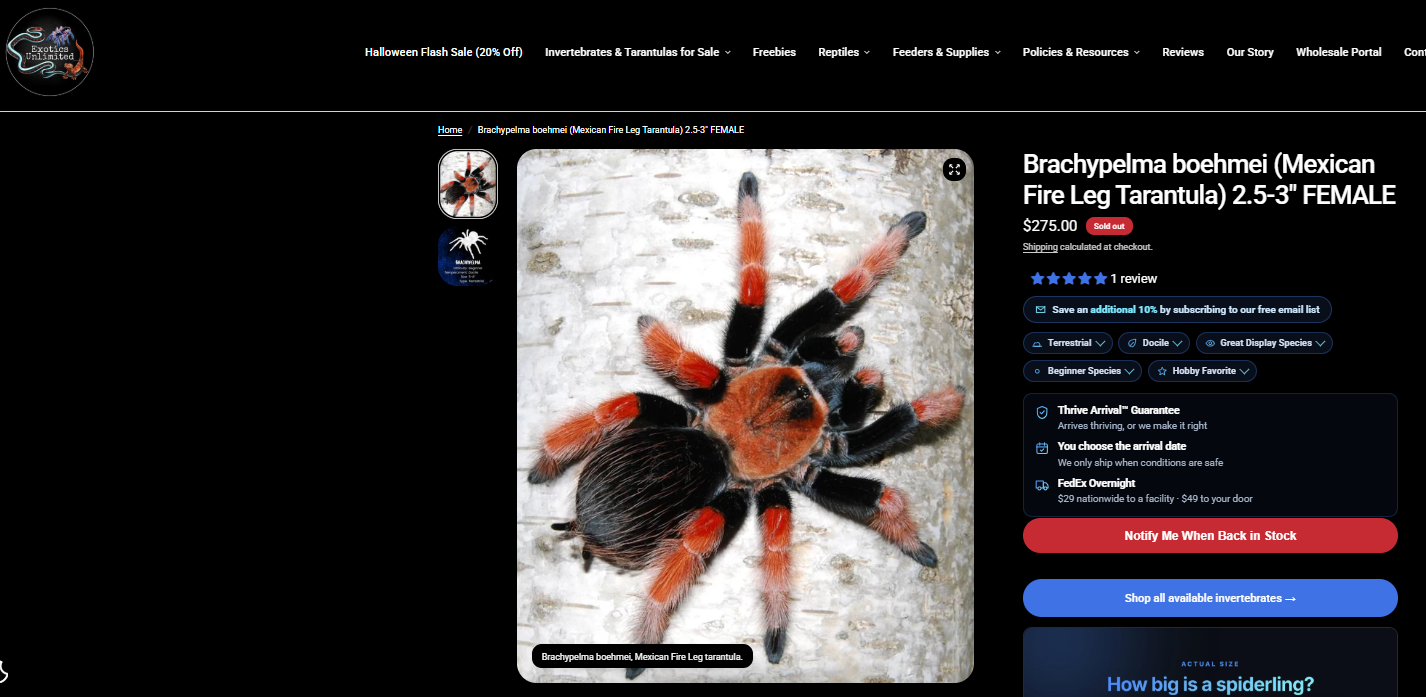
- Online Trade and Doorstep Delivery: E-commerce, hobbyist networks and social media enable demand aggregation, while postal/courier channels complete the final delivery.
- Transit Routing: Shipments may pass through jurisdictions with weaker inspection capacity or be routed through major postal/courier hubs to obscure origin and destination.
Enforcement Challenges:Tarantula enforcement is difficult for four reasons.
- First, species identification requires specialist taxonomic expertise; a vial containing a juvenile specimen may not be readily distinguishable.
- Second, legal protection is uneven. Only a subset of tarantulas is CITES-listed.
- Third, live-animal handling creates practical constraints: seized tarantulas need appropriate care, quarantine, species verification and lawful disposal or repatriation.
- Fourth, the postal/express courier parcels route is high-volume and low-visibility. Unlike live animal shipments at airports, postal/express courier parcels may appear ordinary externally, and officers have to rely on risk profiling, scanner imagery, intelligence and selective examination.
Effective Enforcement Strategy:
- Intelligence-led Postal/Courier Parcel Screening: Customs should develop risk profiles for tarantula trafficking: origin countries, transit hubs, destination patterns, unusual packaging, repeated small parcels, and declarations involving shoes, food, toys, books or thermocol etc.
- Standardized Identification Guides & Apps: Customs officers at Foreign Post Offices, Courier Terminals and airports should be provided with visual field guides and digital quick-reference apps developed in partnership with wildlife scientific authorities such as Zoological Survey of India.
- Advanced Non-Intrusive Inspection (NII): Deploying high-resolution CT cargo scanners and AI-assisted visual recognition software calibrated to identify small cylindrical containers, vials, and organic shapes inside postal/courier parcels will strengthen enforcement.
- Specialized Wildlife Sniffer Dogs: Trained wildlife sniffer dogs may assist in detection of parcels containing tarantulas.
- Institutional Coordination: Each suspected Tarantula parcel should trigger a rapid joint response involving Customs, forest/wildlife, scientific authorities & Animal Quarantine. The Chennai seizure demonstrates the value of this model: Customs detected the parcel, WCCB and ZSI assisted identification, and animal quarantine advised on deportation.
- Cyberspace Monitoring: Institutionalizing cyber-spotting units to track illicit trade of Tarantula will help in dismantling networks operating across darknet, social media, e-commerce and exotic pet forums.
- Enforcing Breeder Registration: Strictly enforcing mandatory registration protocols (such as India's PARIVESH portal) for exotic pet owners and breeders. Unregistered possession or failure to prove legal origin should carry swift seizure/confiscation and legal penalties.
- Forensic Identification Capacity: Enforcement agencies need robust forensic identification capacity, reference collections, DNA barcoding facilities. This is essential because species-level identification determines whether CITES, the Wild Life (Protection) Act provisions apply or not.
- Closing Legal Gaps: CITES should consider including all Tarantula species in its Appendices. Listing all Tarantula species will help in combating smuggling primarily by closing the "lookalike species" loophole. Traffickers routinely exploit the fact that many tarantulas look nearly identical, especially during their juvenile or spiderling stages. When only a few select species are protected, smugglers can mislabel an endangered, protected tarantula as a non-protected species. Because border officials are rarely trained arachnologists, these shipments are easily waved through.
- International Cooperation: Because cases commonly involve Poland, European Union jurisdictions, the Americas and Asian destination markets, enforcement requires rapid information exchange among CITES authorities, customs administrations, INTERPOL, WCO and national wildlife-crime units for a coordinated enforcement action against the traffickers.
Conclusion:
The illegal trade in tarantulas represents a growing challenge to global biodiversity and wildlife law enforcement. Combating this trade requires transitioning from reactive seizures to proactive intelligence-led enforcement. By combining specialized training, advanced screening technology, stronger postal/courier parcel oversight, robust risk profiling and strict domestic compliance, enforcement agencies can close the loopholes exploited by trafficking syndicates and protect these species.