Follow the Money, Save the Wildlife: The Egmont Group's Role in Combating Wildlife Trafficking
Introduction:
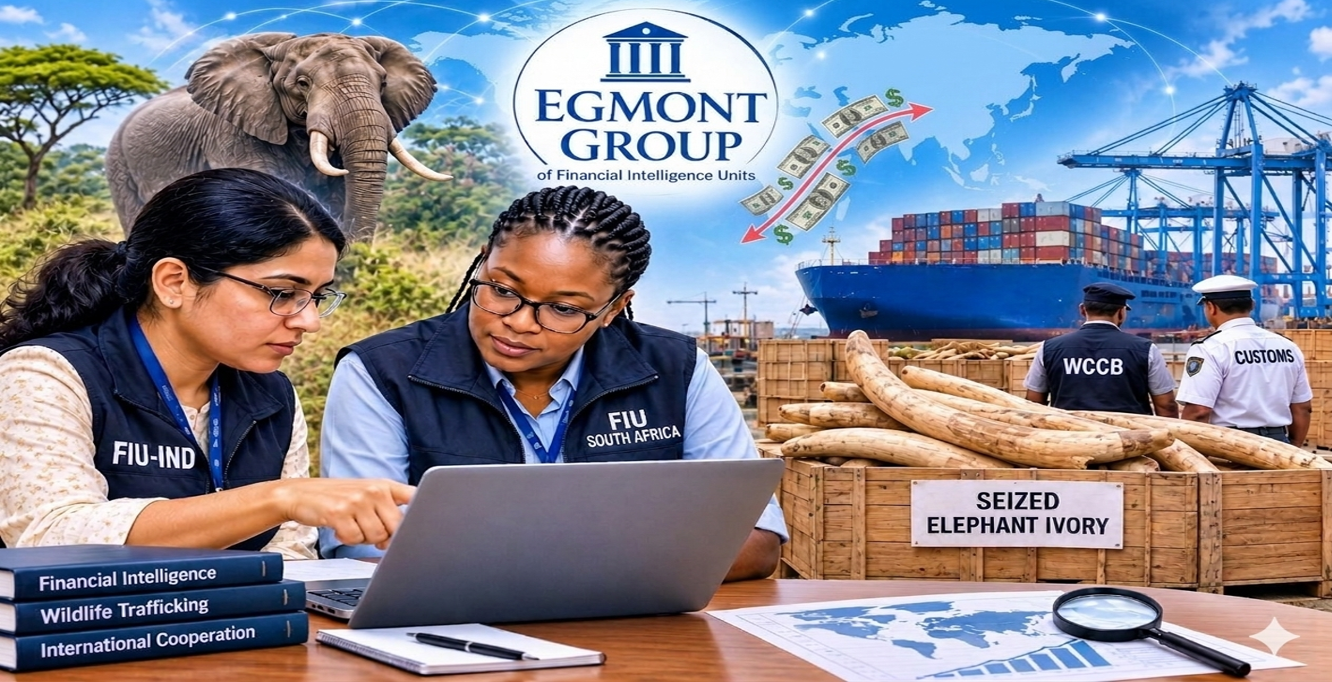
Illegal Wildlife Trade (IWT), has evolved from localized poaching into a highly organized, low-risk, high-profit global enterprise generating an estimated $7 billion to $23 billion annually. Organised Crime Groups (OCGs) leverage sophisticated corporate structures, trade-based money laundering (TBML), shell/front companies, digital finance platforms, and corruption to move poached flora and fauna alongside their illicit proceeds across international borders. For decades, traditional wildlife law enforcement focused primarily on seizure-based interdictions—intercepting ivory, pangolin scales, illegal timber or other wildlife contrabands at customs borders and arresting low-level couriers or poachers. However, seizure-based enforcement alone fails to disrupt the entire wildlife trafficking supply-chain.
Combating money laundering associated with wildlife trafficking is the cornerstone of a holistic wildlife law enforcement strategy. Financial investigations follow the money trail, map transnational criminal networks, identify underlying assets, and secure asset forfeiture—effectively dismantling the economic engine of wildlife syndicates. Central to this financial intelligence architecture is the Egmont Group of Financial Intelligence Units. It serves as the global operational hub for intelligence sharing among national FIUs.

The Egmont Group of Financial Intelligence Units: This Group was formed in 1995 at the Egmont Palace in Brussels. Egmont itself counts 13 founding FIUs. At its 32nd Plenary in Baku (5–10 July 2026) it admitted the FIUs of the Democratic Republic of the Congo, Eswatini, Madagascar and Rwanda, bringing membership to 186. Its Secretariat is based in Canada. The Group operates through regional groups and specialised working groups, enabling member FIUs to cooperate on operational, technical and policy matters.
Its four principal working groups are:
- Information Exchange Working Group (IEWG): Facilitates international information exchange and addresses operational cooperation challenges.
- Membership, Support and Compliance Working Group (MSCWG): Deals with membership requirements, compliance and member support.
- Policy and Procedures Working Group (PPWG): Develops policies, procedures and operational principles.
- Technical Assistance and Training Working Group (TATWG): Supports training, technical assistance and professional development.
The Egmont Centre of FIU Excellence and Leadership (ECOFEL) is another important institutional component, particularly for capacity-building and the development of FIU expertise.
How the Egmont Group Contributes to Combating Wildlife Trafficking:
The Egmont Group provides a platform for member FIUs to securely exchange expertise and financial intelligence to combat money laundering, terrorist financing, and associated predicate offenses—including environmental and wildlife crimes:
- Exchange of Cross-Border Financial Intelligence: The most important operational instrument is the Egmont Secure Web (ESW). It provides a secure communication platform through which member FIUs can exchange financial intelligence.
Consider a hypothetical wildlife trafficking investigation: Indian Customs authorities seize ivory concealed in an export consignment. Investigation identifies an Indian exporter, a foreign consignee and suspicious payments routed through bank accounts in two additional countries. The investigating agency can approach FIU-IND, which may analyse the domestic financial information and seek relevant intelligence from counterpart FIUs through the Egmont network. Such information may help establish: the identity of foreign account holders, financial relationships between suspected wildlife traffickers, transactions involving associated companies, overseas beneficiaries of suspicious payments, links between the suspected network and other financial investigations. This information can provide valuable investigative leads and help identify assets requiring action by competent customs/wildlife & anti-money laundering authorities.
- Development of Typologies and Red Flags of Wildlife Trafficking: The Group develops and distributes indicators of suspicious activity, including unusual cash-intensive trade, mismatched invoices, third-party payments, use of shell/front companies, rapid movement of funds and links between wildlife trafficking and high-risk jurisdictions.
- Capacity-building through ECOFEL: ECOFEL has an important role in developing the capability of FIUs to identify and analyse financial flows associated with wildlife crime. Its January 2021 publication, Financial Investigations into Wildlife Crime, is particularly relevant to wildlife enforcement agencies. The publication discusses financial investigation methodologies, international cooperation, suspicious financial activity, institutional challenges and recommendations for strengthening investigations.
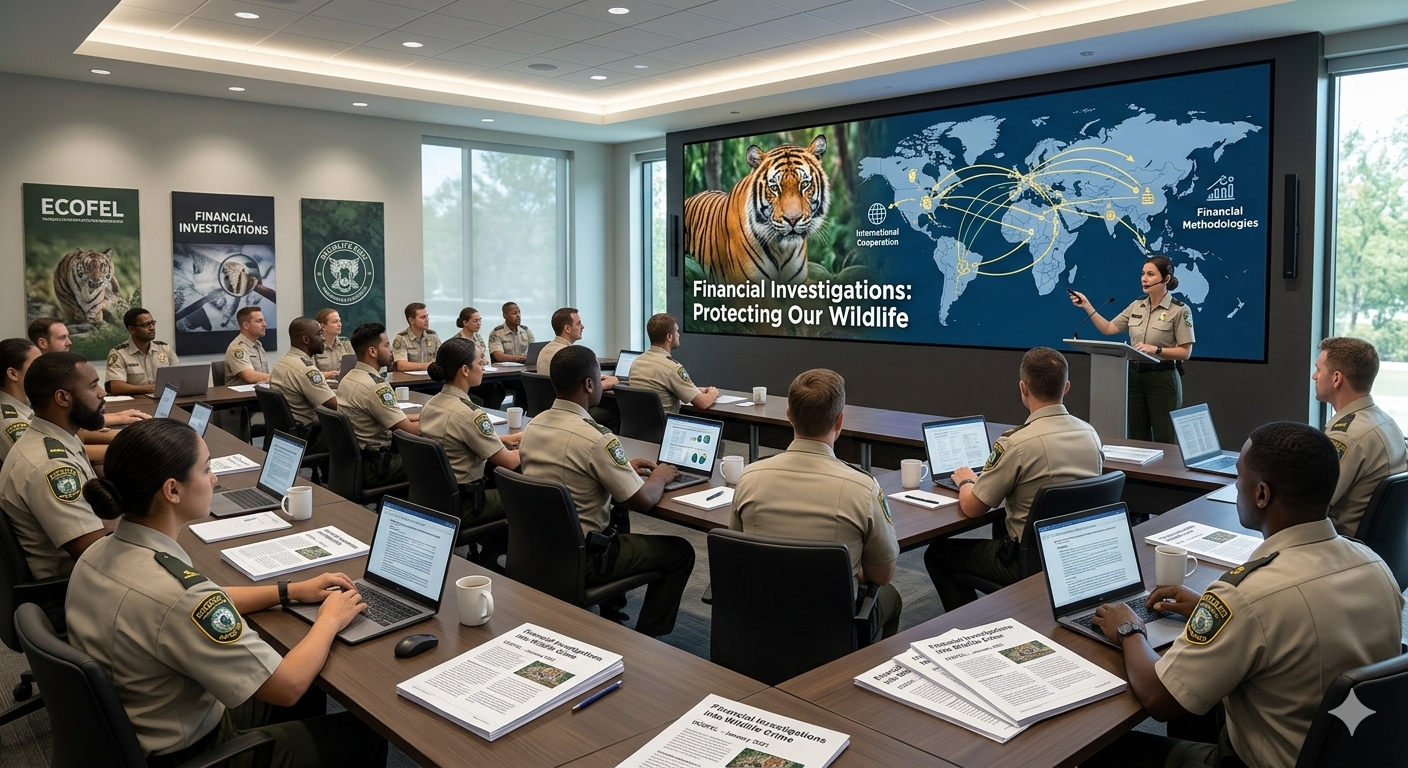
- Promoting Public-Private Partnerships: Financial institutions are often the first entities capable of detecting unusual financial activity associated with wildlife trafficking. Banks, payment service providers, money-transfer operators and other reporting entities can identify suspicious transactions and submit relevant reports to their FIUs. Recognising this importance, ECOFEL organised a virtual workshop on Public-Private Partnership on Financial Investigations into Wildlife Crime on 10 March 2021. More than 370 professionals from 62 countries, including FIUs, law enforcement agencies, international organisations, banks and other reporting entities, participated. The workshop addressed successful public-private partnerships, information-sharing mechanisms and practical approaches to financial investigations into wildlife crime.
- Operational Products: The Information Exchange Working Group's Environmental Crimes Bulletin: Illegal Wildlife Trade – Rhino (June 2026), draws on South African experience. Its red flags include casino use, small aggregated cash deposits across branches, personal accounts used for business, rapid disposal of funds, attorney trust accounts, and mobile money at the lower end of the chain.
- Where FIUs Started & their Progress: In ECOFEL's 2020 survey only 22% of FIUs had conducted or joined parallel wildlife financial investigations, and only 13% of 78 reviewed national risk assessments mentioned wildlife crime. In Egmont's 2025 survey 57% of respondents said environmental crime featured in their risk assessment. This indicates progress.
For a wildlife crime investigator, the value is straightforward: a seized consignment may reveal what was trafficked, but financial intelligence can reveal who paid, who benefited, where the money went and which apparently lawful businesses facilitated the trade.
Real-World Examples of Effective Use of Financial Intelligence to Combat Wildlife Crime:
Some real world examples showing effectiveness of harnessing of financial intelligence to combat wildlife trafficking are discussed below:
- South Africa: Rhino-Horn Trafficking and Corruption: South Africa’s Financial Intelligence Centre (FIC) used financial intelligence, alongside other investigative techniques, to help dismantle a rhino-horn poaching ring. This example illustrates why financial investigation is indispensable in wildlife enforcement. Poaching is often portrayed as a local crime, but the money trail can expose protection networks, corrupt facilitators, brokers and laundering structures that ordinary patrols cannot reach.
- Thailand: Tiger Zoo as a Trafficking Front: Egmont’s ECOFEL report also records a Thai “Tiger Zoo Operation” in which authorities found that a zoo had been used as a front for a wildlife-trafficking network dealing in endangered species and products including tigers, pangolins and ivory. Thailand’s Anti-Money Laundering Office (AMLO) used access to more than 18 government databases to trace financial transfers, cross-border movements and asset purchases connected with the network. The case demonstrates that a zoo, breeding facility or exotic-animal business may appear lawful on paper while functioning as a laundering and trafficking platform.
- Côte d’Ivoire: From Wildlife Case to Laundering Network: One of the documented examples involves Côte d’Ivoire’s FIU, the National Financial Information Processing Unit (CENTIF-CI). An operation against organised wildlife crime expanded into a full money-laundering and international organised-crime investigation. The case involved several investigative units and foreign FIUs. It identified actors across a national criminal chain and resulted in arrests, asset seizures and criminal convictions. CENTIF-CI subsequently emphasised the importance of collaboration among anti-money-laundering authorities, coordination of domestic and international information, public-private cooperation, and the contribution of the NGO EAGLE.
Limitations and Challenges Facing the Egmont Group:
Despite its considerable potential, the Egmont Group faces certain institutional, operational and geographical limitations that affect its effectiveness in combating wildlife trafficking.
- Mainland China is not a member of the Egmont Group: The most significant operational gap in the Egmont architecture regarding wildlife trafficking is that mainland China is not a member of the Egmont Group. Mainland China remains one of the world's largest destination and processing markets for illegal wildlife products, including ivory, pangolin scales, rhino horn, and rosewood. China's primary financial intelligence unit—the China Anti-Money Laundering Monitoring and Analysis Centre (CAMLMAC), operated under the People's Bank of China (PBC)—has not joined the Egmont Group. Special Administrative Regions Hong Kong [JFIU] and Macau [GIF] are independent members of the Egmont Group, but their operational scope is legally restricted to their respective territories. It has an operational impact on wildlife law enforcement. For example, when law enforcement in a source nation (e.g., in East Africa or Latin America) traces illicit financial flows heading toward Mainland Chinese bank accounts or payment platforms (e.g., Alipay, WeChat Pay), they cannot utilize the rapid, informal ESW network to query CAMLMAC. In such a scenario investigators will have to rely on formal Mutual Legal Assistance Treaties (MLATs), or bilateral Memoranda of Understanding between FIUs (such as the FinCEN-CAMLMAC MOU). These formal legal channels are often slow, requiring months or years to process—during which time criminal syndicates move or liquidate illicit assets.
- Varied FIU Capacities: FIUs in biodiversity-rich, developing nations often suffer from understaffing, lack of specialized financial intelligence software, and limited training in wildlife crime typologies/risk indicators.
- Informal Value Transfer Systems (IVTS)/ Unhosted Cryptocurrency Wallets: Wildlife syndicates frequently utilize informal remittance systems (such as Hawala, Fei Chien, or cash-in-transit networks) and unhosted cryptocurrency wallets, which bypass standard bank reporting mechanisms and present tracking challenges for FIUs.
- Inter-Agency Disconnect: In many member states, national law enforcement agencies (e.g., Forest Departments, Customs, Wildlife Enforcement Units) lack institutional gateways to seamlessly request or receive financial intelligence packages from their national FIUs.
- Limited Prioritisation of Wildlife Crime by FIUs: Not all FIUs treat wildlife trafficking as a significant financial crime risk. Some jurisdictions may have limited awareness of the connection between wildlife trafficking and money laundering. Consequently, suspicious transactions associated with wildlife trade may not receive adequate attention.
- Absence of Direct Investigative and Enforcement Powers: The Egmont Group cannot independently investigate wildlife trafficking syndicates or freeze/confiscate criminal assets or arrest suspected traffickers or initiate criminal/prosecutorial proceedings. These functions remain within the jurisdiction of competent national authorities
- Different National Laws and Information-Sharing Restrictions: FIUs operate under different national legislative frameworks. Differences in confidentiality requirements, permissible uses of financial intelligence, data protection provisions and restrictions on sharing information relating to predicate offences may affect cooperation.
Way Forward: Making the Egmont Group More Effective Against Wildlife Trafficking:
To bridge operational gaps and maximize the impact of the Egmont Group in dismantling transnational wildlife crime syndicates, the following strategic measures should be implemented:
- Treating Wildlife Trafficking as a Financial Crime Priority: First, every jurisdiction should expressly designate wildlife trafficking and related environmental offences as money-laundering predicates. This enables FIUs to receive, analyse and disseminate intelligence on laundering the proceeds of wildlife crime.
- Development of a Global Wildlife Financial Intelligence Database by EGMONT Group: It may include : Known financial accounts and transaction patterns associated with wildlife trafficking, suspicious company structures, common trade-based money-laundering techniques, identified high-risk commercial sectors, emerging payment methods, financial red flags associated with particular wildlife commodities etc. Such a resource would help FIUs identify similarities between investigations conducted in different jurisdictions.
- Establishing Alternative Bilateral Financial Intelligence Bridges with Non-Egmont FIUs: Until systemic membership barriers are resolved, Egmont member FIUs must establish robust bilateral MOUs with CAMLMAC (China) and other non-member FIUs. Establishing dedicated environmental/wildife crime communication protocols between host FIUs and Chinese/Non-Menber FIUs will expedite intelligence sharing outside the ESW framework.
- Deployment of Advanced Financial Intelligence Analytical Tools: FIUs must invest in advanced financial intelligence analytical tools & artificial intelligence (AI), and machine learning (ML) models trained to detect trade anomalies, shell company clusters, and crypto-asset flows associated with illegal wildlife trade.
- Institutionalized Inter-Agency Financial-Wildlife Enforcement Taskforces: Wildlife authorities, customs, police, financial-intelligence units, tax authorities, prosecutors and CITES management authorities should operate through institutionalize inter-agency financial-wildlife enforcement taskforces. It will ensure automatic financial profiling/financial investigation of high-value wildlife seizures parallelly with wildlife crime investigation resulting into successful prosecution of wildlife traffickers and forfeiture of proceeds of wildlife crimes.

- Improving Public-Private Partnerships: Banks and other financial institutions should receive specialised training to recognise wildlife-related suspicious financial activity. The Egmont Group should continue supporting cooperation between FIUs, banking associations, payment service providers, wildlife enforcement agencies and international conservation organisations. Financial institutions should be encouraged to identify suspicious patterns such as: unexplained cash deposits by businesses operating near wildlife trafficking hotspots, transactions inconsistent with the declared business activities of import-export companies, repeated payments to individuals or entities connected with wildlife seizures unusual international transfers involving wildlife trading intermediaries, significant purchases of luxury assets by individuals whose declared income cannot reasonably explain their wealth etc. These indicators should be treated as grounds for further examination, not automatic proof of criminality.
Conclusions:
From a wildlife-law-enforcement perspective, the Egmont Group occupies a distinctive position: it does not replace rangers, investigators, customs officers or prosecutors, but it gives them a global financial-intelligence network. Its bulletins, ECOFEL training, secure exchange mechanisms and case-based typologies help enforcement agencies move beyond low-level seizures and target the financiers, facilitators and laundering structures that make wildlife trafficking profitable.
A holistic wildlife-enforcement strategy must therefore protect species in the field, intercept consignments at borders, prosecute offenders in court—and, just as importantly, make the money trail impossible to hide.
Key Sources Referred to in this Post:
Egmont Group: 2026 Plenary Co-Chairs' Statement (Baku); Annual Reports 2014–15 to 2024–25; The Role of FIUs in Fighting Environmental Crimes – Public Summary (July 2025); IEWG Environmental Crimes Bulletin: Illegal Wildlife Trade – Rhino (June 2026); news item on the United for Wildlife Global Summit (November 2025). ECOFEL, Financial Investigations into Wildlife Crime (2021). FATF, Money Laundering and the Illegal Wildlife Trade (2020); FATF, Mutual Evaluation of China (2019) and follow-up reports (2020–21). South Africa FIC, Financial Flows Associated with Illegal Wildlife Trade, BEST EGMONT CASES: Financial Analysis Cases 2014–2020.