The Red-Eared Slider Turtle Smuggling: A Wildlife Enforcement and Biosecurity Challenge
Introduction:
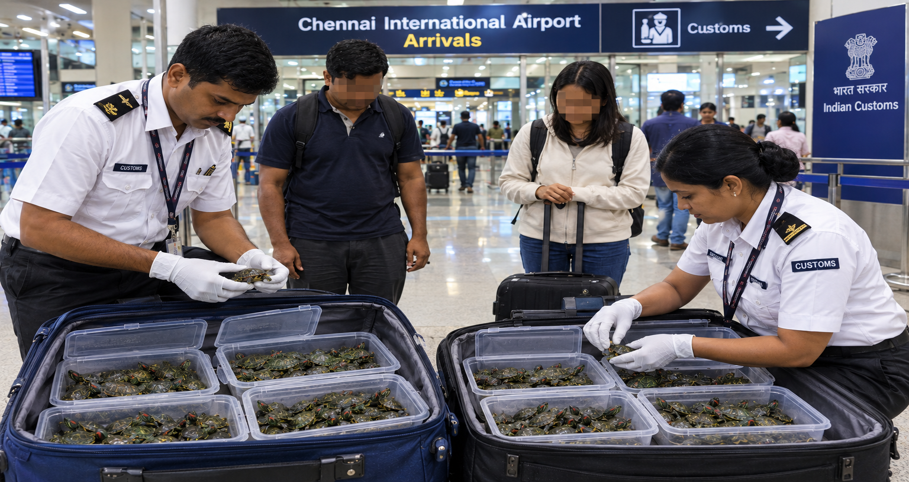
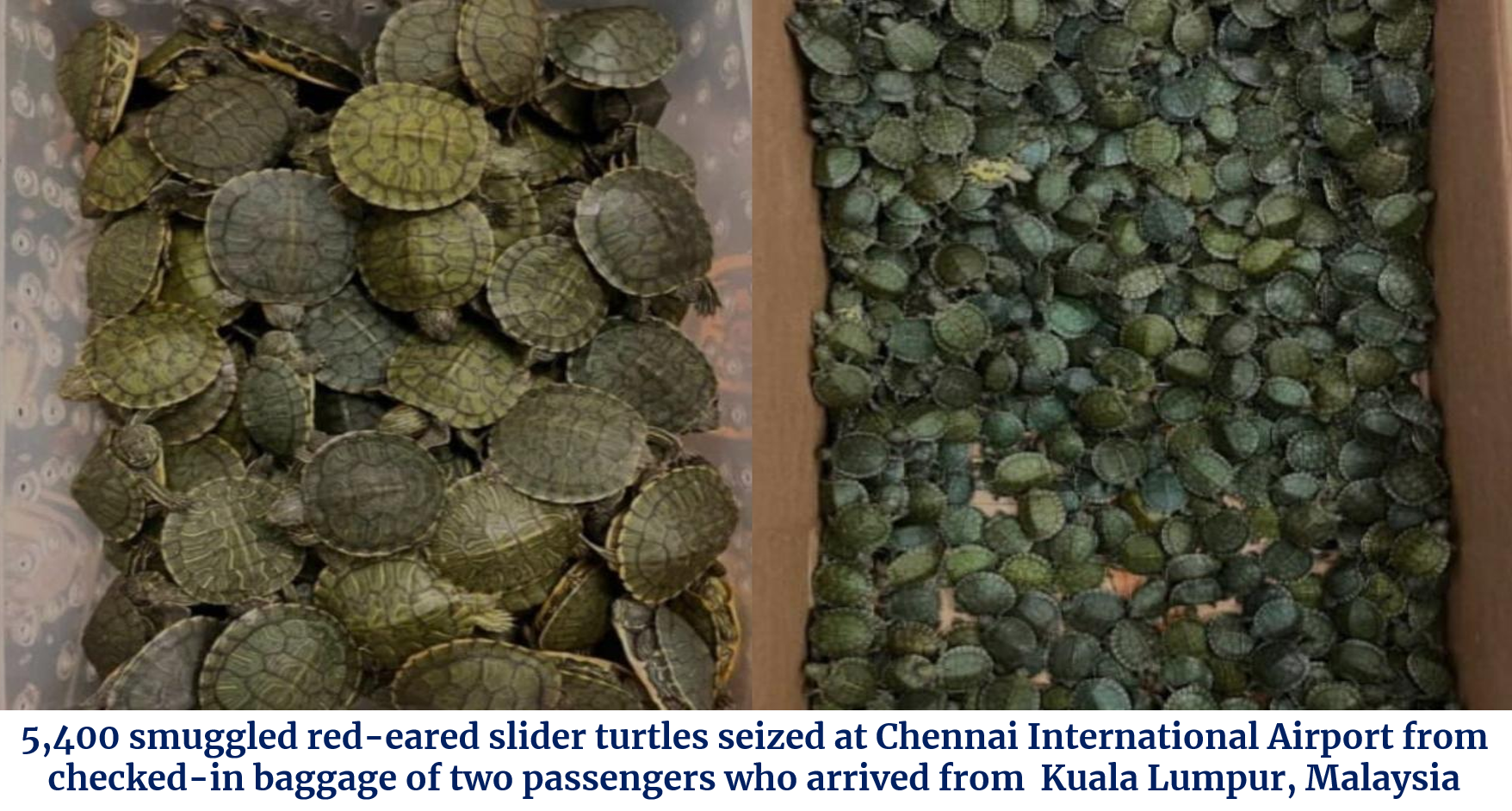
The Red-eared slider turtle (Trachemys scripta elegans), readily identifiable by the distinct red or orange stripes behind its eyes, is globally recognized by the International Union for Conservation of Nature (IUCN) as one of the world's 100 worst invasive alien species. Its appeal as a cheap, hardy, attractive pet has created a large legal and illegal supply chain. For India, that chain increasingly manifests as air-transport smuggling of hatchlings from Southeast Asia and China into airports such as Chennai, Bengaluru and Mumbai.
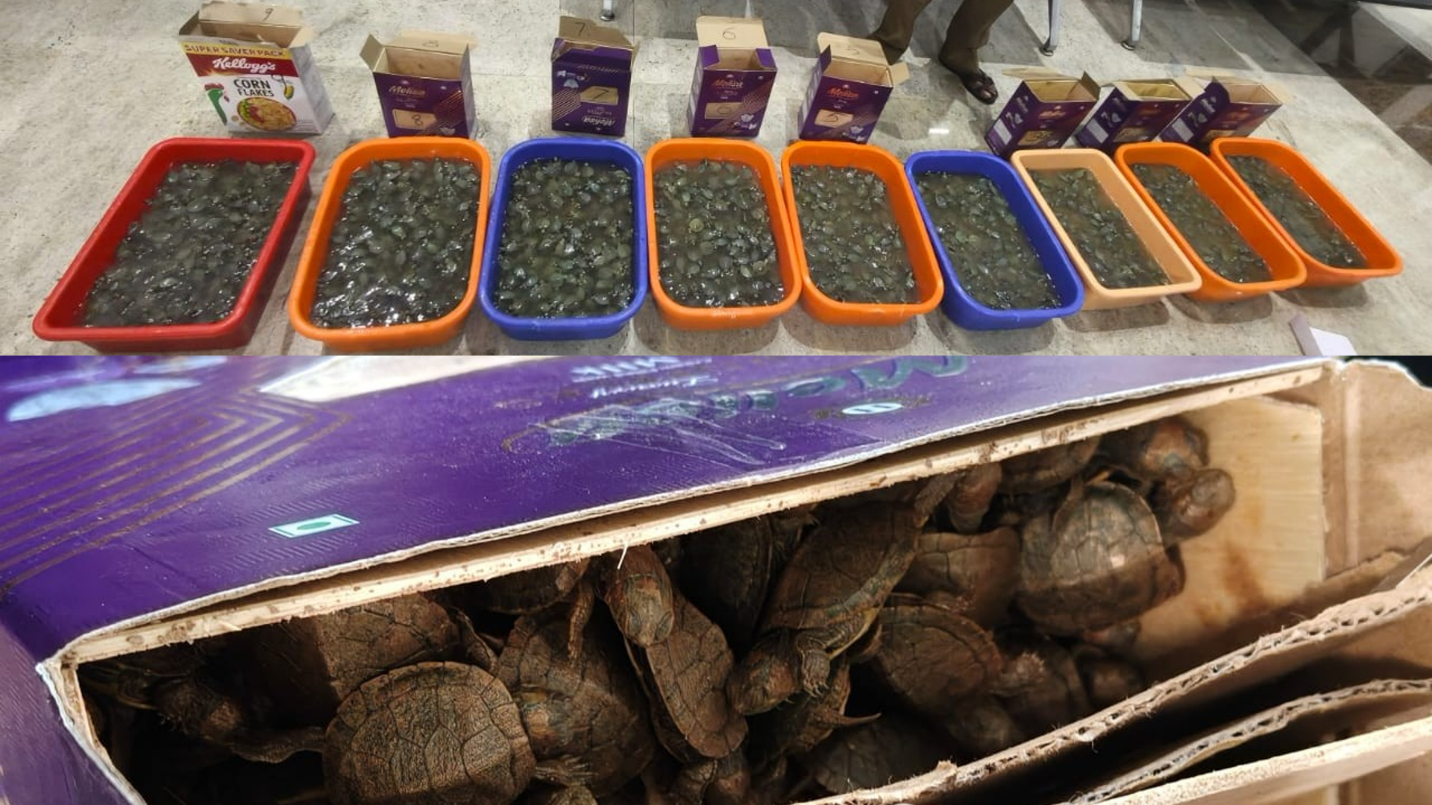
Airport seizures have repeatedly exposed attempts to bring thousands of live red-eared sliders into the country. These smuggling incidents reveal an organised commercial activity involving overseas sourcing, passenger baggage/cargo, transit routes, domestic traffickers and prospective buyers.
For enforcement agencies, the central challenge is therefore twofold: detecting and disrupting the illegal movement of live animals across international borders, and preventing imported turtles from entering domestic pet markets or being released into Indian water bodies. Effective action requires coordinated intelligence, lawful import controls, airport screening, airline cooperation, species identification & investigation of the downstream trade.
Natural Habitat:
The red-eared slider is a freshwater turtle native to the Mississippi River basin and adjacent parts of the south-central United States and northeastern Mexico. Its indigenous range extends from the Midwest eastwards to West Virginia, westwards to eastern New Mexico, and southwards across the Rio Grande into northeastern Mexico.
In its native range, it occupies rivers, streams, lakes, ponds, swamps, marshes and backwaters, especially quiet, slow-moving waters with soft bottoms, abundant aquatic vegetation and exposed basking sites such as logs and rocks. It is highly adaptable and can also survive in ditches, canals, park ponds and even brackish water—traits that greatly assist its establishment after release or escape in foreign environments.
Highly Invasive Species:
The species is on the "100 of the World's Worst Invasive Alien Species" list of the Global Invasive Species Database (GISD), which is maintained under IUCN's Invasive Species Specialist Group. On the IUCN Red List itself, however, it is classed as 'Least Concern'. The two statuses are not contradictory. The species is abundant at home and damaging abroad.
Field and experimental studies show that being an invasive species, it can reduce growth and condition of native turtles through competition for limited food. Once introduced into foreign water bodies, read-eared slider turtles compete for food, basking sites and nesting areas. In Europe, they have been associated with declines in the native European pond turtle, while in North America they compete with species including painted turtles, map turtles and Blanding’s turtle.
Captive Breeding Dynamics:
The pet trade is the principal reason for the species’ global spread. Since the 1970s, large numbers of red-eared sliders have been produced on turtle farms, particularly in the United States, for sale as hatchlings. The turtle farming and breeding operations have also developed in Asian countries including China, Thailand, Indonesia and Malaysia.
Captive breeding is a significant part of the enforcement picture for the following reasons.
- First, large quantities can be supplied commercially. A shipment containing thousands of small turtles is consistent with a high-volume pet-trade business model.
- Second, the size and appearance of hatchlings facilitate concealment. Small turtles can be packed into compact containers, making it possible to move large numbers in passenger baggage/cargo.
International & Indian Legal Framework:
The Red-eared slider turtle is classified as a species of "Least Concern" by the IUCN and is not listed under any CITES Appendices. This species is also not enlisted in any of the Schedules of Wild Life (Protection) Act, 1972 of India. Therefore, its import in India is regulated by the Foreign Trade Policy of India which inter-alia requires No-Objection Certificate form Chief Wildlife Warden of the concerned State, DGFT (Directorate General of Foreign Trade) License for import of red-eared slider turtles. Being a highly invasive species, as there is no likelihood of getting these NOC/License by the importers, they resort to smuggling of these turtles.
Section 62A of Wild Life (Protection) Act of India and Invasive Alien Species:
Section 62A of the Wild Life (Protection) Act, 1972 empowers the Central Government, by Notification, to regulate or prohibit the import, trade, possession or proliferation of invasive alien species that pose a threat to wildlife or habitats in India. It also provides for authorised seizure and disposal of species covered by such Notifications.
Source Markets, Transit Hubs, and Destination Networks:
The global legal supply has historically been dominated by captive-breeding farms in the United States, especially for hatchlings exported to Asian, European and Latin American markets. For smuggling into India, source markets are primary commercial breeding pools originating in Southeast Asian nations, prominently Thailand, Malaysia, Indonesia, and China. To evade targeted profiling by Indian customs intelligence at direct gateways, smugglers frequently follow circuitous transit routes employing convoluted, multi-leg itineraries. Couriers fly out of primary hubs like Bangkok or Guangzhou, transiting through secondary regional airports such as Kuala Lumpur, Singapore, or Colombo, before boarding flights bound for Indian destinations. Major international airports in India—including Chennai, Bengaluru, Mumbai, Kolkata, Trichy, Madurai and Coimbatore—frequently report massive multi-thousand-turtle seizures. From these entry points, the live specimens are rapidly redistributed via domestic courier networks to pet markets across various States.
Concealment Methods:
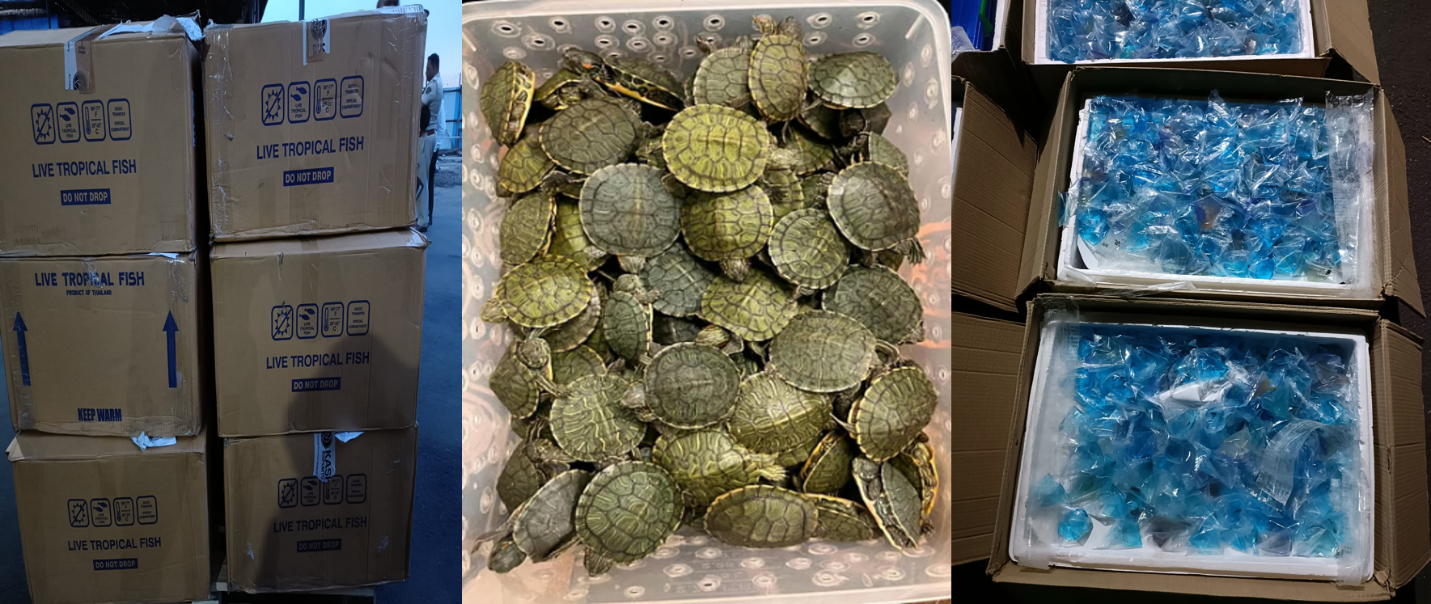
- By misdeclaring & concealing them in air cargo consignments of ornamental fishes.
- Checked-in-baggage has been a recurring concealment method in major seizures. Thousands of small turtles can be packed into plastic containers and placed in suitcases, sometimes with ventilation holes.
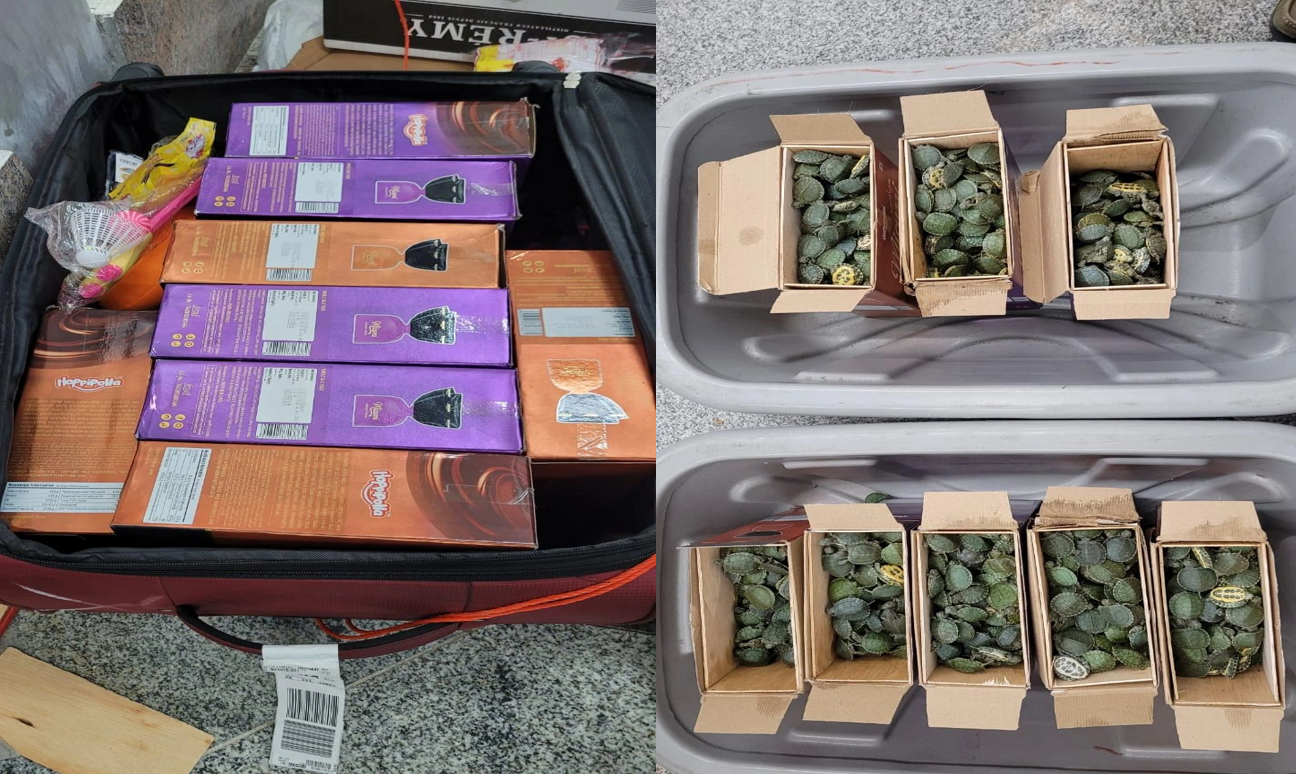
- Smugglers frequently hide these turtles inside food containers like cookie packets, chocolate boxes, and cereal boxes.
- Smugglers also resort to leaving their checked-in baggage at the airport as unclaimed at the time of arrival and exit the airport empty-handed to avoid immediate arrest. The network then attempts to retrieve the "lost" baggage later with the help of corrupt airport officials.
Fragmented Chain of Supply:
To ensure that the organized smuggling of red-eared slider turtles continues even if some of the consignmnets are caught by the Customs authorities, these smugglers often deploy a fragmented chain of supply:
- They deploy multiple couriers for this purpose who don’t know each other.
- These couriers are offered free to and fro air tickets to the source countries with two-three days stay and tourism incentives in these countries to lure them to serve as couriers.
- The person who procures these turtles in source countries, the person who hands over these turtles to the couriers, the person who collects these smuggled turtles from the couriers outside the Indian Airports are generally not known to each other. They are coordinated by the masterminds using encrypted messagaing apps sharing the photos of the individuals in the supply chain, consignmnets of turtles and landmarks where they can meet and hand-over/take-over such consignments. This fragmented supply chain makes it harder for the enforcement authorities to bust the entire network.
Need for Integrated Enforcement Strategy:
Airport seizures alone cannot eliminate the illegal trade. An effective strategy must combine border interception, intelligence-led investigation, market disruption and demand reduction. Integrated Enforcement Strategy may inter-alia include the following:
- Risk-based Passenger Profiling: Focus attention on travellers arriving from known source and transit hubs, especially those with unusual itineraries, last-minute ticket purchases, multiple stopovers or connections through wildlife-trafficking hotspots.
- Trained Wildlife Sniffer Dogs: Trained wildlife sniffer dogs should be widely deployed at airports/air cargo terminals to detect smuggling of this species.
- Baggage Screening Protocols: Artificial Intelligence trained Wildlife Detection Models must be embedded in Baggage/Air Consignments Screening Machines to red-flag baggages/consignments that may have wildlife concealed inside them.
- Cabin and Ground-Staff Reporting: Adequate training to check-in, security, cabin and ramp staff to report unusual noises, smells, leaking fluids, concealed containers or passengers showing avoidance behaviour may also help customs/enforcement authorities in detecting and seizing such smuggled species.
- Risk-based Cargo Controls: Enhanced scrutiny to shipments labelled as ornamental fish, reptile feed, aquarium supplies or general cargo where documentation, packaging or routing is inconsistent may also prove an effective enforcement strategy to combat smuggling of this species.
- Data Sharing: Regular sharing of seizure patterns, concealment techniques, routes intelligence and suspicious-shipment indicators between Customs, the Directorate of Revenue Intelligence, airport security, wildlife crime enforcement authorities and between enforcement authorities of source, transit and destination countries will prove very effective in countering this menace.
- Enabling Legal Provisions: There is an urgent requirement of enabling provisions in wildlife protection laws of countries which make exporting of a wildlife species prohibited/restricted to a country where import of a particular wildlife species is restricted/prohibited even if that particular species is freely allowed to be exported from that source country. In such cases export must be allowed by the source country only if the legal compliance requirements for import are fulfilled by the passenger/importer of the destination country.
- Demand Reduction: Enforcement should be paired with public communication that red-eared sliders are not harmless pets. Awareness campaigns should target pet shops, breeders, online sellers, schools and buyers explaining both the ecological damage and the legal consequences of unauthorized possession, sale or transport of this species.
- Animal Welfare and Repatriation: Seized live turtles create an immediate animal-welfare challenge. Authorities should arrange suitable temporary containment, ventilation, temperature control and veterinary assessment before repatriation of seized turtles. India's Aviation Regulator DGCA’s Operations Circular 02 of 2025, titled "Guidelines for Deportation of Live Animals Detected as Unbeknownst Imports," issued on July 23, 2025 addresses the deportation of live wildlife species brought into India without proper declaration or clearance. The Circular applies to aircraft operators and airlines and makes the airlines responsible for transporting the undeclared wildlife species for their immediate deportation in accordance with applicable governmental instructions. It further places the associated costs, including animal handling, in-transit welfare, documentation and repatriation logistics etc. upon the airline.
- Cross-Border Co-operation, Scientific Criminal & Financial Investigation: Cross-border co-operation among enforcement agencies of source-transit-destination countries in intelligence sharing and investigation is a must to dismantle the entire network. Such co-operation may be resorted to under bilateral customs mutual assistance agreements or under framework of global conventions such as the United Nations Convention against Transnational Organized Crime (UNTOC). Further scientific criminal & financial investigation may lead to busting & dismantling of the entire supply chain by bringing the traffickers to justice and by forfeiting the criminal proceeds generated from smuggling of these turtles.
Conclusion:
The red-eared slider turtle illustrates how the international pet trade can generate a wildlife-enforcement problem even when the traded species is not threatened with extinction. Commercial captive breeding, consumer demand and the rapid international air connectivity have enabled large consignments of these turtles to be smuggled through Indian Airports. Repeated seizures in Chennai, Bengaluru, Coimbatore, Trichy and Madurai demonstrate the importance of sustained vigilance and intelligence-led enforcement. The ecological concern is equally significant.
Ultimately, an effective enforcement strategy would require cross-border, intelligence sharing, airlines cooperation, airport detection, lawful investigation, domestic-market disruption and ecological prevention. The aim must not be simply to intercept individual suitcases containing live red-eared slider turtles but to disrupt the commercial chain that moves them, prevent their release into Indian ecosystems and ensure that the response protects both biodiversity and the species welfare.

I am an Indian Revenue Service (Customs & Indirect Taxes) officer with vast experience of law enforcement especially in tackling transnational smuggling including willdife trafficking. Also, as an expert I have been conducting sessions on various aspects of wildlife crimes and its convergence with other serious crimes, legal and enforcement framework to counter it, wildlife cyber crime, OSINT for combating wildlife crime, combating money laundering associated with wildlife crime, CITES, role of Customs in tackling the menace of wildlife crime, Digital Forensics etc. for forest, police, customs and other enforcement agencies' officials.