The Budapest Convention on Cybercrime: Strengthening International Cooperation Against Wildlife Trafficking


Introduction:
Wildlife criminals increasingly exploit digital infrastructure: social-media, e-commerce platforms, messaging applications, encrypted e-mail communications, cryptocurrency payments, virtual private networks, digital community forums and darknet marketplaces. These technologies enable traffickers to advertise protected species and their derivatives, identify buyers, negotiate transactions, coordinate cross-border shipments, conceal identities, transfer proceeds and communicate with criminal associates. Digital platforms are also used to monetise content depicting illegal hunting, animal cruelty and the exploitation of protected wildlife.
For investigators, this creates a transnational evidentiary problem: wildlife traffickers may post an advertisement in one country, communicate through a messaging service hosted elsewhere, their communications may pass through servers in multiple jurisdictions, receive crypto-assets through foreign exchanges, and some of them may also operate from countries different from those in which the wildlife poaching, illegal export-import occurred.
Consequently, a wildlife investigator may need to obtain subscriber information, preserve electronic communications, secure internet traffic records, identify IP addresses, trace online accounts and obtain evidence stored outside the investigating country's territory. Traditional wildlife-enforcement cooperation remains essential, but it must now be paired with rapid procedures for preserving and obtaining electronic evidence because digital data is volatile and easily deleted and traditional, slow-moving diplomatic channels are frequently inadequate on their own.
The Budapest Convention in Brief:
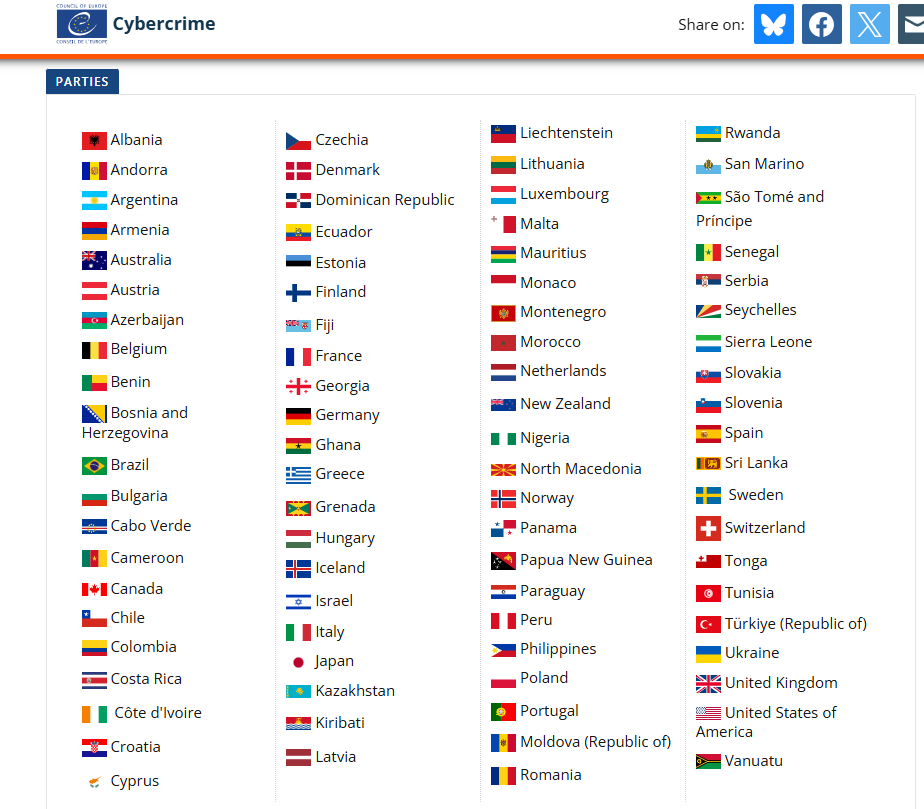
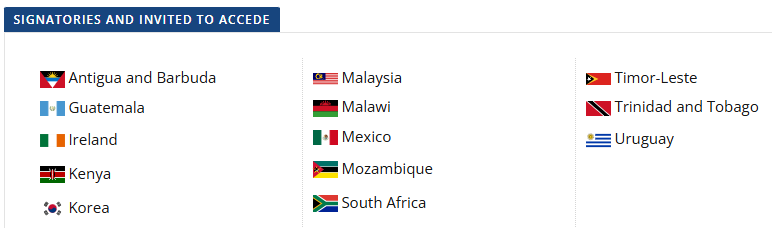
Adopted by the Council of Europe on 23 November 2001 and entering into force on 1 July 2004, the Convention on Cybercrime—commonly known as the Budapest Convention—is the first binding international treaty addressing crimes committed via the internet and computer networks. Despite originating within the Council of Europe, the treaty is open to accession by any state worldwide under Article 37. Following the accession of Kazakhstan in October 2026, the Convention comprises 84 Contracting Parties across Europe, the Americas, Africa, Asia, and Oceania.
The Convention has three core functions:
- It requires Parties to criminalise specified cyber offences.
- It requires procedural powers to search and seize computer systems, preserve stored data, obtain traffic data, compel production of subscriber information, and conduct real-time collection of traffic data, subject to domestic legal safeguards.
- It establishes a framework for international cooperation, including a 24/7 contact-point network, mutual legal assistance, and expedited preservation of electronic evidence.
Importantly, the Convention is not limited to “pure” cyber offences. In 2023, the T-CY confirmed that its procedural powers and cross-border cooperation tools apply to electronic evidence of any criminal offence, not only offences committed against or through computer systems. The most significant provision for wildlife crime investigators is Article 14(2)(c). It expressly extends the Convention's procedural powers to the collection of evidence in electronic form relating to a criminal offence. Thus, a wildlife trafficking investigation involving an offence under domestic wildlife legislation can benefit from the Convention even when the offence is not itself a computer-related crime.
The 24/7 Network: A Critical Operational Mechanism:
One of the Convention's most useful features is the establishment of a network of designated National Contact Points available 24 hours a day, seven days a week, under Article 35. The purpose is to ensure immediate assistance in investigations involving computer systems, computer data and electronic evidence. For a wildlife investigator, this mechanism is particularly important because digital evidence is often volatile. Social media accounts can be deleted, messages can disappear, online advertisements can be removed and service-provider retention periods may be limited. An investigator should therefore seek preservation assistance as soon as a electronic record held in foreign jurisdiction becomes relevant, rather than waiting until the entire investigation is complete.
Second Additional Protocol: Strengthening Cross-Border Electronic Evidence Cooperation:
Budapest Convention is supplemented by two additional protocols:
- First Additional Protocol: It is aimed at criminalizing acts of a racist and xenophobic nature committed through computer systems.
- Second Additional Protocol: The Second Additional Protocol to the Budapest Convention, formally titled the Protocol on Enhanced Co-operation and Disclosure of Electronic Evidence, seeks to address practical difficulties in obtaining electronic evidence from foreign service providers. Its important mechanisms include:
- Direct cooperation with service providers in other jurisdictions for obtaining subscriber information.
- Direct requests to domain-name registrars for domain-registration information.
- Improved government-to-government procedures for obtaining subscriber information and traffic data.
- Expedited cooperation in emergency situations.
- Joint investigation teams and joint investigations.
- Use of video conferencing taking testimony or statements.
These mechanisms could be particularly useful in wildlife trafficking investigations involving multiple jurisdictions.
Step-by-Step Guide for Wildlife Crime Investigator for Effective Utilization of Budapest Convention:
Consider this hypothetical case: A wildlife crime investigator finds a social-media account advertising elephant ivory and tiger bones. The seller uses an encrypted messaging application for communication/negotiation and accepts payment in cryptocurrency. For investigation of this case Budapest Convention may be utilized in following manner:
- Capturing & Documenting the Open-Source Evidence Immediately: The investigating authority must immediately capture & document the listing, profile, images, timestamps, usernames, payment instructions, wallet address, and any publicly visible communications using forensically sound methods.
- Identifying the Relevant Offences under the National Wildlife Protection Laws: These may include wildlife poaching, possession or sale of protected species/their body parts/derivatives, money laundering associated with wildlife crime, or use of a computer system to facilitate the wildlife crime.
- Issuing Domestic Preservation and Production Orders without Delay: The investigating authority must seek preservation of digital platform data, account records, messages, emails, IP logs, and payment-related records from domestic service providers before deletion or routine data-retention expiry period.
- Contacting the National 24/7 Cybercrime Point of Contact: If the cyber platform, email provider, registrar, crypto-exchange, or server is located in foreign territory, investigating authority should send an urgent request through their designated 24/7 Contact under Article 35, asking for preservation and, where lawful, disclosure of specified data. Avoiding vague requests and making a precise international request with specifics of the social media account, URL, transaction references, dates, data categories sought, legal basis, suspected wildlife offences, and the need for preservation increases the likelihood of prompt and lawful assistance.
- Using Mutual Legal Assistance for Content and Intrusive Evidence: The investigating authority must send a formal MLA request through their Central Authority for message content, stored device data, financial records, or evidence requiring a foreign judicial order. 24/7 Channel may be used for urgent preservation and operational coordination, while preserving chain of custody and admissibility requirements.
- Following the Money. Electronic evidence of money laundering falls within the Budapest Convention’s broad evidence-gathering scope. Details may be obtained from Crypto-Exchange or Virtual-Asset-Service-Provider/Mobile Payment Service Providers/other Digital Payment Service providers and suitable action may be taken for forfeiture of proceeds of wildlife crime and criminal proceedings under wildlife protection/anti-money laundering laws.
- Preserving Admissibility of the Evidence: Maintaining hash values, forensic images, access logs, legal authorizations, translation records, and a clear record of how each item was obtained and transferred i.e. Chain of Custody ensures that digital evidences gathered against the wildlife criminals are admissible in the court of law.
Limitations of the Budapest Convention in Wildlife Enforcement:
The Budapest Convention is valuable but it has its own limitations such as:
- Incomplete Global Coverage: While 84 states are Parties, several major wildlife source, transit, and demand countries (such as China, India, Russia, Indonesia, Viet Nam, and South Africa) are not Parties to the Budapest Convention. When servers or suspects reside in non-Party states, the Convention cannot be invoked.
- No Specialized Wildlife Mandate: The Convention does not require states to criminalize wildlife trafficking or monitor online marketplaces for illicit species trade. Enforcement depends entirely on domestic wildlife statutes meeting dual criminality standards.
- Capacity Gaps Persist: Wildlife agencies in many member states lack digital-forensics capability, cryptocurrency-analysis skills, secure evidence-handling systems, and trained personnel to prepare precise cross-border requests.
- Second Additional Protocol Not Yet in Force: The Second Additional Protocol offers important improvements, particularly in direct cooperation with service providers and emergency disclosure. However, it has only four ratifications so far and has not entered into force. This limits the immediate availability of its enhanced enabling mechanisms.
- MLA Bottlenecks for Content Data: While Article 29 preserves data quickly, obtaining actual content data (e.g., private encrypted messages) still requires formal MLA procedures (Article 31), which can take months—far slower than the rapid transit of wildlife contrabands and proceeds of crimes.
Way Forward:
Following measures may be implemented to make the Budapest Convention more effective for wildlife enforcement:
- Wildlife crime investigators must have access to National 24/7 Cybercrime Contact Points and understand when and how to use them.
- Wildlife-crime Units must be adequately trained in electronic-evidence preservation, open-source intelligence, online platform legal-process procedures, cryptocurrency tracing, and cross-border request drafting etc.
- Institutionalized mechanism for wildlife-cybercrime coordination between wildlife authorities, police, prosecutors, customs, and cybercrime authorities etc. must be put in place.
- Non-Party States must accede to and implement the Budapest Convention.
- States must also ratify the Second Additional Protocol, thereby gaining more effective tools for subscriber information, domain-registration data, emergency cooperation, and joint investigations.
- Standardized international request templates must be developed by the Convention Party States for wildlife cases, covering digital platform data, communications metadata, financial records, and preservation requests etc.
- Building secure information-sharing arrangements with social-media platforms, online marketplaces, payment service providers, registrars, and virtual-asset service providers, while maintaining due-process and privacy safeguards will further enhance the effectiveness of this Convention.
Bridging the Budapest and UN Conventions against Cybercrime for Wildlife Enforcement:
With the adoption of the United Nations Convention against Cybercrime (opened for signature in October 2025, which includes non-Budapest states such as India, Indonesia, China, and Viet Nam among its signatories), wildlife enforcement agencies should prepare to use both treaties complementarily—deploying the Budapest Convention for rapid cooperation among its 84 Parties while utilizing the UN Convention, as it enters into force, to close jurisdictional gaps in key wildlife source, transit and demand states.
Conclusion:
The digitalisation of wildlife crime requires moving beyond traditional investigative methods, as traffickers now operate through digital platforms located in multiple jurisdictions to advertise, sell, transport, and receive payments. The Budapest Convention offers an essential legal and operational framework to tackle this challenge by equipping authorities with cross-border tools—such as expedited preservation, production orders, and the 24/7 Network—to secure scattered electronic evidence . However, maximizing its impact depends on wider international participation, stronger technological capacity of wildlife crime investigators, effective domestic implementation, and the eventual enforcement of its Second Additional Protocol. Ultimately, integrating wildlife enforcement agencies into international cybercrime cooperation mechanisms is vital to ensure that digital borders do not become safe havens for traffickers.
Key Sources Referred to in this Post:
- Council of Europe – Convention on Cybercrime (CETS No. 185). Full text and explanatory report. Read the Convention and Explanatory Report.
- Council of Europe – Milestones of the Budapest Convention. Membership developments, including the 84th Party. Official membership and milestones.
- Council of Europe – Budapest Convention and its Protocols. Convention and Protocols.
- Council of Europe – Second Additional Protocol. Enhanced cooperation and disclosure of electronic evidence.
- Council of Europe – 24/7 Network. 24/7 Network and operational cooperation.
- Council of Europe – Competent Authorities under the Convention. International cooperation authorities.
- Eurojust – The Budapest Convention on Cybercrime and Cross-border Access to Electronic Evidence. Legal analysis of cross-border electronic evidence.
- Eurojust – Article 7 of the Second Additional Protocol. Direct cooperation for subscriber information.
- United Nations Treaty Collection – United Nations Convention against Cybercrime. Treaty status and participation.
- European Commission – Proposal COM(2026) 186. Third-country accession to the Budapest Convention.