Foreign Trade Policy as a Wildlife Enforcement Tool: Regulating India’s International Wildlife Trade
Introduction:
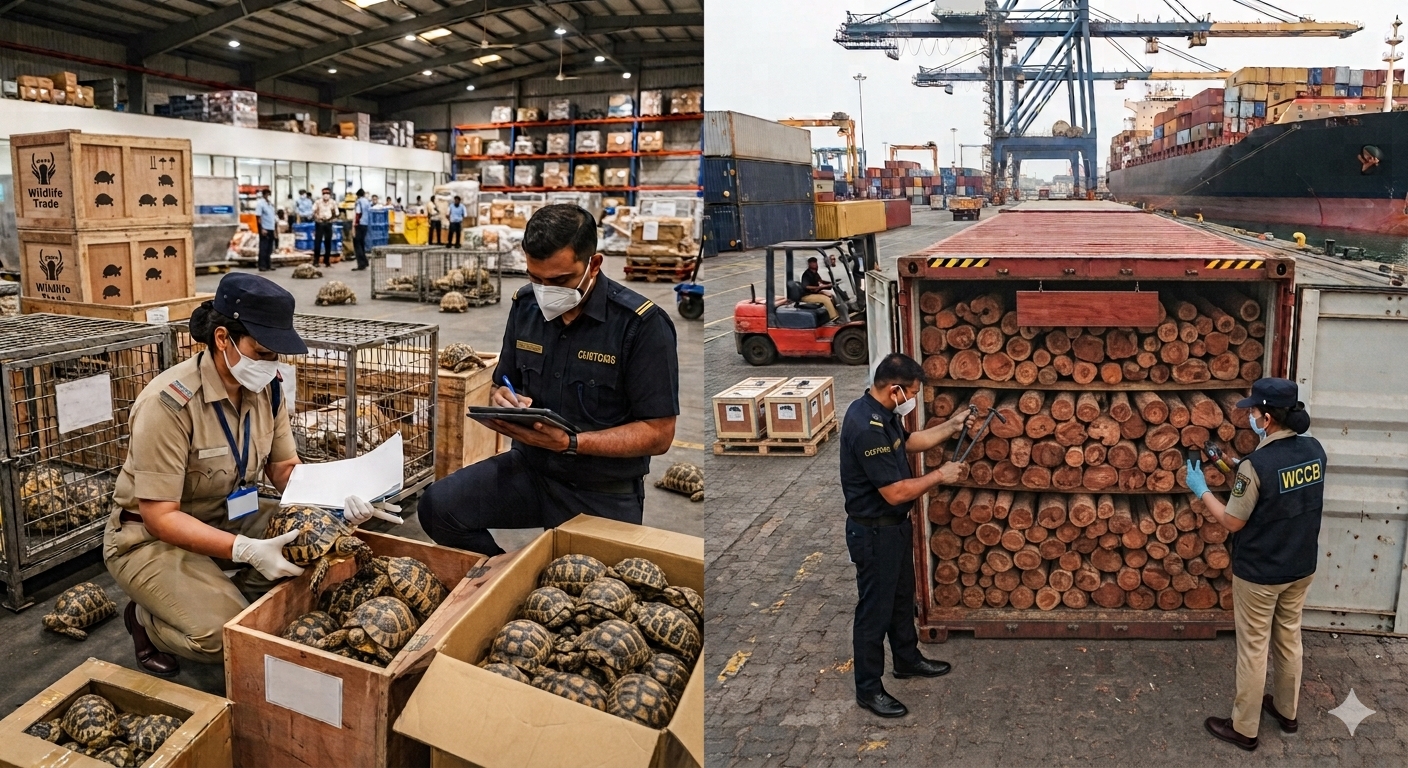
India’s Foreign Trade Policy (FTP) is a central trade-control instrument for wildlife movement across India’s borders. For an enforcement officer, its practical value is that it converts conservation restrictions into enforceable import/export policy through ITC(HS) classification, DGFT authorisations, CITES documentation, port controls, and Customs clearance procedures. The FTP does not replace the Wild Life (Protection) Act, 1972, CITES, quarantine law, or the Customs Act—it works alongside them, and a lawful shipment must comply with all applicable regimes.
The FTP is issued by the Ministry of Commerce and administered by the Directorate General of Foreign Trade (DGFT). Three features of FTP matter most to a wildlife law enforcement officer:
- Free unless regulated. Under Para 2.01, all imports and exports are "free" unless the ITC(HS) makes them "prohibited", "restricted" or canalised through State Trading Enterprises. Wildlife items are frequently concealed, misdescribed, under-valued, or classified under broad commercial descriptions such as “decorative article,” “medicine,” “traditional medicine ingredient,” “leather goods,” “fish product,” “specimen,” “plant material,” “wood,” “bone,” “horn,” “hair,” or “handicraft" to bypass the Policy Restrictions/Prohibitions. An enforcement officer should, therefore, look beyond the declaration and examine the biological identity, source, country of origin, intended use, CITES status, Wild Life (Protection) Act provisiosn and accompanying permits.
- Two schedules. ITC(HS) Schedule 1 lays down Import Policy and Schedule 2 lays down Export Policy, item by item, at 8-digit level. Import & Export of wildlife related consignment is subject to the compliance of the Policy Conditions of the relevant Chapter of the FTP.
- The policy is enforced at the border by Customs.
The Legal Backbone:
Foreign Trade (Development and Regulation) Act, 1992:
- Section 3: The Central Government may prohibit, restrict or regulate imports and exports of wildlife by notification. Under Section 3(3), goods covered by such an order are deemed prohibited under Section 11 of the Customs Act, 1962. This is what allows Customs to seize wildlife that moves against the FTP.
- Section 7: It requires an importer-exporter to hold an Importer Exporter Code (IEC), except where exempted. In a commercial wildlife-trade case, absence, misuse, suspension, or false use of an IEC is a violation and important lead for enforcement officer.
- Section 8: It provides for suspension or cancellation of an IEC in prescribed circumstances such as being used for import-export of restricted/prohibited wildlife in violation of FTP.
- Section 9: It provides for authorisations/licences for imports and exports. Where a wildlife item is “Restricted,” the DGFT authorisation is not a formality: it is a substantive pre-condition to lawful trade.
- Section 11(1): Prohibits any import or export except in accordance with the Act, Rules, Orders and the Import-Export policy in force. This is the direct statutory link between breach of an ITC(HS) condition and FTDR enforcement in relation to import/export of wildlife.
- Section 11(2): Makes a person who makes, attempts, or abets a contravening import/export of wildlife liable to a penalty. For an investigating officer, “attempt” and “abetment” are important. A completed clearance is not essential. False declaration, concealment, false classification, forged permits, routing through an unauthorised port, or attempting shipment without the required authorisation can support action even before the wildlife related consignments leave or enter India.
- Section 11(5): Provides that the illegally imported/exported wildlife, packages, receptacles, and conveyances may be liable to confiscation by the adjudicating authority.
Foreign Trade (Regulation) Rules, 1993:
- Rule 7 lets the DGFT Regional Authority refuse or block authorisations to a firm indulged in illegal import/export of wildlife and placed on the Denied Entity List.
- Rule 9 & Rule 10 also provide for suspension/cancellation of licences and consequences for breaches of licence conditions. Theses Rules expressly provides for cancellation where a licence was obtained through fraud, suppression or misrepresentation, where conditions were breached, or where customs/foreign-exchange laws etc. were contravened by the importer/exporter of wildlife.
- Rule 11 requires the owner of imported/exported wildlife to correctly declare their value, quality and description in the relevant customs documents.
- Rule 14 provides that no person shall make, sign or use or cause to be made, signed or used any declaration, statement or document for the purposes of obtaining a licence or importing any goods knowing or having reason to believe that such declaration, statement or document is false in any material particular; and no person shall employ any corrupt or fraudulent practice for the purposes of obtaining any licence or importing or exporting any goods.
Who Does What in Implementation of Foreign Trade Policy:
- Directorate General of Foreign Trade (Ministry of Commerce): Regulates wildlife trade policies through the Foreign Trade Policy (FTP) and ITC(HS) classifications, and issues the mandatory Importer Exporter Code (IEC) and specific import/export licenses wherever applicable.
- Customs: Enforces the FTP and wildlife regulations directly at the borders, intercepting and taking legal action against illegal wildlife shipments.
- MoEFCC & CITES Management Authority: Formulates wildlife laws (like the Wild Life (Protection) Act), issues international CITES permits, and aids Customs in clearing wildlife cargo.
- Scientific Authorities (ZSI, BSI, CMFRI, WII, IFGTB etc.): Advise the government on whether wildlife trade will harm species survival and evaluate if an importer is capable of housing live animals.
- Wildlife Crime Control Bureau (WCCB): Acts as the statutory nodal agency for CITES enforcement. It gathers intelligence, coordinates multi-agency operations, and assists Customs in on-site species identification.
- Chief Wild Life Wardens (CWLW) of a State: Manage local approvals for live animal imports (zoos, circus, private possession etc.) and handle the registration and licensing of exotic specimens under the Wild Life (Protection) Act, 1972.
- Animal Quarantine and Certification Services (AQCS): Inspects the health of live animal consignments at borders, issues quarantine clearances, and detains animals to prevent disease spread.
- Directorate of Plant Protection, Quarantine and Storage (DPPQS): Regulates wild plant trade at designated ports by verifying mandatory phytosanitary certificates to prevent invasive pest entry.
- State Forest Departments: Serve as the primary verifier of origin by issuing Legal Procurement Certificates to prove an exported wildlife item was legally sourced.
Designated Ports for Import-Export of Wildlife:
For the purposes of Chapter VB of the Wild Life (Protection) Act—the CITES implementation chapter—the Central Government Notification dated 8 August 2023 designates the following ports of entry and exit:
- Amritsar
- Chennai
- Delhi
- Kandla
- Kochi
- Kolkata
- Kozhikode
- Mumbai
- Mundra
- Nhava Sheva
- Thiruvananthapuram
- Tuticorin
Therefore import/export of CITES listed wildlife can take place from these ports only.
Consequences of Non-Compliance of Foreign Trade Policy:
- FTDR Act & Foreign Trade Policy (FTP) Actions: Fiscal Penalties minimum ₹10,000 up to five times the cargo value for illegal trade, misdeclaration, or abetment (Section 11(2) & 11(3); Seizure & Blacklisting: Immediate seizure/confiscation of goods and transport vehicles (Section 11(8)), coupled with blocking the firm via the Denied Entity List (DEL) to halt all future trade licenses (Rule 7); IEC Revocation: Suspension or cancellation of the Importer Exporter Code (IEC) for violations or failing to pay penalties (Section(8) & Section 11(7)).
- Customs Act, 1962 Enforcement: Border Seizure: Seizure & confiscation of illegally traded wildlife (Sections 111/113); Criminal Prosecution: Arrest and prosecution for smuggling of wildlife under Section 135, with maximum jail terms upto 7 years.
- Wild Life (Protection) Act, 1972 Penalties: Upto 7 years imprisonment and fine depending upon the species and nature of the offence. All seized wildlife automatically becomes State/Central Government property as applicable.
- Prevention of Money Laundering Act (PMLA) Penalties: Illegal wildlife trafficking violating the Foreign Trade Policy (FTP) triggers the Prevention of Money Laundering Act (PMLA), as specified wildlife crimes under Wild Life (Protection) Act and smuggling of wildlife under Customs Act are Scheduled Offences. Under PMLA, all illicit wildlife trade revenue are treated as "proceeds of crime," allowing Enforcement Directorate to initiate independent financial investigations, provisionally freeze and permanently confiscate all proceeds of crime. Wildlife offenders also face 3 to 7 years of rigorous imprisonment under strict, non-bailable provisions of PMLA.
Conclusion:
India's Foreign Trade Policy is not merely a mechanism for regulating commercial imports and exports. When read together with the ITC(HS) classification, Customs Act, Wild Life (Protection) Act, CITES framework, quarantine regulations and forest laws, it becomes an important component of India's wildlife-border enforcement system.
For wildlife enforcement officers, the key is to understand that no single document determines legality:
- A DGFT authorisation does not replace a CITES permit.
- A CITES permit does not legalise illegally sourced wildlife.
- A Customs declaration does not establish lawful ownership.
- An AQCS certificate does not establish wildlife legality.
- A Plant Quarantine clearance does not prove legal harvesting.
- Similarly, an item being classified as “Free” under ITC(HS) does not necessarily mean that it is free from wildlife controls.
Effective enforcement therefore requires a coordinated examination of:
species → specimen → origin → ownership → HS classification → FTP status → DGFT authorisation → wildlife permissions → CITES documentation → quarantine requirements → Customs declaration → destination.
For a frontline officer, this integrated approach can make the difference between merely detecting a suspicious consignment and establishing the complete chain of an illegal wildlife-trade transaction.
In the fight against international wildlife trafficking, the border is not simply the final point of enforcement. It is also a valuable source of intelligence. Every Bill of Entry, Shipping Bill, HS code, DGFT authorisation, CITES permit and quarantine certificate can provide a piece of the trafficking picture.
Used systematically, India's foreign-trade regulatory system can therefore serve not only as a trade-facilitation mechanism but also as a powerful preventive, detection and investigative tool against international wildlife trafficking.

I am an Indian Revenue Service (Customs & Indirect Taxes) officer with vast experience of law enforcement especially in tackling transnational smuggling including willdife trafficking. Also, as an expert I have been conducting sessions on various aspects of wildlife crimes and its convergence with other serious crimes, legal and enforcement framework to counter it, wildlife cyber crime, OSINT for combating wildlife crime, combating money laundering associated with wildlife crime, CITES, role of Customs in tackling the menace of wildlife crime, Digital Forensics etc. for forest, police, customs and other enforcement agencies' officials.