CITES Appendix II: The Enforcement Challenge of Ensuring Legal, Sustainable and Traceable Wildlife Trade
Introduction:
CITES Appendix II is the Convention’s principal framework for permitting international trade in wildlife and plant species that are not necessarily threatened with extinction today, but could become so unless trade is strictly regulated. As of the latest detailed CITES species table, Appendix II covers approximately 40,000 plant and animal species.
The Significance of Appendix II:
Appendix II operates under Article II(2) and Article IV of CITES. It includes two broad categories:
- Species that may become threatened with extinction unless international trade is controlled.
- “Look-alike” species that need regulation so that trade in protected species can be effectively controlled.
The second category has direct operational importance. A shipment may contain a species that is not itself at immediate risk, but whose resemblance to a regulated species makes inspection and enforcement difficult. Listing such species reduces the ability of traffickers to hide protected specimens in apparently lawful consignments.
Three core guiding principles for enforcement are as follows:
- Legal acquisition: The exporting State’s Management Authority must be satisfied that specimens are of lawful origin and not obtained in violation of domestic laws protecting fauna and flora.
- Non-detriment: Before an Appendix II export permit is issued, the Scientific Authority of the exporting State must advise that export will not be detrimental to the survival of the species. This is commonly called a non-detriment finding, or NDF. Scientific Authorities must also monitor permits issued and actual exports, and recommend limits when trade needs to be reduced.
- Traceability and control at borders: Each shipment must be supported by the CITES Permit/Comparable Document, presented before trade occurs, and capable of being linked to the actual specimen, quantity, source, exporter, consignee and declared purpose. This creates an audit trail from lawful source to final destination.
The practical implication is that CITES does not treat Appendix II trade as automatically lawful. A consignment becomes non-compliant if the specimen is illegally acquired, the export is scientifically unsustainable, the permit is forged or invalid, the shipment does not match the permit, or national stricter measures have not been met.
CITES Permit System:
A Party importing Appendix II specimens normally needs only to receive and examine the exporting country’s export permit or re-export certificate. However, Article XIV allows Parties to apply stricter domestic measures, including import permits, additional licensing, complete prohibitions, quotas, health controls, timber-legality requirements, or restrictions on possession and transport. For example, to protect biodiversity and combat illegal wildlife trade, India prohibits the commercial export of any wild-sourced fauna or flora included in the CITES Appendices vide CITES Notification to the Parties No. 2018/031, issued on March 26, 2018 with a specific exception allowed for select Dalbergia species. Import permits are not mandatory under the Convention text for Appendix II species. This means the requirement of an import permit is discretionary and rests with each importing Party's domestic law.
This discretion has real enforcement consequences. Where an importing country does not mandate an import permit, the only checkpoint against which a consignment can be verified is the export document from the origin country — placing the entire evidentiary burden on the exporting side and on the importing country's ability to independently verify that export permit's authenticity. This creates an asymmetry that traffickers can exploit: fraudulent or altered export permits may pass through import checkpoints unchallenged if the importing Party has no parallel permit requirement or verification mechanism, and re-export or laundering through third countries with weaker Management Authorities becomes more attractive. Enforcement strategy must therefore compensate for this gap through independent verification with the issuing Management Authority rather than facial acceptance of the document.
Important fields of the CITES Permit for Enforcement:
A CITES permit normally contains information enabling an officer to establish:
- issuing country and Management Authority;
- permit or control number;
- exporter and importer;
- scientific and common name;
- CITES Appendix;
- description of specimen;
- quantity and unit;
- source code;
- purpose of transaction;
- country of origin;
- details of previous permits in case of re-export;
- validity period;
- signatures, stamps and security features; and
- special conditions or annotations.
For an enforcement officer, these fields are not merely administrative details. They provide risk indicators. For example, a mismatch between the scientific name on the permit and the specimen, an unexplained difference in quantity, an incorrect source code, an expired permit or an inconsistent country of origin should immediately trigger verification.
Comparable Documents: An Important Enforcement Concept
CITES also permits trade with non-Party States or accommodates situations where a Party has entered a reservation against a particular listing, through what the Convention terms "comparable documentation" under Article X. A comparable document serves the same evidentiary function as a CITES permit but is issued by a domestically designated authority rather than through the standard CITES permit format, typically because the issuing country is not bound by the specific listing or has taken a formal reservation to it.
India's Dalbergia case illustrates this well. Since the genus Dalbergia was listed under CITES Appendix II from 2 January 2017, a CITES permit is required for Parties, while comparable documentation is required for non-Parties, to export or import Dalbergia sissoo specimens. India entered a reservation regarding the inclusion of Dalbergia species in Appendix II and declared the Export Promotion Council for Handicrafts (EPCH) as the competent authority to issue comparable certificates. This comparable certification took the form of the Vriksh Shipment Certificate, issued under EPCH's Timber Legality Assessment and Verification Scheme. The certificate applies to consignments of Dalbergia sissoo and Dalbergia latifolia, remains valid for six months, and is issued only after physical verification of the shipment by an authorised auditor. The Vriksh Shipment Certificate functions as a permit to export goods manufactured from these species in lieu of the CITES permit, and is required for every individual shipment rather than being a one-time clearance.
For enforcement purposes, the key takeaway is that a comparable document is not a lesser or informal substitute — it must be checked in the same manner as a CITES permit rather than accepting at face value, since the certificate format differs from the standard CITES permit and can more easily be counterfeited if officers are unfamiliar with its layout.
Fake CITES Permits and Document Fraud:
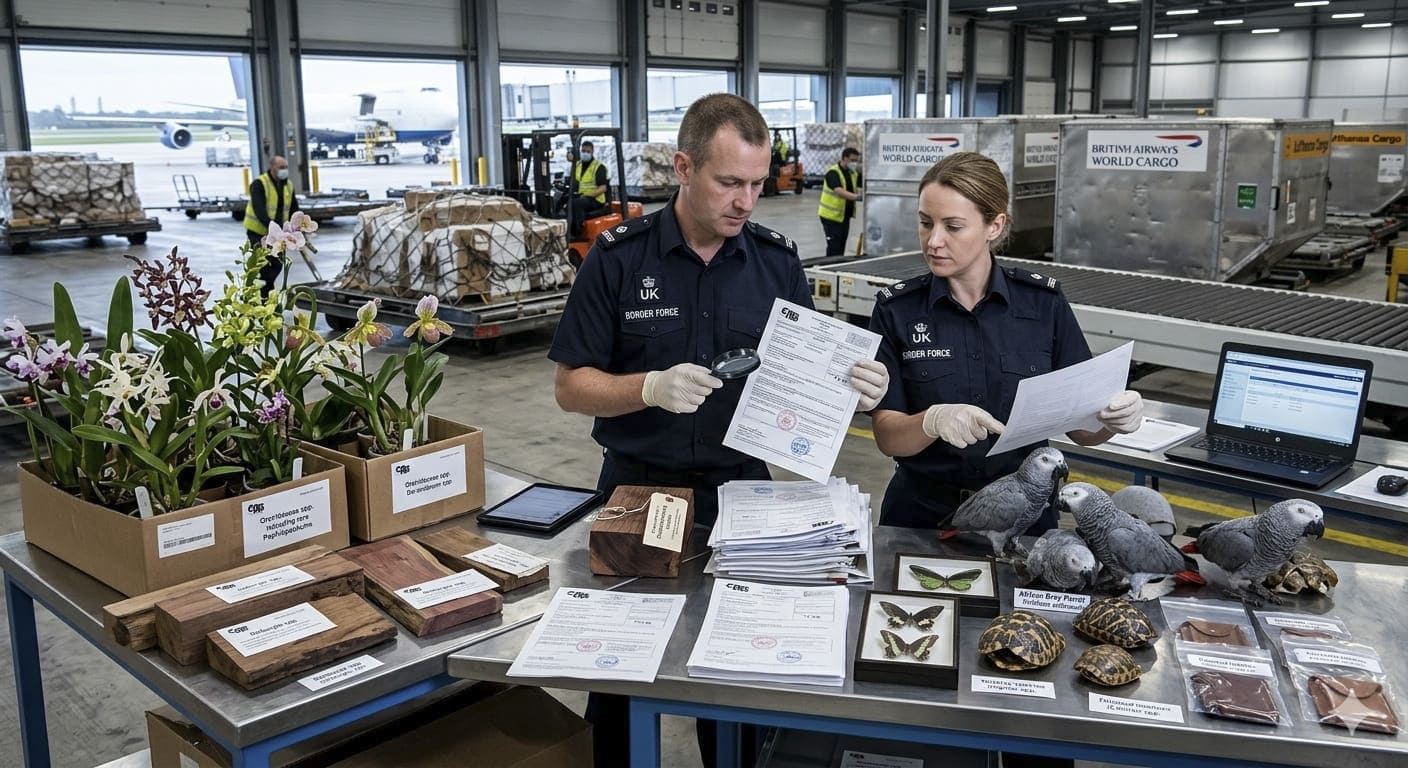
False, altered, stolen, cancelled, reused and fraudulently obtained CITES permits are a serious threat because the permit system is central to legal trade. A genuine-looking paper may be used to conceal unlawful source, wrong species, excessive quantity, an undeclared specimen, or a shipment moved after the document has expired. Whenever doubt arises, officers should not rely only on visual inspection. They must:
- Check the current CITES Appendices, annotation, species name and scope of covered parts or derivatives.
- Check whether the exporting country, importing country and any transit country are Parties, and whether reservations or stricter domestic measures apply.
- Compare all permit details against the physical consignment, invoice, packing list, airway bill or bill of lading, Customs declaration and inspection findings.
- Verify the validity of the permit directly with the issuing Management Authority through established official channels.
- Check whether the permit has been cancelled, lost, stolen, replaced, expired or previously used.
- Examine seals, signatures, security paper, barcode, QR code or electronic signature according to the issuing State’s published procedures.
- Refer species identification, timber identification, forensic examination or DNA analysis to qualified experts where visual identification is insufficient.
- Preserve the document, packaging, samples, electronic records and chain of custody if fraud is suspected.
- Share intelligence promptly with the national CITES Management Authority, Customs, police, wildlife authority and relevant foreign authority.
Enforcement in the Era of Free Trade Agreements and Trade Facilitation:
Free Trade Agreements, single-window systems, paperless trade, advance cargo processing, express cargo, e-commerce and faster border-clearance procedures can benefit legitimate trade. However, they also create opportunities for wildlife traffickers to move goods quickly, fragment consignments, use low-value declarations, misdescribe timber or wildlife products, exploit trans-shipment hubs, and depend on the limited time available for physical inspection. Practical compliance strategy may include:
- Use risk profiling based on species, commodity codes, routes, origin countries, traders, permit history, declared values and discrepancies.
- Integrate CITES permit data with Customs single-window, cargo-manifest and licensing systems.
- Require advance electronic transmission of permit data for high-risk shipments.
- Establish rapid verification contacts with CITES Management Authorities and foreign counterparts.
- Designate trained points of entry and exit for high-risk wildlife and timber consignments.
- Use non-intrusive inspection, document analytics, targeted physical examination and forensic support.
- Train frontline officers to distinguish scientific names, source codes, product descriptions and CITES annotations.
- Audit repeat traders and permit holders, especially where large volumes, frequent amendments or inconsistent source claims appear.
- Avoid routine detention of low-risk, fully verified consignments, while applying enhanced scrutiny to high-risk movements.
The objective should therefore be “smart enforcement, not blanket inspection.”
Exemptions and Special Provisions:
Article VII contains exemptions and special provisions, but these are frequently misunderstood. They do not create a general licence for unregulated trade. Important categories include:
- Transit & Trans-shipment: Exempt from Articles III–V if remaining under Customs control during normal transport. Authorities can still inspect shipments, verify CITES permits, or seize undocumented items.
- Pre-Convention Specimens: Applies only if acquired before CITES listed the species. Certificates must state the acquisition date (or earliest provable date of possession).
- Personal & Household Effects: Covers legally acquired, non-commercial items in personal baggage. It is generally invalid for Appendix II items acquired outside one's home country if the origin state requires an export permit.
- Captive-Bred & Artificially Propagated: Allows special certificates (or phytosanitary certificates for Appendix II plants). Specimen sources are strictly scrutinized to prevent wild items from being misdeclared.
- Scientific Exchange: Restricted to non-commercial loans or exchanges between registered scientists/institutions. Shipments require approved labels and cover preserved specimens or live plants.
- Travelling Exhibitions: Valid for up to three years for pre-Convention, captive-bred, or propagated specimens. Requires individual certificates for live animals, identifiable markings, and bars any sales.
Conclusion:
Appendix II regulates rather than bans international trade, relying on legal acquisition, sustainability and traceability. Permits constitute corroborative evidence, not absolute proof of legality. Enforcement officers must reconcile documents with physical specimens, verify authenticity with the issuing authority, audit source and quantity claims, and enforce domestic measures. Without impeding legitimate trade, enforcement must shift from indiscriminate delays to intelligence-led, digitally enabled, and scientifically supported targeted enforcement.

I am an Indian Revenue Service (Customs & Indirect Taxes) officer with vast experience of law enforcement especially in tackling transnational smuggling including willdife trafficking. Also, as an expert I have been conducting sessions on various aspects of wildlife crimes and its convergence with other serious crimes, legal and enforcement framework to counter it, wildlife cyber crime, OSINT for combating wildlife crime, combating money laundering associated with wildlife crime, CITES, role of Customs in tackling the menace of wildlife crime, Digital Forensics etc. for forest, police, customs and other enforcement agencies' officials.