The Rhino Under Protection: How India Is Fighting Poaching and Trafficking
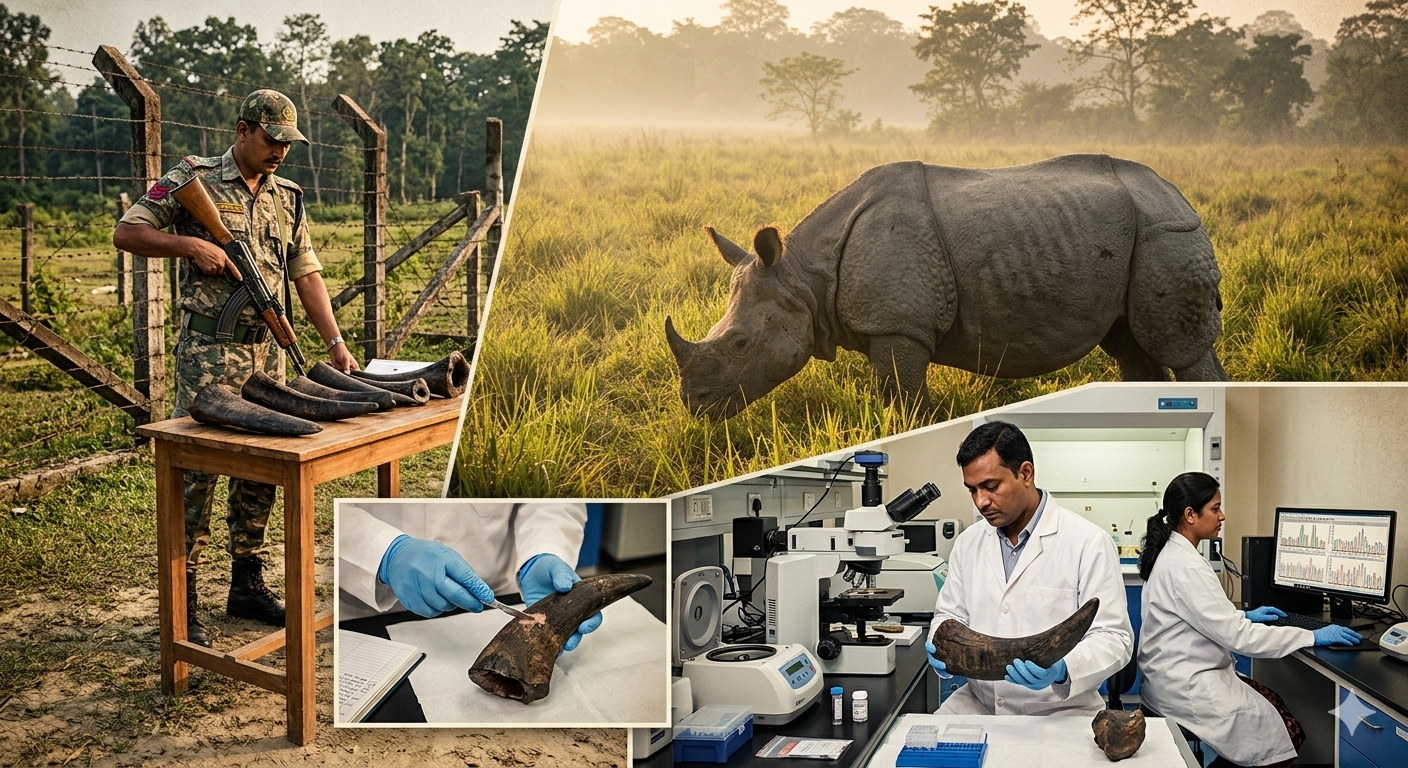
The Greater One-Horned Rhinoceros (Rhinoceros unicornis), popularly known as the Indian Rhinoceros, is one of India's most important wildlife-conservation success stories.
Yet this success remains vulnerable. Rhino horn continues to have substantial value in the illegal international wildlife market, creating an incentive for organized poaching and trafficking. The contemporary challenge is therefore not merely to protect the rhino inside a protected area, but to secure the entire conservation and enforcement chain—from habitat protection and intelligence gathering to scientific investigation, prosecution and disruption of international trafficking networks.
India’s Rhino Population and Distribution
The Greater One-Horned Rhino is principally associated with alluvial floodplains, riverine grasslands, wetlands and adjoining forests. In India, its present wild range is concentrated in Assam, West Bengal and Uttar Pradesh.
The latest consolidated assessment of the Asian Rhino Specialist Group places India's population at approximately 3,323 Greater One-Horned Rhinos, comprising about 2,885 in Assam, 392 in West Bengal and 46 in Uttar Pradesh.
Assam’s Kaziranga National Park and Tiger Reserve contains the largest concentration, while other populations occur in Orang, Pobitora and Manas. West Bengal's principal populations are in Jaldapara and Gorumara, while Uttar Pradesh's population occurs in Dudhwa National Park & Tiger Reserve.
The species is classified as Vulnerable on the IUCN Red List. It is listed in CITES Appendix I & Schedule I of India's Wild Life (Protection) Act, 1972. Thus the Greater One-Horned Rhino receives the highest statutory protection.
Why Are Rhinos Poached?
The principal driver of poaching is the illegal demand for rhino horn. The horn consists principally of keratin, yet traditional beliefs, perceived medicinal properties and status-related demand have led to Rhino poaching and trafficking of Rhino-horns.
From a law-enforcement perspective, however, the critical issue is not merely the existence of demand but the criminal structure that responds to it. A typical trafficking chain may involve:
local informer → tracker → shooter/poacher → horn remover → transporter → intermediary → financier → international trafficker → overseas buyer.
The person apprehended with a horn may therefore be several layers removed from the person who ordered the killing or financed the operation. The objective of a successful investigation should consequently extend beyond seizure and arrest. For investigators, the relevant questions therefore extend beyond:
Who killed the rhino?
They include:
Who financed the operation? Who supplied the weapon? Who arranged the killing? Who received the horn? Who transported it? Who was the intended buyer? Where did the proceeds go?
Modus Operandi of Poachers and Traffickers
Historically reliant on primitive weapons, electrocution, or poisoning, modern rhino poaching has evolved into a highly organized, intelligence-driven crime network. Local informants track animal movements and patrol patterns to guide armed poachers into the habitat. Once the rhino is killed and the horn is removed, the rhino-horn moves rapidly through a deliberately compartmentalized network. Because shooters, transporters, and mastermind/financiers operate in isolation from one another, traditional reactive policing is ineffective. Combatting this menace requires intelligence-led investigations that target the underlying criminal network rather than just the horn itself.
India’s Geolocation and the Trafficking Threat
Located in eastern and northeastern India, the primary rhino habitats of Assam and West Bengal are highly vulnerable due to their proximity to porous international borders. Historical trafficking routes have systematically funneled contraband through Nepal, Bangladesh, Bhutan, and Myanmar toward primary consumer markets in China and Vietnam. However, trafficking corridors are dynamic. As enforcement pressure intensifies, criminal networks rapidly shift routes, intermediaries, transport methods, and communication channels. Effective counter-trafficking operations must therefore transition from relying on historical route data to generating real-time, intelligence-led disruption strategies.
The Insurgency–Rhino Poaching Nexus
The convergence of rhino poaching with regional insurgency and illicit financing constitutes a major national security threat in Northeast India. While these operations typically involve localized cadres and splinter factions rather than entire organizations under unified command, high-value rhino-horn is systematically leveraged to procure weapons and generate operational capital. Open-Source records reveal that law enforcement interventions have repeatedly disrupted these illicit links, notably exposing cases where Karbi People's Liberation Tigers (KPLT) leadership facilitated rhino-horn trades and supplied automatic weapons, and where cash-strapped NDFB(S) cadres were deployed specifically for poaching operations. Furthermore, high-profile arrests of NSCN(IM) and Zomi Revolutionary Army (ZRA) operatives carrying rhino horns alongside assault weapons underscore that this trade operates as a convergent crime alongside arms trafficking and organized syndicates. Consequently, effective suppression demands that counter-trafficking operations look past the wildlife contraband and treat wildlife crime as an active component of insurgent financing networks. The significance of these cases is that wildlife crime can, in particular circumstances, intersect with organised crime, arms trafficking, border crime and insurgent financing. This requires coordination among the Forest Department, State Police, Counter-Insurgency Units, Wildlife Crime Control Bureau, Customs and Border-Security Agencies, and Central & State Intelligence Agencies.
Assam’s Anti-Rhino Poaching Task Force
Assam has institutionalized a unified, intelligence-led response to Rhino-poaching by evolving its specialized enforcement architecture. Originally constituted in 2021 to address the critical threat to the greater one-horned rhinoceros, the state's Anti-Rhino Poaching Task Force was formally re-designated as the Anti-Poaching Task Force in December 2024. This transition structurally expanded its operational mandate from a species-specific focus to all endangered wildlife across the State. By directly integrating senior command elements—including the Special DGP (Law & Order), PCCF (Wildlife) & Chief Wildlife Warden, Additional DGP (Special Branch), IGP (STF), Protected Area Directors, and District Superintendents of Police—the task force effectively bypasses traditional inter-departmental silos. This platform shifts the enforcement paradigm from standard frontline field patrolling to a centralized intelligence & enforcement hub, ensuring that actionable data regarding poachers, illicit arms suppliers, network financiers, and cross-border trafficking syndicates is rapidly processed and executed across agencies.
Special Legislative Measures in Assam
To enforce an unyielding legal deterrent against poaching, the Wild Life (Protection) (Assam Amendment) Act, 2009 serves as India's most stringent statutory shield for the greater one-horned rhino. By drastically overhauling Section 51 of the Wild Life (Protection) Act within Assam, the amendment provides for maximum prison sentence of ten years for a first-time offender, while repeat offenses carry a mandatory penalty of life imprisonment alongside heavy fines.
DNA Forensics and the Rhino Horn
Under modern counter-trafficking protocols, a seized rhino horn must be processed as critical forensic evidence rather than mere contraband. Leveraging initiatives like the RhODIS India genetic database, forensic analysts can extract unique DNA signatures to establish species identity, link contraband directly to specific carcasses, and connect seemingly isolated cases into a single prosecution. Dismantling transnational syndicates requires shifting from passive, seizure-oriented policing to an intelligence-led, network-oriented prosecution paradigm. Law enforcement must move beyond seizure of rhino-horns by systematically combining carcass forensics and horn DNA with ballistics, digital forensics, financial intelligence, and witness testimony. This multi-layered convergence builds an airtight evidentiary chain capable of dismantling entire criminal syndicates rather than just prosecuting low-level couriers.
Destruction of Seized Rhino-Horn Stockpiles
Publicly destroying seized Rhino-horn stockpiles is a strategic counter-trafficking tool used to permanently disrupt the financial and speculative value of the illegal wildlife trade. India has executed major public incinerations on World Rhino Day—notably destroying a historic cache of 2,479 rhino horns in 2021 at Bokakhat, Assam, followed by a subsequent public incineration of 105 seized rhino horns in 2026 at Jaldapara, West Bengal. These high-visibility enforcement operations send an unequivocal zero-tolerance signal to trafficking syndicates, definitively demonstrating that wildlife products carry zero commercial or medicinal value.
Contribution of Aaranyak (Conservation NGO) to Rhino Conservation
Aaranyak, a scientific and conservation organisation based in Assam, has made significant contributions to the protection of the Greater One-Horned Rhinoceros in India. Its Rhino Research and Conservation Division has worked closely with the Assam Forest Department, supporting anti-poaching operations through communication equipment, vehicles, motorcycles, boats, solar equipment and floating anti-poaching camps, thereby strengthening field-level protection in rhino habitats. Aaranyak has also contributed to scientific research, population monitoring, habitat management and community-based conservation.
A particularly important contribution is its Wildlife Genetics Laboratory (WGL), which provides DNA-based forensic support to wildlife law-enforcement agencies. Genetic analysis assists in species and individual identification and can establish links between seized rhino horns, carcasses and crime scenes, strengthening investigations and prosecutions. Aaranyak’s experts have also supported the scientific examination and genetic sampling of rhino horns held in government stockpiles before their disposal.
Importantly, the Government of Assam has formalized this science-led approach by notifying Aaranyak’s WGL under Section 329(4) of the Bharatiya Nagarik Suraksha Sanhita (BNSS), 2023, enabling its designated biologists to provide expert scientific evidence before courts. This institutional recognition strengthens the evidentiary value of wildlife genetics in criminal proceedings and enhances the capacity of enforcement agencies to secure convictions in wildlife trafficking cases. Aaranyak thus provides an important bridge between conservation science, forensic investigation and wildlife law enforcement.
Conclusion
India’s recovery of the Greater One-Horned Rhinoceros demonstrates the effectiveness of sustained conservation, strong legislation, specialized anti-poaching mechanisms, scientific research and coordinated enforcement. However, continuing international demand for rhino horn, evolving trafficking routes and its occasional nexus with organized crime, arms trafficking and insurgency demand constant vigilance. Future protection must therefore extend beyond safeguarding individual rhinos to dismantling the criminal networks that finance, facilitate and profit from poaching. Intelligence-led investigation, financial and digital analysis, DNA forensics, inter-agency coordination, border vigilance and community participation must work together.

I am an Indian Revenue Service (Customs & Indirect Taxes) officer with vast experience of law enforcement especially in tackling transnational smuggling including willdife trafficking. Also, as an expert I have been conducting sessions on various aspects of wildlife crimes and its convergence with other serious crimes, legal and enforcement framework to counter it, wildlife cyber crime, OSINT for combating wildlife crime, combating money laundering associated with wildlife crime, CITES, role of Customs in tackling the menace of wildlife crime, Digital Forensics etc. for forest, police, customs and other enforcement agencies' officials.