CITES Appendix-III: Bridging Domestic Wildlife Protection and International Trade Control
Introduction
The Convention on International Trade in Endangered Species of Wild Fauna and Flora (CITES) is generally discussed in the context of Appendices I and II. Appendix III, however, performs a distinct and important enforcement function. It is essentially a cooperative mechanism through which a country seeks international assistance to control trade in a species that it already protects under its domestic law.
Unlike Appendices I and II, an Appendix III listing does not require approval by the Conference of the Parties (CoP). A Party may unilaterally list a species native to its territory when it regulates that species domestically and considers international cooperation necessary to control exploitation and trade
For wildlife-enforcement agencies, Appendix III is therefore particularly significant because it creates a bridge between domestic wildlife protection and international border control.
What is CITES Appendix III?
Article II(3) of CITES provides that Appendix III contains species which a Party identifies as being subject to regulation within its jurisdiction for the purpose of preventing or restricting exploitation and as needing the cooperation of other Parties in controlling trade.
The fundamental idea is simple:
The range State protects the species domestically; CITES enables other countries to help prevent that protection from being defeated through international trade.
This is particularly important where a species is legally protected in its country of origin but may be commercially attractive in foreign markets.
Appendix III is therefore different from Appendix II. Appendix II is essentially a multilateral CITES listing adopted through the CoP, whereas Appendix III is based on a unilateral decision of an individual Party. Amendments to Appendix III do not require the voting procedure applicable to Appendices I and II. Currently there are around 530 species in Appendix-III.
How is a species included in Appendix III?
The process is considerably more flexible than the procedure for Appendices I and II.
Under Article XVI of CITES and Resolution Conf. 9.25 (Rev. CoP18), the listing Party should, among other things:
- Ensure that the species is native to its territory;
- Have adequate national legislation and regulations to prevent or restrict its exploitation and control trade;
- Have adequate national enforcement measures;
- Determine that cooperation from other Parties is required to monitor and control international trade;
- Consult relevant range States, major importing countries and the CITES Secretariat; and
- Submit to the Secretariat the scientific name of the species and specify the parts and derivatives to which the listing applies.
The listing subsequently becomes effective following the Convention's notification procedure.
This flexibility makes Appendix III potentially valuable as an early-intervention mechanism. A country does not have to wait until the conservation situation warrants the considerably more complex process of securing an Appendix I or II listing.
How does Appendix III regulate international trade?
The regulatory mechanism is principally contained in Article V of CITES.
There are three principal situations.
- Export from the country that listed the species
If a specimen is exported from the country that placed the species in Appendix III, an Appendix III export permit is required.
The Management Authority may issue the permit when satisfied that the specimen was not obtained in contravention of the laws of that State for the protection of fauna and flora. Importantly, unlike Appendix I and II exports, an Appendix III export does not require a CITES non-detriment finding by the Scientific Authority.
- Export from another range State
Where the species occurs in another country that has not itself listed the species, export to another country requires a Certificate of Origin.
This is one of the most important enforcement features of Appendix III. It enables the importing country to establish that the specimen did not originate from the country that had prohibited or restricted its exploitation.
- Re-export
Where an Appendix III specimen has already entered another country and is subsequently re-exported, the relevant documentation is generally a re-export certificate.
Thus, the system can be summarised as:
- Listing State → Export Permit
- Other Range State → Certificate of Origin
- Re-exporting State → Re-export Certificate
This documentary chain provides customs and wildlife officers with an important opportunity to detect illegally sourced specimens.
Why is Appendix III significant for enforcement?
The real value of Appendix III lies not merely in the permit itself but in the internationalisation of domestic wildlife law. It prevents the circular trading of (laundering) protected in one country through another country where that species is not protected.
Consider a species that is protected in Country A but is not listed under CITES. A trafficker may attempt to move the specimen from Country A through Country B where that species is not protected and exploit differences between the two countries' legal systems by exporting it legally as it being of Country B origin.
An Appendix III listing creates an international documentary requirement. Consequently, customs officials in another country have a legal basis to ask:
An Appendix III listing creates an international documentary requirement and allows enforcement officers to examine five fundamental questions:
- What species is being traded?
- Where did it originate?
- Was it legally acquired?
- Is the appropriate CITES document available?
- Do the document, species, quantity and declared origin correspond?
Examples demonstrating its Enforcement Value
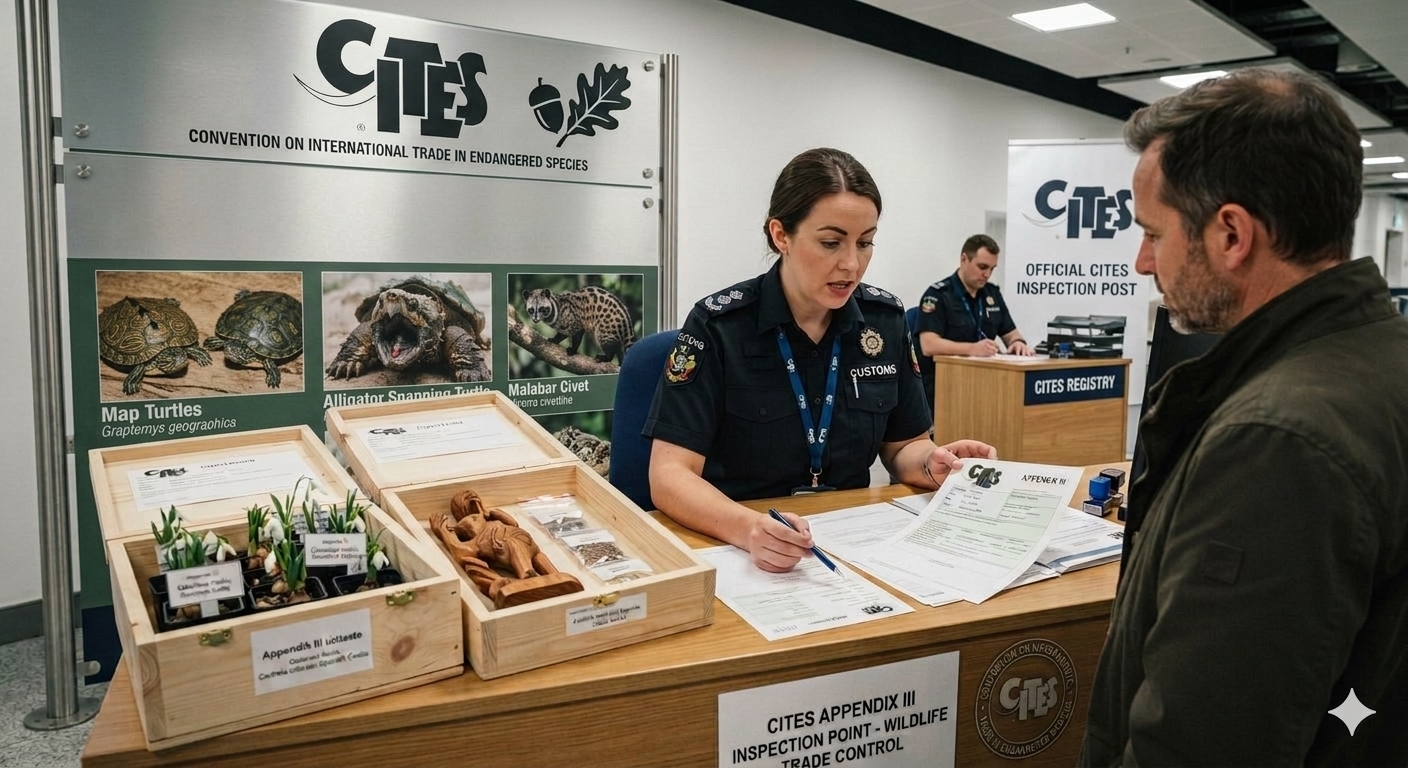
The United States used Appendix III for map turtles (Graptemys spp.) and the alligator snapping turtle (Macrochelys temminckii) to strengthen monitoring of international trade. Map turtles have appeared prominently in international wildlife seizures, including substantial numbers of live specimens. India had also listed some species in Appendix III, including the Malabar civet (Viverra civettina), Siberian weasel and certain red-fox subspecies. The Malabar civet example is particularly important because it illustrates the value of Appendix III for endemic species. Where a species occurs only within one country, claims that illegally obtained specimens originated elsewhere are much easier for enforcement authorities to challenge.
Way Forward: Strengthening Appendix III Enforcement
- Strategic rather than passive listing
Range States should undertake periodic assessments of nationally protected species that are increasingly appearing in international trade and consider whether Appendix III would provide an appropriate additional enforcement mechanism.
- Stronger Inter-Agencies Coordination
Customs, wildlife authorities, police, border agencies and CITES Management Authorities should maintain real-time channels for verification of CITES documents.
- Digital verification of Permits
A secure digital CITES-document verification system would substantially reduce opportunities for forged permits and certificates of origin.
- Better use of trade intelligence
Appendix III trade records should be analysed not merely for statistical reporting but for risk profiling also To optimize risk profiling for Appendix III species, customs authorities should focus on these 5 critical risk indicators:
- Porous Border Laundering: Sudden surges in Certificates of Origin issued by countries that share weak or porous borders with the nation that originally requested the Appendix III listing.
- Endemic Mismatches: Trade documents claiming a specimen originated in a third-party country, despite the species being strictly endemic (native exclusively) to one specific nation.
- Source Code Surges: Abrupt spikes in claims that wild-caught specimens are "captive-bred" or "pre-convention" to bypass standard import scrutiny.
- Illogical Transshipment Routing: Shipments traveling through highly indirect, circuitous geographic routes or known wildlife trafficking hubs instead of direct commercial paths.
- Vague Declaration Data: The use of generic Harmonized System (HS) codes or ambiguous descriptions to mask regulated parts and derivatives.
- Cross-border intelligence
Range States and major consumer countries should exchange intelligence concerning trafficking routes, modus operandi, fraudulent documentation and repeat offenders.
- Species identification capacity
Border personnel require practical identification guides and access to taxonomic expertise. Misidentification can defeat the entire documentary-control system.
Conclusion
Appendix III occupies a distinctive position within the CITES architecture. It is neither merely a lesser form of Appendix II nor simply an administrative listing. Properly used, it is a rapid international enforcement instrument that extends the reach of domestic wildlife protection across national borders.
For wildlife law-enforcement agencies, the central lesson is therefore clear: Appendix III should be viewed as an intelligence, documentation and border-control tool—not merely as a conservation label. Its effectiveness will ultimately depend on accurate species identification, reliable documentation, inter-agency cooperation, international information exchange and rigorous follow-up of suspicious consignments.
In an era in which wildlife traffickers increasingly exploit transit countries, false origins and fragmented legal systems, a more strategic use of Appendix III could provide an important first line of international defence before trafficking pressures necessitat

I am an Indian Revenue Service (Customs & Indirect Taxes) officer with vast experience of law enforcement especially in tackling transnational smuggling including willdife trafficking. Also, as an expert I have been conducting sessions on various aspects of wildlife crimes and its convergence with other serious crimes, legal and enforcement framework to counter it, wildlife cyber crime, OSINT for combating wildlife crime, combating money laundering associated with wildlife crime, CITES, role of Customs in tackling the menace of wildlife crime, Digital Forensics etc. for forest, police, customs and other enforcement agencies' officials.