Introduction:
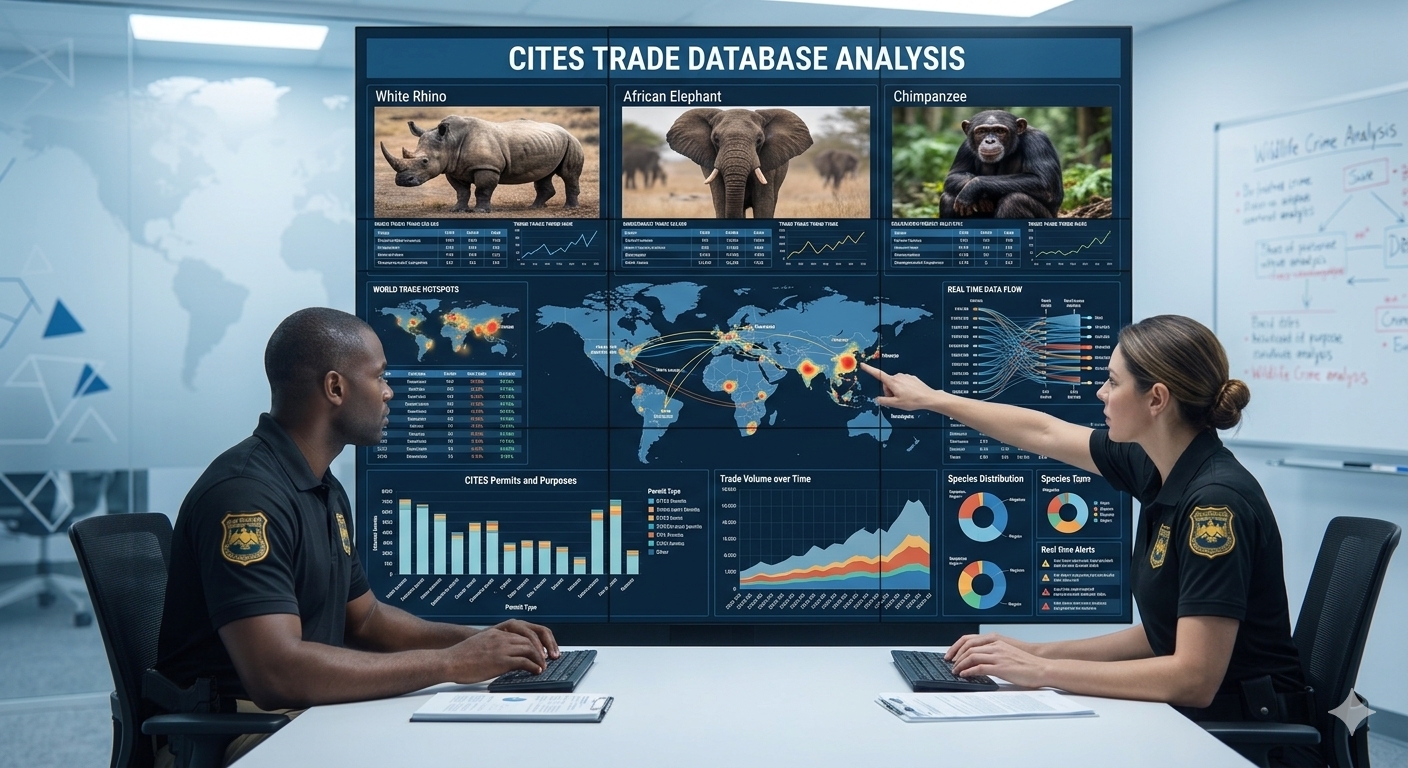
The CITES Annual Trade Report is one of the most important international sources of information on the legal trade in specimens of species regulated under the Convention on International Trade in Endangered Species of Wild Fauna and Flora (CITES). Article VIII(7)(a) of CITES requires each Party to report annually on its trade in listed species. The deadline is 31 October for trade in the previous calendar year. Resolution Conf. 11.17 treats these reports as the only available means of monitoring implementation and international trade. They support comparative trade analysis, quota management and the Review of Significant Trade.
The data feed the CITES Trade Database, managed by UNEP-WCMC. The reports cover authorised trade only. Seizures go into the separate Annual Illegal Trade Report, and domestic trade and non-listed species are not captured.
Reporting Compliance:
Submission of Annual Report by all Perties is mandatory but not all comply with this requirement. Parties that miss three consecutive years without justification face a Standing Committee recommendation that other Parties suspend trade with them.
|
Meeting |
Finding |
|
SC77 (Nov 2023) |
Comoros, Eritrea, Nigeria and Somalia had missed three consecutive years. Sixteen further Parties lacked 2020 and 2021 reports |
|
SC77 outcome |
Eleven Parties formally determined in default. Eight supplied reports within 60 days. Trade-suspension recommendations issued for Brunei Darussalam, Saint Vincent and the Grenadines, and Somalia |
|
SC78 (Feb 2025) |
Secretariat listed Bahamas, Guinea-Bissau, Liberia, Malawi, Mali, Paraguay and Samoa as defaulting. Afghanistan, Djibouti, Grenada, Sao Tome and Principe, and Somalia remained under suspension recommendations |
Timeliness is also a problem. UNEP-WCMC has noted that many Parties do not submit their Reports by the prescribed date.
Why the Data Matter for Enforcement:
A mismatch between importer and exporter records is neither proof of illegality nor administrative noise. It is a risk indicator that requires structured verification.
- Cross-verification: Declared exports can be compared with declared imports. In the database, export permit numbers are mandatory and import permit numbers optional. Where reported, permit numbers allow matching of import and export shipments and tracking through re-export, which helps identify discrepancies for further investigation.
- Targeting: Persistent, directional gaps highlight species, routes and Parties for further investigation.
- Compliance Checks: Records can be tested against quotas, source codes and declared purposes.
- Intelligence: Combined with customs, seizure and financial data, they help generate actionable intelligence about illegal wildlife trade, modus-operandi, routes, species, importers-exporters involved, origin & transit countries, ports, transshipment hubs, transnational organized wildlife crime syndicate, their assets & associated money laundering leading to dismantling of these organized networks through International Co-operation among Parties.
Causes of Discrepancy and their Enforcement Meaning:
The Secretariat has recognized these problems since at least SC50, which identified reports based on permits rather than actual trade, trade omitted from reports, and permits reported a year late.
|
Cause |
Mechanism |
Typical Signature |
First Verification Step |
|
Permit-Based Reporting |
Permits issued but unused or partly used are reported as trade |
Exporter figure above importer figure |
Check permit endorsements and customs clearance records |
|
Importer Under-Reporting |
CITES does not require import permits for Appendix II, so imports may go unrecorded |
Importer figure absent or low |
Compare export permits with import declarations, manifests and receiving-facility records |
|
Year-End Timing |
A permit issued late in the year is used and reported by the importer the next year |
Gaps that offset across adjacent years |
Compare at least the preceding and following years |
|
Coding Differences |
Terms, units, source, purpose or taxon level applied differently |
Records appear on separate lines |
Standardise units and codes before comparing |
|
Re-Exports and Double Counting |
Gross reports count the same specimen on each leg |
Inflated trade totals |
Separate direct exports from re-exports using country of origin |
|
Possible Illicit Causes |
Under-reporting, source laundering, over-quota trade |
Gap with altered legal meaning, such as wild versus captive-bred |
Escalate to permit, customs and shipment investigation |
A discrepancy becomes an enforcement concern when it changes legal status. A wild versus captive-bred mismatch affects permit requirements, quota use and whether a breeding claim is credible.
Illustration: A permit is issued for 1,000 live reptiles, but 650 are exported. If the exporter reports permits and the importer reports arrivals, the database shows 1,000 against 650. The 350-specimen gap may be unused permit balance, partial shipment or cancellation, and it needs checking before anyone infers smuggling.
Documented Evidences: Following are some of the documented evidences showing mismatch between trade data reported by importing and exporting countries with inherent implication:
|
Study |
Finding |
Implication |
|
Ball Pythons, West Africa (Harrington et al. 2020) |
Exporter-reported exports of 3,121,022 against importer-reported 3,979,680 since 1975, a gap of about 859,000 (22% of the importer figure) |
Directional under-reporting on the exporter side |
|
Togo Ball Pythons (D'Cruze et al. 2020) |
Exports appear consistently underestimated by Togo, and ranched and wild quotas exceeded several times, including 2017 |
Mismatch pointed to quota non-compliance |
|
U.S. CITES versus Customs Data (Blundell and Mascia 2005) |
Divergence from a CITES figure 376% above Customs (live coral imports, 2000) to a Customs figure 5,202% above CITES (conch exports, 2000) |
Inaccuracy occurs even in a well-resourced Party |
|
Indonesia–Netherlands Live Animals (TRAFFIC 2016) |
1,146 transactions, 2003–2013, with large discrepancies; one coral reported despite an EU restriction |
Bilateral reconciliation reveals restricted trade |
|
Singapore Birds (Poole and Shepherd 2017) |
Significant discrepancies between Singapore's import and export figures and its partners' figures. Singapore reported imports of 225,561 birds, 2005–2014 |
Transshipment hubs warrant scrutiny |
|
Sungazer Lizard, South Africa (2025) |
Importer-exporter discrepancies, misused source and purpose codes, and evidence of wildlife laundering |
Source-code abuse can accompany mismatches |
The sources attribute some of these gaps to reporting weakness and some to possible illegality. The cases show gaps coinciding with quota breaches and laundering.
Ramifications:
- Concealed illegality: Under-reported exports and false source codes can mask over-quota or wild-caught trade as lawful.
- Distorted risk assessment: Divergent data can distort the perceived risk of exploitation and lead to misallocation of management resources.
- Misdirected enforcement: Resources may chase routes that look suspicious only because of reporting error.
- Reduced traceability: Free-text permit fields prevent automatic matching. UNEP-WCMC noted that one permit number can appear as "12/AB/1234", "12 AB 1234" or "12-AB-1234".
- Analytical error: Treating records as one row per shipment is wrong. Rows aggregate a year's trade for the same taxon, exporter, importer and term.
Recommendations: Following are some recommendations to effectively deal with the problem of CITES Trade data mismatch:
|
Measure |
Basis |
|
Report actual trade, state the basis, and file by 31 October |
Existing guidelines and Resolution Conf. 11.17 |
|
Adopt Electronic Permitting that generates Annual Reports automatically |
Resolution Conf. 12.3 (Rev. CoP20) asks Parties to consider such systems. The eCITES framework aims at automated report generation |
|
Exchange Permit Data between Parties |
The Secretariat is developing EPIX to improve validation of permit data by Management Authorities and customs. This allows checks before a shipment moves |
|
Standardise Permit Numbers and use secure identifiers |
Resolution Conf. 12.3 encourages standard permit-number conventions. UNEP-WCMC proposed secure identifiers to address SC69 concerns that publishing permit numbers could facilitate fraud, at an estimated USD 2,000 start-up and USD 700 a year |
|
Reconcile Bilaterally for Appendix I, high-value and Quota-Managed Species |
The studies above found their problems only after comparing both sides. TRAFFIC likewise urged stronger cooperation on enforcement between Indonesia and the Netherlands |
|
Cross-check against Seizure Records, the Annual Illegal Trade Report and Customs Data |
Provides an independent check on legal-trade figures |
|
Support low-capacity Parties and follow up defaults promptly |
Reporting gaps cluster in defaulting Parties |
Recommended Reconciliation Workflow: Implementing a structured CITES reconciliation workflow eliminates technical reporting noise, allowing enforcement officers to isolate high-risk discrepancies that mask illegal wildlife trafficking:
- Extract Comparative Tabulation data for the species, route and years of interest.
- Standardise taxon, term, unit and source before comparing.
- Exclude re-exports from direct-trade comparisons.
- Compare across adjacent years to remove timing offsets.
- Classify each remaining gap as exporter-high, importer-high or source-code mismatch.
- Trace the gap from database record to permit, from permit to customs entry, from customs to shipment, and from shipment to traders and financial records.
Conclusion:
In conclusion, CITES Annual Trade Reports reflect administrative data rather than verified shipments, creating systemic reporting gaps that law enforcement must neither dismiss nor automatically equate with trafficking . Instead, these discrepancies require systematic reconciliation to filter out technical noise like timing or coding errors. Ultimately, upgrading trade data quality is an operational enforcement necessity, transforming static statistics into a sharp, predictive tool to intercept illicit trade operating under legal cover.

I am an Indian Revenue Service (Customs & Indirect Taxes) officer with vast experience of law enforcement especially in tackling transnational smuggling including willdife trafficking. Also, as an expert I have been conducting sessions on various aspects of wildlife crimes and its convergence with other serious crimes, legal and enforcement framework to counter it, wildlife cyber crime, OSINT for combating wildlife crime, combating money laundering associated with wildlife crime, CITES, role of Customs in tackling the menace of wildlife crime, Digital Forensics etc. for forest, police, customs and other enforcement agencies' officials.