Telegram and the Digitalisation of Illegal Wildlife Trade: An Enforcement Guide

Introduction:
Wildlife trafficking has moved from physical markets to the smartphone. Telegram has become a significant facilitator of illegal wildlife trade because it combines public broadcasting, large groups, private messaging, pseudonymous accounts, rapid content sharing, and cross-border reach. For enforcement, the central lesson is that Telegram should not be treated merely as a “messaging app”: it is often a layered marketplace in which public channels advertise animals or specimens, closed groups screen customers, and private chats arrange payment & delivery.
Singapore Case Study:
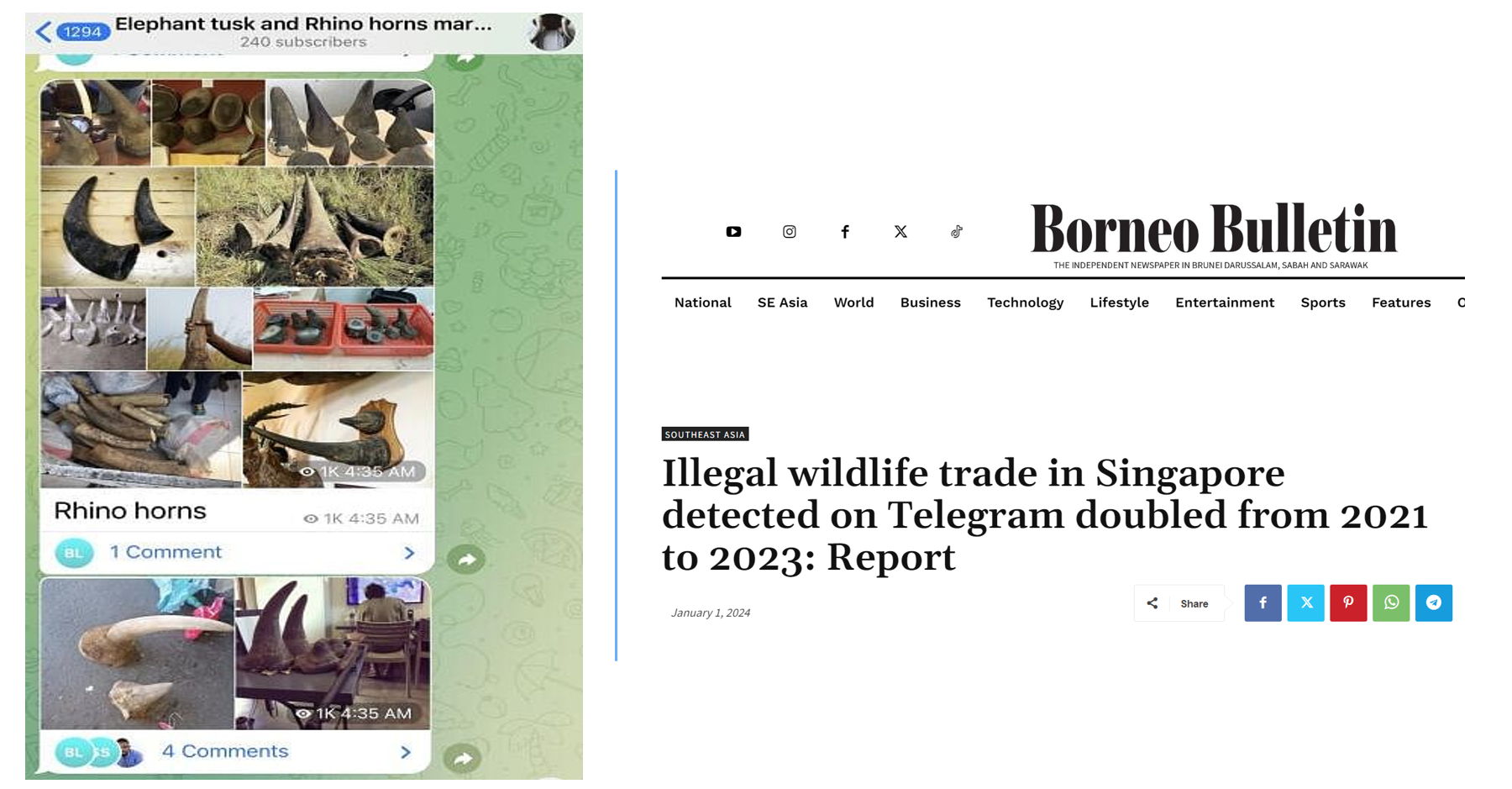
Singapore provides a useful real-world illustration of the scale and visibility of the problem. In a 2023 Telegram Wildlife Trade Report, the Animal Concerns Research and Education Society documented a 196% increase in prohibited wild animals advertised and a 586% rise in individual sellers compared to 2021. In just 122 days, they documented 993 prohibited wild animals offered for sale across three Telegram chats — averaging eight illegal wildlife listings per day. The investigation recorded advertisements involving live wildlife as well as products such as tiger teeth and claws, bear teeth, and rhino horn.
Why Wildlife Traffickers Use Telegram:
As Facebook, Instagram, YouTube and e-commerce sites tightened their rules & regulations, wildlife trafficker moved to less regulated space like Telegram because of its several features which the traffickers can exploit for this illicit trade.
For Example:
A trader can operate using a username rather than publicly displaying a telephone number or real name. This creates an attribution problem for investigators.
A Telegram identity may therefore initially appear as:
@WildlifeTrader123
rather than:
Rahul Sharma, Delhi, +91xxxxxxxxxx
Therefore, the investigative objective must be to move from the first identity to the second through lawful attribution.
Telegram Features Traffickers Exploit and How to Respond:
|
Feature |
How Wildlife Traffickers Exploit It |
Enforcement Response |
|
Hidden Phone Number |
Number set to "Nobody"; prepaid SIMs in false names; since December 2022, anonymous +888 numbers bought on Fragment with Toncoin. These have no SIM, no telecom record and cannot receive calls or SMS. |
Telegram still holds the number, so request it through legal process. For a +888 number, telecom records will not help. Trace the crypto wallet and the exchange where Toncoin was bought, as exchanges usually hold KYC records. Numbers posted in ads or given to couriers are common mistakes. |
|
Usernames |
Easily changed or resold, so one trader looks like several. |
Record the numeric user ID, which normally stays the same. Confirm it from two independent sources using agency-approved tools, since third-party tools can be wrong. Search the handle on other platforms. |
|
Profile Picture, Bio, Name |
Stolen or fake images. |
Run reverse image searches. Bios often contain contacts or payment details. Photos sent as files may keep metadata, so preserve originals for forensic examination. |
|
Groups |
Hidden member lists, anonymous admins, joining by approval, "vouching" rules that screen out outsiders. |
Map admins, linked channels and members praised as "trusted", who are often sellers or brokers. Note posting hours and language. Join restricted groups only through an authorised undercover account. |
|
Public and Private Channels |
Public channels work as catalogues, with backups ready if one is removed. Private channels need invite links given only to screened buyers. |
Capture creation date, subscriber count, pinned posts and links to backup channels. Record invite links when received. Channels are not end-to-end encrypted, so Telegram can access their data. |
|
Secret Chats and Auto-Delete |
Encrypted, self-destructing chats; deletion for both sides. |
Content survives only on devices. Capture conversations in real time on your undercover device. Send preservation requests early. Seized phones may hold recoverable content. |
|
Live Streams and Stories |
Used to show animals or run auctions, then vanish. |
Record with date and time. Note backgrounds, voices, accents and enclosures. Set your own calls (not Peer to Peer calls) so your IP is not revealed. |
|
Bots and In-App Payments |
Automated shops, order-taking and payment collection. Telegram supports payments inside bots, in-app digital currency (Stars) and wallet features linked to cryptocurrency. Traffickers may ask for payment in cryptocurrency, gift cards, or direct transfer to intermediary accounts held by "mules." |
Study how the bot works and record payment details and wallet addresses. The bot's operator holds transaction data. A blockchain is a public ledger. Crypto Wallet addresses can be traced through blockchain analysis tools, and funds often reach exchanges that hold customer identification (KYC) records. |
|
Multiple Accounts, VPN, Tor |
Front accounts for advertising, separate accounts for deals, replacement after bans, Hiding their actual IP Address. |
Link accounts by reused images, writing style, payment details and posting hours. A VPN provider may hold records. |
How Telegram Is Used for the Illegal Wildlife Trade:
The trade generally follows a predictable pattern. The hypothetical example below is illustrative only.
Illustrative example
A seller, "Account A," runs a public Telegram channel advertising "exotic pets." The channel posts photos of Indian star tortoises, some with a note such as "captive bred, fresh stock, delivery available." The channel has 3,000 subscribers and links to a discussion group of 800 members, where buyers post questions and reviews.
A buyer writes in the group asking about price. Account A replies "DM me." In private messages, the seller sends a short video of the animals and gives a price and a bank or UPI number, crypto-wallet address. The seller asks for the buyer's address or a pickup point and suggests a courier service. The parcel is labelled as "toys" or "plants." The animals travel in poor conditions and some die.
To stay hidden, Account A deletes messages after a few days, changes its username every few weeks, and moves buyers to a new channel when the old one is reported.
What Telegram Cannot Hide:
Traffickers are hidden from other users, not from everyone. Telegram, telecom operators, payment service providers and couriers all hold traces. Even careful traffickers leave the following traces:
- Registered number and login IP addresses (Telegram, telecom operators, internet service providers)
- Payment records (banks, payment apps, crypto exchanges)
- Delivery records (couriers, transport operators, airlines, CCTV)
- Reused usernames, images and numbers on other platforms
- Behaviour patterns such as posting hours, spelling and price lists
Tools Available to Enforcement Officers to Counter this Menace:
Enforcement officers can use a mix of Telegram's own features and freely available or commercial open-source intelligence (OSINT) tools to counter this menace. Some are as follows:
|
Purpose |
Examples |
|
Searching within Telegram |
Telegram's built-in global search, and searching inside a Channel or Group by keyword |
|
Channel Analytics |
Websites such as TGStat and Telemetr, which show channel size, growth, posting history and links to related channels |
|
Independent Telegram Search Engines/Google Dorking |
Various third-party search sites such as Google Customs Search Engine ‘Telegago’ and Google Dorking |
|
Data Collection from Public Channels |
Open-source tools such as Telepathy, which can collect messages, member lists and links from public channels |
|
Username and Phone-Number Research |
Public Username Lookups, and services that show where else a username or number appears |
|
Web Archiving and Page Capture |
Hunchly, Wayback Machine, and screen-recording tools |
|
Link and Relationship Mapping |
Maltego, or a simple spreadsheet or diagram to map accounts, phone numbers, payment details and channels |
|
Image and Video Checks |
Reverse image search (Google Lens, TinEye, Yandex), and tools that read image metadata |
|
Payment Tracing |
Blockchain Analysis Tools such as developed by CypherTrace, Chainanalysis, TRM Labs, Elliptic (for cryptocurrency) and bank or payment app enquiries |
Investigation Steps:
1. Passive Work (no interaction with wildlife traffickers)
- Capture first. Record the link, name, ID, subscriber count, creation date and every relevant post, using screen recording that shows the URL and timestamp. Keep original files.
- Extract identifiers: Usernames, IDs, numbers, emails, payment details, photographs, places named.
- Pivot to other Platforms. Reused handles and photos often lead to classified sites or unencrypted platforms where the trafficker left a real name or address.
- Analyse content for language, slang, currency, delivery locations and time zone clues.
- Map the network of channels, admins, bots and payment identifiers.
- Verify the offence: Confirm the species is protected and check whether a lawful breeder or dealer exists.
2. Undercover Engagement with Wildlife Traffickers
- Obtain written authority. Use a dedicated device, SIM and account that cannot be traced to you. Build a credible profile over time.
- During negotiation, ask for a video call, payment details, delivery arrangements and a small test purchase where legally allowed. Let the trafficker propose a larger deal or meeting. Note names of suppliers and drivers.
- Avoid entrapment. You may offer the opportunity to commit an offence the person is already engaged in, but never pressure them. Keep a full record of all contact.
- Plan animal welfare before buying or seizing live animals.
3. Controlled Handover
Choose a location that allows surveillance and safe arrest. Coordinate teams so suppliers and drivers are also arrested. Arrange veterinary support. Seize phones in a way that limits remote deletion, then send them for forensic examination.
4. Financial Investigation
Following the money often reaches the real operators.
- Banks and Payment Apps (such as UPI): Request account-opening details, transactions, linked numbers and devices. Many small incoming payments suggest a seller, and consolidation into a few accounts suggests a controller.
- Mule Accounts: An account holder with no link to the trade may be sharing proceeds and is a lead.
- Cryptocurrency: Collect wallet addresses from chats and bots. Trace them to regulated exchanges, which hold identity documents and login IPs.
- Asset Freezing: In many countries wildlife crime is a predicate offence for money laundering. Freezing proceeds often damages a network more than one arrest.
5. Obtaining Data from Various Service Providers
Telegram: In 2024 it announced it would disclose IP addresses and phone numbers in response to valid legal requests.
- Send a preservation request through authorized channels.
- Ask for registered number, login IP logs (with date, time and time zone), device details, and username and ID history and other details about the subscriber.
- Identify accounts by numeric ID, not username alone.
Telecom Operators: Request the subscriber record for any ordinary number. False-name SIMs are common, so also check the retailer and CCTV.
Internet Providers: An IP address alone does not identify a person.
- Confirm the exact date, time and time zone.
- Identify the provider that owns the IP.
- Request the subscriber assigned that IP at that time. Providers often need the source port number as well.
- Check whether the IP is a home connection, mobile network, public wifi, VPN or Tor. VPN or Tor may end the trail.
- Corroborate with payment, delivery or image evidence.
Other Platforms: Where the suspect also uses a less protected platform such as Facebook, Instagram, YouTube, e-coomerce sites etc., request registration data and IP logs there, as they often hold more information about their users than Telegram.
6. International Cooperation
- Mutual legal assistance is the formal route for data held abroad. It is slow, so send preservation requests in parallel.
- 24/7 contact points under the Budapest Convention and the G7 network can ask another country to preserve data quickly. Use your national cybercrime unit. The Convention's Second Additional Protocol allows direct requests to providers abroad for subscriber data.
- INTERPOL, CITES authorities and Customs may support intelligence sharing, species checks and parcel tracing.
7. Evidence Handling
- Preserve originals, not just screenshots. Record time, URL, username, ID and device.
- Generate a hash value for each file at capture and log it.
- Keep a chain of custody and a step-by-step investigation log, including failed attempts.
- Link the account to a real person through several independent sources (subscriber record, payment, IP, device, delivery, meeting). A single link is easy to challenge.
- Obtain electronic-evidence certificates as required by law. In India, this is under the Bharatiya Sakshya Adhiniyam.
- Use trained forensic examiners for seized devices.
- Document veterinary examination and species identification of seized animals.
- Protect undercover identities in court.
Conclusion:
The future of wildlife enforcement will depend not only on protecting forests, borders, airports and ports, but also on developing the capability to identify, investigate and dismantle the criminal networks operating behind screens such as on Telegram. Successful cases rarely depend on breaking Telegram's protections. They combine careful capture of public information, undercover engagement, financial tracing and lawful data requests, and they exploit traffickers' own mistakes. Treat every online identity as a starting point, and always work towards a real person, a real payment and a real seizure that will stand in court.

I am an Indian Revenue Service (Customs & Indirect Taxes) officer with vast experience of law enforcement especially in tackling transnational smuggling including willdife trafficking. Also, as an expert I have been conducting sessions on various aspects of wildlife crimes and its convergence with other serious crimes, legal and enforcement framework to counter it, wildlife cyber crime, OSINT for combating wildlife crime, combating money laundering associated with wildlife crime, CITES, role of Customs in tackling the menace of wildlife crime, Digital Forensics etc. for forest, police, customs and other enforcement agencies' officials.