Joint Intelligence, Investigation and Prosecution Across Land Borders: A Framework for Combating Wildlife Trafficking
Introduction:
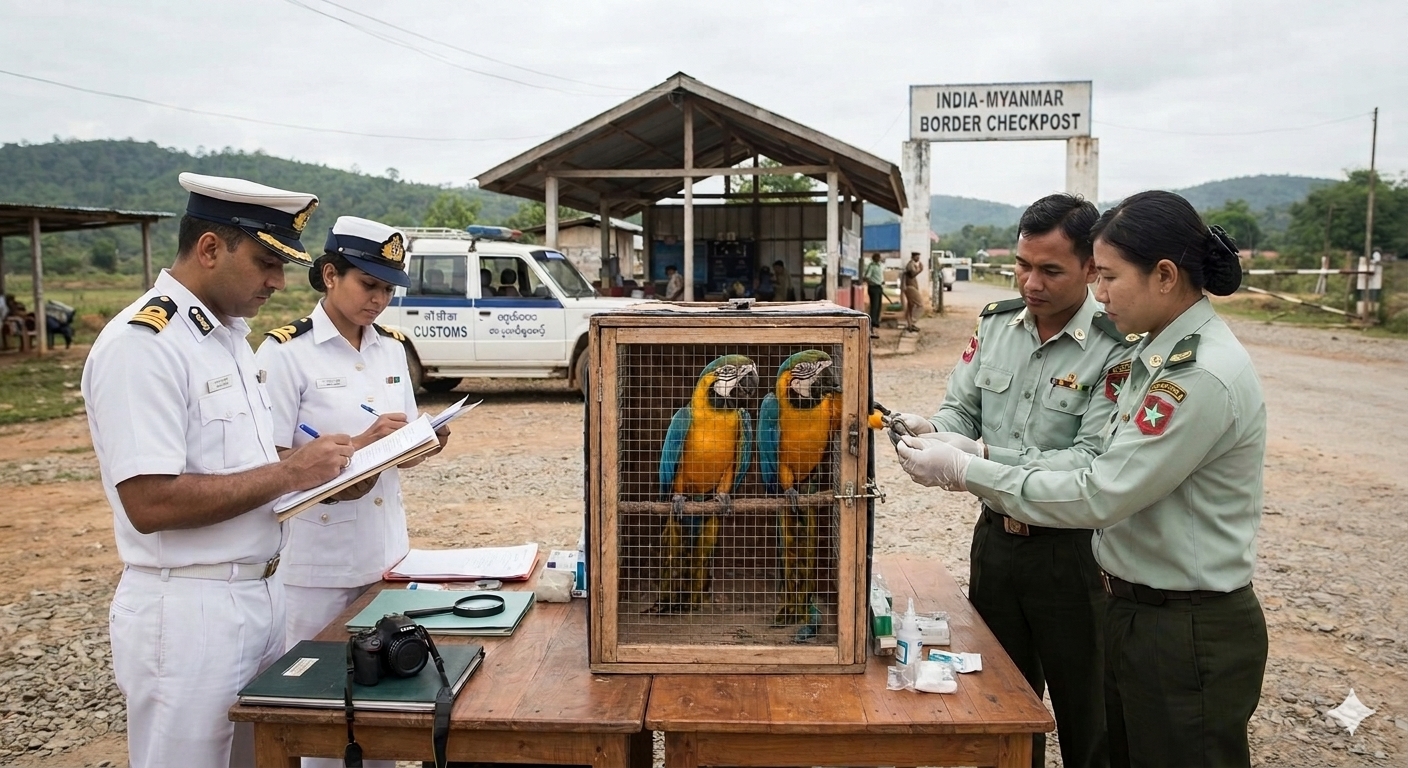
Wildlife trafficking is no longer a local poaching issue; it is a sophisticated transnational organized crime. Criminal networks exploit porous land borders, fragmented jurisdictions, and weak enforcement coordination to outpace law enforcement. For example, in South Asia, traffickers move high-value wildlife contrabands including tiger body parts, rhino horns, live pangolins & scales, red sanders, live exotic wildlife species and other protected species and their body parts across the borders of India, Nepal, Bangladesh, Bhutan, and Myanmar in mere hours, outrunning the speed at which national agencies can share vital intelligence.
No single nation can dismantle these global syndicates alone. Eradicating this illicit trade requires seamless, cross-border cooperation across the entire supply chain—from source to destination states. CITES expressly recognizes that effective collaboration and collective action across States and enforcement chains are essential because illegal wildlife trade cannot be tackled by any one country or agency.
Why Land Borders Need a Joint Approach:
Land-border trafficking has features that make unilateral enforcement ineffective.
- Fragmented, high-frequency movement: Instead of large container shipments, goods often move in small, frequent consignments by couriers, buses, trucks, boats and on foot, along informal crossings that are difficult to monitor.
- Blended with legitimate traffic: Trafficking hides in lawful trade, local markets, and in places where communities live on both sides of the border and move freely.
- Staged networks: Poachers, local collectors, transporters, brokers, financiers and exporters are often in different countries. The people at the bottom of the chain are the easiest to arrest and the easiest to replace.
- Jurisdictional arbitrage: Traffickers choose routes through states with weaker laws, lower penalties or less enforcement, and shift routes when pressure rises.
- Evidence scattered across states: Phone records, bank data, witnesses and forensic material may sit in two or three countries. No single agency can assemble the full case.
The UNODC World Wildlife Crime Reports (2020 and 2024) consistently show that seizure data capture only part of the trade and that most cases end with the courier. The conclusion drawn by ICCWC and its partners is that enforcement must move from seizure-focused to network-focused, and that requires cooperation across borders at every stage from intelligence to prosecution.
The International Legal and Policy Basis:
-
UN Convention against Transnational Organized Crime (UNTOC): UNTOC is the strongest legal basis for joint action. It does not mention wildlife, but it applies to "serious crime" (Article 2(b), defined as an offence punishable by at least four years' imprisonment, where the offence is transnational and involves an organized criminal group. Many states have set wildlife penalties at or above this threshold precisely to bring trafficking within UNTOC. The relevant provisions are:
- Article 27: law-enforcement cooperation, including direct channels of communication, exchange of information on persons, methods and routes, and cooperation in tracing persons and property.
- Article 19: joint investigations, through bilateral or multilateral agreements or on a case-by-case basis.
- Article 20: special investigative techniques such as controlled delivery, electronic surveillance and undercover operations.
- Article 18: mutual legal assistance (MLA), including taking evidence, executing searches and seizures, and examining objects and sites.
- Articles 16 and 13: extradition and international cooperation for confiscation of proceeds.
- UN Convention against Corruption (UNCAC): Wildlife trafficking also depends on corrupt officials at checkpoints and in permit systems. UNCAC offers similar tools, including joint investigations (Article 49) and asset recovery.
- CITES: Article VIII requires parties to penalize illegal trade and confiscate specimens. Resolution Conf. 11.3 (Rev. CoP19) on compliance and enforcement encourages cooperation among enforcement agencies, the use of controlled delivery, and the treatment of wildlife crime as serious crime, including through anti-money-laundering and asset-forfeiture measures.
- UN Resolutions: UN General Assembly Resolution 69/314 (2015) and ECOSOC Resolution 2013/40 call on member states to treat wildlife trafficking as serious crime, to use UNTOC and UNCAC, and to strengthen cross-border cooperation.
- Regional Precedents:
- The EU Framework on Joint Investigation Teams (JITs): Under Council Framework Decision 2002/465/JHA, the European Union established the legal structure for Joint Investigation Teams (JITs). Europol provides crucial analytical, logistical, and secure data-exchange support. Concurrently, Eurojust assists with the judicial coordination, legal planning, drafting of agreements, and essential operational funding.
- The Lusaka Agreement Framework: The Lusaka Agreement on Co-operative Enforcement Operations Directed at Illegal Trade in Wild Fauna and Flora is an African regional treaty adopted in 1994 to fight wildlife crime. It specifically established the permanent, multi-national Lusaka Agreement Task Force (LATF) as its operational arm. The LATF executes cross-border intelligence-gathering and joint wildlife investigations by directly collaborating within each member state's designated focal point, officially termed the National Bureau.
- Regional Enforcement Networks such as ASEAN-WEN and SAWEN provide platforms for exchange, although they generally lack binding authority to run joint investigations.
The lesson of these instruments is that states do not need a new wildlife-specific treaty to begin. UNTOC, supplemented by bilateral or regional protocols, already supports joint investigation. What is usually missing is the operational protocol that turns the legal permission into routine practice.
Joint Intelligence: The Foundation
Joint investigation succeeds or fails on the quality and speed of intelligence exchange. Intelligence in this field is often fragmented: a seizure in one country, a suspicious vehicle in another, a phone number that appears in both. Without a way to connect them, each agency sees only a piece of the picture.
- Designated focal points: Each state should name a single point of contact for wildlife-crime intelligence, ideally a multi-agency unit combining police, customs, wildlife authorities and border forces. Direct counterpart-to-counterpart channels, which UNTOC Article 27 encourages, avoid the delays of diplomatic correspondence.
- Secure channels: INTERPOL's I-24/7 network and National Central Bureaus allow rapid police-to-police exchange, and its notices system and databases help circulate information on suspects and seizures. The WCO's Customs Enforcement Network (CEN) and Regional Intelligence Liaison Offices (RILOs) serve the same function for customs. Joint operations such as INTERPOL–WCO Operation Thunder show how intelligence pooled across many countries produces coordinated seizures and arrests.
- Border liaison offices: UNODC has long promoted border liaison offices where officers from both sides work in the same place or in close contact. These offices allow quick, trust-based exchange on movements at specific crossings, and they are often where informal tip-offs become formal intelligence.
- Common analytical products: Joint Intelligence should go beyond sharing raw data. It should map routes, identify repeat actors and map the structure of networks, drawing on seizure records, phone and financial data, shipping and transport information, and open-source and social-media material. Standardized seizure reporting, including species, weight, concealment method and route, makes comparison across countries possible.
- Forensic intelligence: DNA analysis can identify species, geographic origin and links between seizures. Shared forensic databases and agreed laboratory standards allow one country's results to be used by another and, importantly, to support prosecution.
- Rules for handling intelligence: Information must be graded for reliability and protected through agreed handling codes and need-to-know principles. The risk of leaks, particularly through corruption, is one of the main reasons agencies hesitate to share. Vetted units and clear protocols are essential for building trust.
Joint Investigation: From Parallel Cases to One Case
Parallel national investigations into the same network tend to duplicate effort, alert suspects and produce evidence that cannot be combined. A joint investigation team (JIT) converts these into a single coordinated operation.
- What a Joint Investigation Team (JIT) is: A JIT is a team of investigators and, ideally, prosecutors from two or more states, set up by agreement for a specific investigation and a limited period. Each member operates under their own national law while sharing information directly within the team, which removes the need to send a separate formal request for each item. The agreement should define the offences and suspects covered, the objectives and duration, the roles and leadership of each country, the rules on sharing and using evidence, the handling of media and confidentiality, and the allocation of costs.
- Special investigative techniques: Under UNTOC Article 20, teams can use:
- Controlled delivery: allowing an illicit consignment to continue under supervision across one or more borders so that the whole chain, not just the courier, is identified.
- Coordinated surveillance of suspects, vehicles and premises as they move across the border.
- Undercover operations to reach buyers and organizers.
- Simultaneous operations: searches, seizures and arrests carried out on the same day in each country to prevent suspects from warning one another or destroying evidence.
- Financial investigation: Wildlife trafficking is driven by profit, and parallel financial investigations are among the most effective tools recommended by ICCWC, UNODC and the Financial Action Task Force. Teams should trace payments through banks, informal value-transfer systems and digital wallets, and identify assets for freezing and confiscation. Financial evidence often connects the financier, who is never at the border, to the offence.
- Digital evidence: Mobile phones, messaging applications, e-commerce and social-media platforms are central to modern trafficking. Teams need shared procedures for lawful extraction, preservation and exchange of digital evidence, and rapid channels to obtain data from service providers.
- Corruption: Where border officials facilitate trafficking, joint anti-corruption investigation under UNCAC should run alongside the wildlife case.
Joint Prosecution: Turning Evidence into Convictions
Many wildlife cases fail not at investigation but at trial, because evidence gathered abroad is not admissible, witnesses cannot be brought, or prosecutors in different countries charge inconsistently.
- Early involvement of prosecutors: Prosecutors should join the team at the start so that evidence is gathered to meet the legal standards of each court. This practice is consistently recommended in UNODC and ICCWC guidance.
- Admissibility of foreign evidence: States should ensure that evidence collected by a foreign officer in a JIT can be used in domestic courts. This may require legislative amendment, and agreements should set out chain-of-custody and certification procedures.
- Coordinating charges and jurisdiction: Prosecutors should agree on where each suspect is best tried, to avoid double jeopardy problems and to maximize sentences. Charges should reflect the network structure, adding organized crime, conspiracy, money laundering and corruption offences to the wildlife offences. These are the charges that carry heavier penalties and reach organizers.
- Witnesses and expert evidence: Video-link testimony, where permitted by UNTOC Article 18, spares witnesses and officers a trip abroad. Forensic experts, such as DNA analysts, should be able to give evidence that is accepted across jurisdictions.
- Extradition: For suspects who stay in a third country, extradition under UNTOC Article 16 or bilateral treaties is the route to bring them to trial. Where a state does not extradite its own nationals, it should prosecute them domestically on the basis of the evidence supplied by the partner state. INTERPOL notices help locate and detain fugitives.
- Asset confiscation: Confiscation under UNTOC Article 13 removes profits and funds future operations. Sharing confiscated assets between cooperating states can also fund future enforcement.
- Sentencing and deterrence: Courts need to see wildlife trafficking as serious crime. Training for prosecutors and judges, and impact statements on conservation and organized-crime links, support proportionate sentencing.
Hypothetical Case Study: Seizure of Ivory and Pangolin Scales
- Intelligence: Customs officers at a remote crossing in Country X stop a truck carrying timber and find 40 kg of pangolin scales and 12 ivory tusks hidden beneath the load. The driver, a local, says only that a man named "Kalu" arranged the job. His phone holds encrypted chats and a payment-app account. Country X's wildlife-crime focal point uploads the phone number and seizure data to INTERPOL's secure network. Within days, Country Y's analysts report that the same number appears in a stalled investigation into a warehouse in their border town. Separately, rangers in a national park in Country X report poached elephants and snare lines for pangolins, and the ranger-collected evidence is added to the case file.
- Joint Investigation Team: Countries X and Y form a JIT under their bilateral protocol, each contributing investigators, a financial analyst, a forensic expert and a prosecutor. Country Z, where the buyers and financiers are believed to live, joins as an information partner. The agreement fixes a four-month timeline, leadership roles, confidentiality terms and evidence-sharing rules.
- Operation: Phone and community-informant intelligence identifies two village poachers in Country X who kill the animals, sell the tusks and scales to a local collector, and are paid in cash. The collector hands the goods to carriers, who are paid through mobile-money accounts by Kalu, the broker. Kalu supplies a warehouse owner in Country Y, who stores the goods and arranges onward transport. Financial analysts trace the payments back to a shell trading company in Country Z, controlled by a financier who funds the purchases and launders the proceeds through informal value-transfer agents. The team agrees a controlled delivery: a seized-and-replaced consignment is allowed to cross two borders under surveillance, leading officers to a safe house and to the buyer's representative who inspects the goods and arranges payment.
- Takedown: On one agreed morning, simultaneous raids occur in all three countries. The poachers and the collector are arrested in Country X along with the carriers. Kalu and the warehouse owner are arrested in Country Y. In Country Z, the buyer's representative, the financier and the value-transfer agent are arrested. Bank accounts are frozen, and vehicles, weapons, snares and cash are seized.
- Prosecution: Prosecutors agree jurisdiction. Country X tries the poachers, collector and carriers for poaching, possession and trafficking. Country Y tries Kalu and the warehouse owner for wildlife trafficking and conspiracy. Country Z prosecutes the buyer's representative, the financier and the agent for trafficking, money laundering and organized crime, using evidence shared under mutual legal assistance. Officers and rangers testify by video link, and DNA results link the pangolin scales and ivory to the poaching sites and to earlier seizures.
- Outcome: Long prison terms for traffickers and asset confiscation follow, and a bribed checkpoint official is separately prosecuted. The entire network, from poacher to collector, carrier, broker, warehouse owner, buyer and financier, is dismantled rather than a single driver.
Conclusion:
Land borders are both the vulnerability and the opportunity in the fight against wildlife trafficking. Traffickers exploit jurisdictional boundaries; well-designed joint mechanisms can turn those same boundaries into points of coordinated interdiction.
The legal architecture already exists in substantial part. CITES calls for intelligence exchange and cooperation among exporting, transit, and importing States; UNTOC provides tools for joint investigations, MLA, extradition, and asset recovery; INTERPOL and WCO demonstrate the operational value of coordinated border action; ICCWC supplies assessment and capacity-building tools; and various regional Wildlife Enforcement Networks (WENs) offers ready regional platform.
The next step is to move from general cooperation to operational joint enforcement: permanent border coordination centres, 24/7 contact points, shared risk intelligence, joint investigation teams, financial investigations, and prosecution-led case planning. If implemented consistently, such mechanisms can transform wildlife trafficking from a series of disconnected national seizures into a coordinated criminal-justice response capable of dismantling networks, recovering assets, and securing meaningful imprisonment for the traffickers who profit from the destruction of wildlife.

I am an Indian Revenue Service (Customs & Indirect Taxes) officer with vast experience of law enforcement especially in tackling transnational smuggling including willdife trafficking. Also, as an expert I have been conducting sessions on various aspects of wildlife crimes and its convergence with other serious crimes, legal and enforcement framework to counter it, wildlife cyber crime, OSINT for combating wildlife crime, combating money laundering associated with wildlife crime, CITES, role of Customs in tackling the menace of wildlife crime, Digital Forensics etc. for forest, police, customs and other enforcement agencies' officials.