Technology, Forensics and Fixed Timelines: How the New Criminal Laws Strengthen Wildlife Enforcement in India
Introduction:
Wildlife crime in India is rarely confined to the act of poaching. It usually involves a chain of transporters, brokers, online sellers, forged documents, financial transactions and distant buyers. Effective enforcement therefore requires more than seizing a specimen: investigators must preserve evidence, establish the species and its origin, trace the supply chain and present a reliable case in court.
To modernize the Criminal Justice System of India, the Bharatiya Nyaya Sanhita (BNS), Bharatiya Nagarik Suraksha Sanhita (BNSS) and Bharatiya Sakshya Adhiniyam (BSA), 2023 (which replaced the Indian Penal Code, 1860, the Code of Criminal Procedure, 1973 and the Indian Evidence Act, 1872 respectively) came into force on 1st July, 2024. They do not displace the Wild Life (Protection) Act, 1972 (WLPA), which remains the principal law for wildlife offences, investigative powers and penalties. They complement it where applicable. The opportunity lies in combining wildlife-specific expertise with modern investigative and evidentiary practice.
Substantive Provisions of the Bharatiya Nyaya Sanhita (BNS) Useful in Wildlife Cases:
A wildlife case is stronger when the WPA charge is supported by BNS offences that capture the full criminal enterprise:
- Organized Crime (Section 111 of BNS): The BNS for the first time defines organized crime as continuing unlawful activity by a person or group acting singly or jointly, using violence, threat, intimidation, coercion or other unlawful means to obtain material benefit. The definition covers trafficking in illicit goods or services. A syndicate that repeatedly poaches protected wildlife species and trades in wildlife specimens can arguably fall within it. The punishment ranges from five years to life imprisonment with a fine of not less than five lakh rupees. Section 111 also penalises membership of a syndicate, abetment, harbouring members, and holding property derived from organised crime such as wildlife crime. The maximum punishment for most Schedule I offences under the WLPA is seven years. Adding Section 111 of BNS raises the exposure to life imprisonment of organized wildlife criminals.
- Receiving Stolen Property (Section 317 of BNS): Under Section 39 of the WLPA, wild animals are statutory government property. Consequently, illegally poached wildlife, contraband, or derived products qualify as "stolen property." Section 317 criminalizes the dishonest receipt or retention of such property, providing a powerful mechanism to target downstream buyers, warehouse operators, and traders who fuel the market but evade direct poaching charges.
- Conspiracy, Common Intention and Transnational Abetment (Sections 61, 3(5), and 48 of BNS): Sections 61 and 3(5) help establish the liability of those who planned, financed or transported but did not personally poach the protected wildlife species. Furthermore, wildlife syndicates frequently use handlers based abroad to orchestrate local operations. Section 48 provides the legal jurisdiction to prosecute individuals who abet a crime within India from a foreign territory.
- Forgery and Counterfeiting (Sections 336, 340, 341, and 342 of BNS): Fake ownership certificates, forged transit passes, and fake CITES Permits or DGFT Licence documents are commonly used for laundering wildlife into the legal market. While Sections 336 and 340 cover general forgery (including digital records) and the fraudulent use of such documents as genuine, Sections 341 and 342 specifically penalise the making, possessing, or utilizing of counterfeit government seals, stamps, or security authentication marks. This directly strengthens cases involving forged documents by providing law enforcement with a mechanism to target the fabrication tools and physical indicators of fraud.
- Criminal Breach of Trust by Public Servant (Section 316(5) of BNS): Enforcement faces significant challenges when high-value seized contraband (like ivory, rhino horn, or red sanders) is misappropriated or substituted from official custody. Charging a compromised official under Section 316(5) carries a severe penalty of upto life imprisonment or 10 years plus a fine.
- Destruction of Evidence (Section 238 of BNS: Burying wildlife carcasses, burning skins or wiping phones to hide evidence is a separate offence.
- Protection of Field Staff (Sections 121, 132 and 221 of BNS): Hurting or assaulting a public servant to deter duty, using criminal force against officials, and obstructing a public servant carry independent penalties. Attacks on patrol parties and Anti-Poaching Squads should always be charged under these Sections as well.
BNSS: Modernizing the Investigation of Wildlife Crimes
The BNSS has some of the most immediate practical implications for wildlife enforcement because it addresses how criminal investigations and proceedings are conducted:
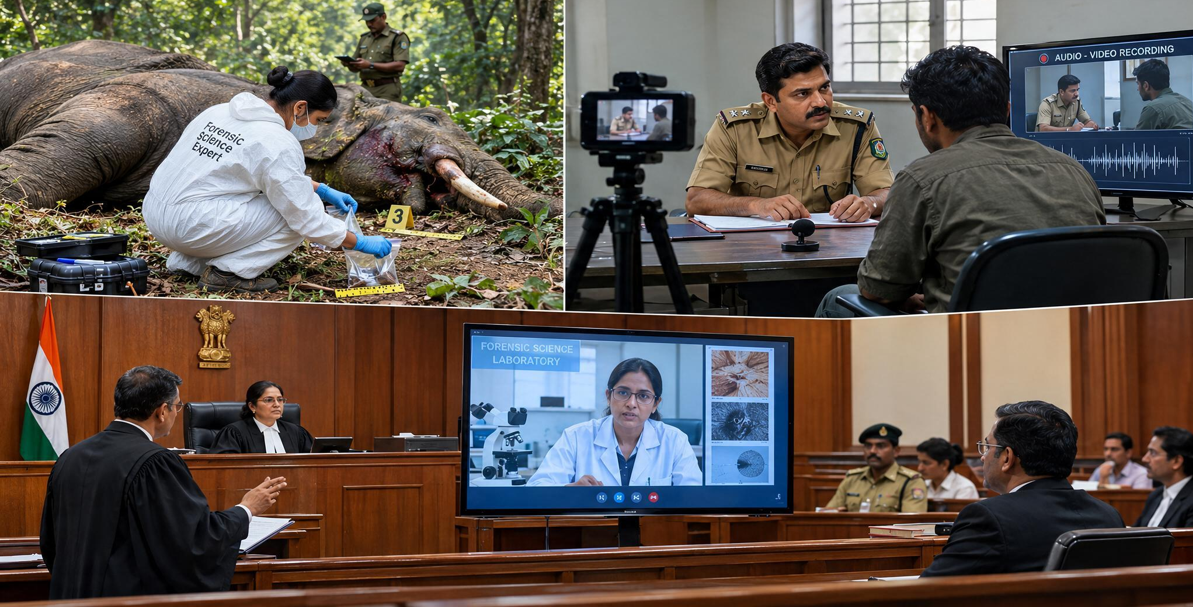
- Scientific Investigation and Forensic Examination: One important reform is Section 176(3) of the BNSS. It provides for forensic experts to visit crime scenes, collect forensic evidence and have the evidence-collection process videographed in offences punishable with imprisonment of seven years or more. The provision also addresses the use of another State's forensic facilities when necessary. Relevant forensic opportunities include:
- Wildlife species identification: Establishing whether seized meat, skin, bone, horn, ivory, feathers, scales, timber or plant material belongs to a protected species.
- DNA analysis: Linking seized specimens to biological samples, individual animals or other material where scientifically feasible.
- Ballistic and tool-mark examination: Examining firearms, ammunition, traps, cutting tools and other objects potentially connected with poaching.
- Fingerprint and trace evidence: Examining weapons, packaging, containers, vehicles and other recovered objects.
- Digital forensics: Examining relevant phones, computers, storage devices and other digital material through lawful and technically sound procedures.
- Video-Recording of Search and Seizure: Section 105 of the BNSS provides for audio-video recording of the process of conducting a search or taking possession of property, articles or things under the relevant provisions. The recording includes preparation of the seizure list and its signing by witnesses. The police officer must forward the recording without delay to the specified Magistrate or Executive Magistrate.
- For wildlife enforcement, this reform addresses a recurring evidentiary concern: whether the recovered wildlife specimen/other incriminating evidences were actually found at the location described in the seizure record and whether the seizure was conducted and documented properly.
- Consider a vehicle interception in which officers recover live pangolin, protected wildlife body parts or illegally traded timber. A properly conducted and documented recording may help establish:
- The location and circumstances of recovery.
- The condition and position of the seized material.
- The identification and counting of articles.
- The preparation of the seizure list and participation of witnesses.
- The manner in which the material was taken into official custody.
- Recording Statements and Documenting Investigative Steps: Section 180(3) of the BNSS permits statements made during police examination of witnesses to be recorded through audio-video electronic means. In a wildlife-trafficking case, properly documented investigative interviews can help investigators identify suppliers, transporters, intermediaries, buyers and other participants. They may also help locate additional specimens, storage locations and financial or digital leads.
- Tranche-Based Police Custody (Section 187 of BNSS): Complex wildlife trafficking networks require extensive time to map out. Unlike older laws that required police custody to be exhausted consecutively within the first 15 days of arrest, Section 187 allows investigators to seek police custody in split tranches spread across the first 40 or 60 days of detention. This provides the temporal flexibility needed to match digital analysis and chain-of-supply findings with interrogation.
- Electronic Communication and Digital Investigation: The BNSS expressly recognises audio-video electronic means and provides a framework for conducting various criminal processes electronically. Section 530 permits trials, inquiries and proceedings under the Sanhita to be held in electronic mode, including through electronic communication and audio-video means. For wildlife investigators, this supports a more technology-enabled approach to case management and evidence presentation. Relevant material may include online advertisements, chat records, photographs of wildlife products, transaction communications, shipment documents and other electronic records lawfully obtained during an investigation.
- On the courtroom side, Section 329 of the BNSS allows reports of notified Government scientific experts to be used as evidence without calling the expert, though the court may still summon the expert.
- Absconding Accused and Trial in Absentia: Kingpins of wildlife syndicates often operate from outside the state or country. Under older law, the trial of such persons used to get stalled. Section 356 of the BNSS now permits inquiry, trial and judgment in the absence of a proclaimed offender who has absconded to evade trial and has no immediate prospect of arrest. One point needs care. Under Section 84(4), a person can be declared a proclaimed offender only where the offence is punishable with imprisonment for ten years or more, life imprisonment or death. Standard WLPA offences carry a maximum of seven years and may not meet this threshold on their own. Where facts disclose organised wildlife crime under BNS Section 111, which is punishable up to life imprisonment, the route to proclamation and trial in absentia opens.
- Time-Bound Justice and Technology in Trials: Delay in trial is the commonest reason wildlife cases end in acquittal: witnesses lose interest, officers are transferred, and evidence degrades. The BNSS introduces time limits and electronic processes that, if used consistently, can change this:
- Trial and Proceedings to be Held in Electronic Mode (Section 530 of BNSS): Trials, inquiries and proceedings, including summons, warrants and recording of evidence, may be conducted in electronic mode.
- Electronic summons (Section 64 and related provisions of BNSS): Summons can be served by electronic communication bearing the court's digital seal or signature, and officers should keep the delivery record.
- Supply of Documents (Section 230 of BNSS): Copies of the police report and documents are to be supplied to the accused within 14 days. Where the case is on a forest officer's complaint, the same discipline helps prevent procedural challenges.
- Strict Timelines for Completing Investigation, Framing of Charges & Judgement Delivery:
(a) The 60-Day Track (Standard WLPA Cases): For standard offenses under the Wild Life (Protection) Act, 1972—such as the illegal hunting, possession, or commercial trade of scheduled animals—the maximum statutory punishment is 3 to 7 years. Because these offenses carry a penalty of less than 10 years, investigators must complete the probe and file the final complaint within 60 days (Section 187(3)(a)(ii) of the BNSS).
(b) The 90-Day Track (Willdife Crime Syndicates and Organised Wildlife Crimes): When a case involves kingpins, cross-border wildlife smuggling networks, or repeat offenders charged under Section 111 of the Bharatiya Nyaya Sanhita (BNS) for Organised Crime, the penalty scales up to 5 years to life imprisonment. Because the potential punishment meets or exceeds the 10-year threshold, investigators are granted a longer window of 90 days to complete the investigation (Section 187(3)(a)(i) of the BNSS).
(c) Supplementary Clocks: Once the initial report is filed, any further investigation must ordinarily be wrapped up within 90 days under Section 193 of BNSS with the court's permission, and investigators are legally required to provide a formal progress update within 90 days of registering the case.
(d) Framing of Charge within 60 Days: For trials before a Court of Session, Section 251(1)(b) of BNSS mandates that the judge must frame the charge in writing within 60 days from the date of the first hearing on the charge. The exact same 60-day timeline applies to Magisterial warrant cases under Section 263(1) of BNSS.
(e) Judgment Delivery within 45 Days & Uploaded within 7 Days: Section 392(1) dictates that a criminal court of original jurisdiction must pronounce its final judgment either immediately upon the termination of the trial or within a maximum of 45 days. To complement this, Section 392(4) adds that a digital copy of the complete judgment must be safely uploaded onto the court's online portal within 7 days of its open-court pronouncement.
- Bridging the Personnel Gap: The Bharatiya Nagarik Suraksha Sanhita (BNSS), 2023, introduces a critical mechanism to combat a perennial challenge in wildlife enforcement: officers transfers and retirements. Under Section 336, if a forensic expert or an investigating officer who prepared a crucial document is unavailable, deceased, or transferred, their incumbent successor can testify and authenticate the record. In wildlife crime trials, crucial evidence frequently stalls when the original officer becomes unavailable. By allowing current officers to depose using official records, BNSS ensures that case timelines remain uninterrupted, preventing delayed trials from compromising justice.
- Restricting Adjournments (Section 346): The BNSS discourages adjournments unless circumstances are beyond a party's control.
- International Cooperation (Sections 112 to 124 of BNSS): Letters of request to foreign authorities for evidence, and mechanisms for attachment and forfeiture across borders, support investigation of transnational wildlife smuggling.
- Attachment and Forfeiture of Property (Section 107 of BNSS): This introduces a highly effective asset-recovery tool. Section 107 empowers investigating agencies, through proper judicial channels, to attach and forfeit property derived from or obtained through criminal activity. This allows investigators to freeze and seize the financial assets, vehicles, and real estate of wildlife traffickers, striking at the economic foundations of the illicit trade.
- Witness Protection Scheme (Section 398 of BNSS): Wildlife crime cases frequently suffer when rural or tribal witnesses are intimidated by influential criminal networks. Section 398 mandates that State Governments notify comprehensive Witness Protection Schemes, providing a formal mechanism to safeguard crucial link-witnesses.
BSA: Making Scientific and Digital Evidence more Effective in Court:
Wildlife cases frequently depend on specialised knowledge. A court may need to determine the species represented by a seized specimen, whether two biological samples are related, whether a document is genuine or whether digital records reliably connects an accused person to an alleged transaction.
The BSA provides the evidentiary framework for proceedings to which it applies:
- Expert Evidence under Section 39 of BSA: Section 39 of the BSA makes relevant the opinions of persons specially skilled in science, art or another relevant field when a court must form an opinion on such a matter. It also recognises the relevance of an Examiner of Electronic Evidence under Section 79A of the Information Technology Act, 2000, in matters involving information stored or transmitted electronically. This is particularly important in wildlife investigations, where scientific evidence can help establish facts that ordinary witness testimony cannot reliably resolve. Expert evidence may address:
- Identification of protected wildlife species or plant specimens.
- DNA findings.
- Examination of electronic devices and digital records.
- Handwriting, fingerprints and document authenticity where relevant.
- Electronic Records as Primary Evidence & Electronic Records Certificates (Section 57 & Section 63 of BSA): These provisions strengthens the evidentiary framework for investigating wildlife crimes involving digital evidence. CCTV footage, mobile phone chats, call records, GPS locations, photographs, videos, emails, social media communications, and digital payment records can help establish links between poachers, intermediaries, and international wildlife trafficking networks. Section 57 addresses primary evidence, including electronic and digital records, while Section 63 prescribes conditions for the admissibility of electronic records and associated certification requirements including hash value. Investigators must ensure lawful collection, preservation, integrity, and proper documentation of digital evidence to support successful prosecution.
Conclusion:
India’s new criminal laws offer a timely opportunity to strengthen wildlife law enforcement by modernising how offences are investigated, evidence is gathered and trials are conducted. Enforcement agencies will benefit most by applying these provisions carefully alongside the WLPA. However, the reforms do not in themselves guarantee faster trials, successful prosecutions or the dismantling of trafficking networks. These outcomes depend on the training of wildlife enforcement officials, forensic infrastructure, lawful scientific investigation, inter-agency cooperation and effective prosecution.

I am an Indian Revenue Service (Customs & Indirect Taxes) officer with vast experience of law enforcement especially in tackling transnational smuggling including willdife trafficking. Also, as an expert I have been conducting sessions on various aspects of wildlife crimes and its convergence with other serious crimes, legal and enforcement framework to counter it, wildlife cyber crime, OSINT for combating wildlife crime, combating money laundering associated with wildlife crime, CITES, role of Customs in tackling the menace of wildlife crime, Digital Forensics etc. for forest, police, customs and other enforcement agencies' officials.