What Goes in the Soil Comes on our plates
An Awakening to the Hidden Burden of Land Pollution
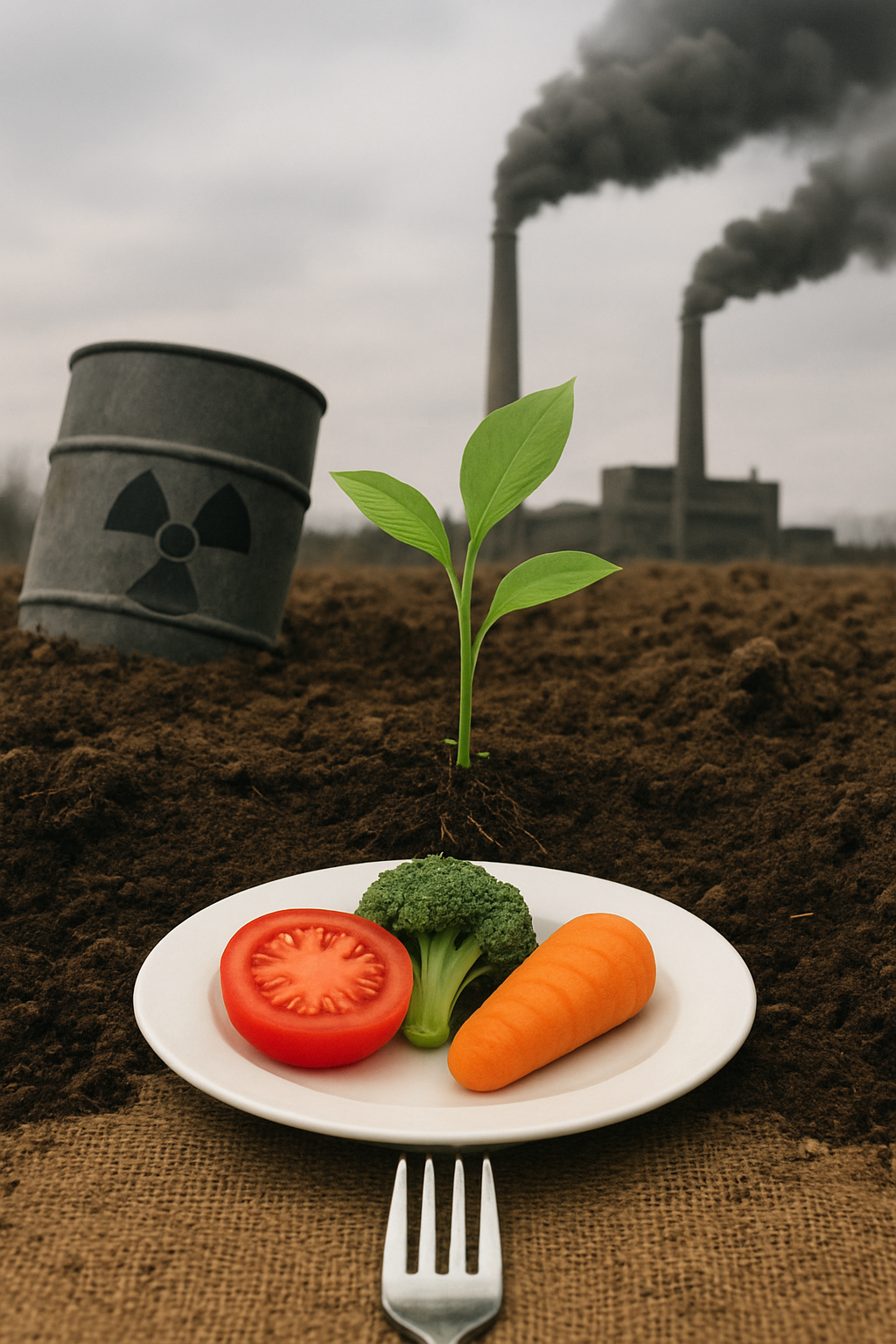
The saying “What goes in the soil, comes on our plates” captures a profound truth about the interconnectedness of human wellbeing and the environment. When we allow toxins, waste, and pollutants to accumulate in the land, we are not merely degrading the physical landscape we are contaminating the very systems that sustain us. In an era of rapid urbanization, expanding agriculture, and increasing waste generation, this truth is becoming impossible to ignore.
Soil may appear resilient, but it has limits. Once contaminants such as heavy metals, pesticides, plastics, petroleum residues, and untreated waste enter the ground, they do not simply disappear. Instead, they bind to soil particles, disrupt soil chemistry, and quietly infiltrate ecological pathways. Plants, as primary producers in ecological systems, absorb nutrients through the same soil that now holds harmful substances. Over time, these contaminants accumulate in crops, entering the food supply and ultimately the human body. Scientific studies have shown that crops grown in polluted soils often contain elevated concentrations of heavy metals such as lead, cadmium, and arsenic, posing long term risks to human health (Alloway, 2013).
Communities that depend heavily on agriculture especially smallholder farmers are among the most vulnerable. Their livelihoods hinge on soil fertility, yet they often lack adequate resources to monitor or restore degraded lands. When plastic waste is burned or buried, when mining residues are carelessly dumped, or when chemical fertilizers and pesticides are applied in excess, it is not only the land that suffers. It is the people who depend upon that land for food, nutrition, and income. The contamination moves from the soil into crops, then onto plates, and eventually into human bodies, where it can trigger chronic health problems ranging from neurological damage to gastrointestinal complications (Tóth et al., 2016).
Beyond human health, the ecological consequences are equally striking. Contaminated soils weaken plant resilience, reduce biodiversity, and disrupt soil microorganisms that are essential for nutrient cycling. When soil life declines, agricultural productivity follows, creating a cycle in which farmers are forced to use more chemical inputs simply to maintain yields further polluting the land they rely upon. In this sense, land pollution is not just an environmental issue; it is a threat to food security, social stability, and sustainable development.
However, the power to reverse this trend lies in collective awareness and responsible action. Tackling land pollution begins with acknowledging our role in creating it, whether through improper waste disposal, overreliance on agricultural chemicals, or weak enforcement of environmental regulations. Communities must be encouraged to adopt sustainable waste management practices, participate in land restoration efforts, and safeguard soils through conservation agriculture and organic alternatives. Policymakers, in turn, must prioritize soil protection in environmental legislation, recognizing that food systems cannot thrive on degraded land.
The message is simple yet urgent: healthier soils mean healthier people. Every piece of waste avoided, every toxin prevented from entering the soil, and every effort made toward sustainable farming brings us closer to a future where our plates reflect nourishment rather than contamination. In embracing the wisdom of “What goes in the soil, comes on our plates,” we confront a truth that challenges us to rethink our relationship with the land. It is a call to responsibility, a reminder of our shared vulnerability, and an invitation to protect the foundation of life for generations to come.
References
Alloway, B. J. (2013). Sources of heavy metals and metalloids in soils. Springer.
Tóth, G., Hermann, T., Da Silva, M. R., & Montanarella, L. (2016). Heavy metals in agricultural soils of the European Union with implications for food safety. Environment International, 88, 299–309.
I am an emerging environmental and climate change professional focused on Environment management, climate action, and sustainable natural resource governance. I am currently in my final year pursuing a Bachelor’s degree in Environment and Climate Change at Mukuba University, with a growing orientation toward applied, policy relevant, and community grounded solutions.
My professional experience includes industrial attachment with the Mansa Forestry Department in Luapula Province, where I gained practical exposure to forest management, conservation planning, and the operational realities of environmental governance. This experience reinforced my interest in forests as critical climate systems and strengthened my commitment to linking ecosystem protection with local livelihoods and resilience.
I bring a strong blend of technical, leadership, and advocacy credentials. My training includes ISO 14001 Environmental Management Systems Awareness, GIS applications in conservation mapping, leadership in climate change, natural conservation education, climate change and human health, and WASH related environmental programming. These competencies position me at the intersection of environmental management, spatial analysis, public health linkages, and climate leadership, with an emphasis on evidence based action.
Beyond formal training, I have demonstrated leadership through regional and grassroots engagement. I served as the 2024 Africa Ambassador for the Healthy Environmentally Friendly Youth Campaign and remain actively involved with the Mukuba University Climate Change Action Society and the Copperbelt Institute of Natural Resources and Climate Change. I have contributed to tree planting initiatives and community mobilization under platforms such as the Keep Your Promise Campaign, advocating for climate justice and accountability.
My long term direction is centered on advancing practical solutions in forest conservation, environmental management systems, and climate policy implementation. I am particularly interested in roles that allow me to integrate science, leadership, and community engagement to drive sustainable and measurable environmental impact in Zambia and across Africa.